The Lunatic is: IN

In amongst Michelle Cottle’s epic takedown (don’t get too excited, it’s 15 years too late by my count) of Betsy McCaughey, we have this tidbit:

Her standard m.o. (as “Daily Show” host Jon Stewart recently experienced) is to greet each bit of contradictory evidence by insisting that her questioner is poorly informed and should take a closer look at paragraph X or footnote Z. When those sections don’t support her interpretation, she continues to throw out page numbers and footnotes until the mountain of data is so high as to obscure the fact that none of the numbers add up to what she has claimed.

The natural linkup to this observation is in the activities of Sarah Palin, and Cottle goes there too:

…[Palin’s] scorching self-regard and ostentatious disdain for politics-as-usual infuse even her most self-serving fabulisms. Palin, of course, hawks homespun wisdom, faith, and common sense, in contrast to McCaughey’s figures and footnotes. But both women have an uncanny ability to shovel their toxic nonsense with nary a blink, tremor, or break in those dazzling smiles. People of goodwill and honest counsel don’t stand a chance.

The issue is really that these sorts of people feel safe in the assumption that they cannot be effectively countered given the constraints of the modern news cycle. They know that, no matter how prepared the host/anchor may be, they have to move on within 90 or 180 seconds and can thus be easily filibustered into oblivion. Muddy water: sprayed. It’s out there now; mission accomplished.

The solution, of course, is almost as pathetically obvious as it is unimplemented. CNN (and the rest; to keep it simple I’ll refer broadly to all the respectable, 24/7 news networks as “CNN” from here on out) essentially run on floating schedules. If they need to report for 6 hours on a car chase, they fucking do it. Wolf (or whoever) will just sit there and repeat that we’re waiting for, uh, something to happen. And then cut to some guy also waiting for something to transpire.

Sooner or later, then, they need to spend as much time as it takes to reduce McCaughey (or somebody like her) to tears on national television. Simply pull out every one of her page attributions. Turn off her microphone while you find it so she can’t further confuse issues. Dispatch that point. Move to the next. As long as it takes. She runs out of material or simply runs off the set. Either way: victory. Pyrrhic to be sure, but a step.

Sure, this will be gruesome live television, but excellent YouTube material. Somebody will edit it down to 90 seconds of pure joy. Which then, of course, fits back into CNN’s attention span. All it takes is the will to do the initial, extremely long-form interview. Jon Stewart could even do it, were he willing to call her back “on” and then expend a day wearing her down. Jim Cramer was easily cowed; he had a job to protect. McCaughey and her ilk are more like kamikazes. Occasionally they survive their attack run, but that outcome is purely incidental to them. They need to be made to see the fundamental hopelessness of such tactics such that they choose not to employ them in the first place. Realizing that they will simply be called to account on national television for as long as it takes will dissuade all but the craziest. That last subset will simply no longer receive bookings after being seen as fundamentally unhinged.

Such a trip to the woodshed would only need to be done once or twice. The worst of these offensive people would then dutifully scuttle back under whatever rock they live when not being offered a national audience.

Beck (and not the good one)

Ben Cohen tosses something out there, so by Cokie’s Law, we’re required to take it up:

Advertisers pulling their brands from Beck’s show is a signal that there are boundaries that cannot be crossed. It is a warning to Fox that their bottom line will be affected if it continues to promote such hateful speech, and that a growing cross section of the public are turning their backs on the Fox brand.

And the bottom line for Murdoch is that he cannot tolerate it for long.

And the problem with this line of reasoning? The various advertisers that have pulled their products have done so from Beck’s program, and/but not from FOXnews as a whole. The bottom-line is just the same; those ads just moved to another time slot, and less-caring ads moved from that other time slot into their place. The Masters has a harder time paying its way than does Glenn Beck, for Christ’s sake. And so, Murdoch, ever conscious of the bottom line without regard to particular policy (here Cohen and I agree) will say: gimme gimme gimme.

Excessive

Bob Somerby reacts to this tidbit from the WaPo:

It is possible to sympathize with Clinton. Today, when the mainstream media seems so weakened, we forget how powerful—and arrogant—the New York Times and The Washington Post, along with the networks and news magazines, seemed to be in the early and mid-1990s. They were part of a giant scandal machine that dominated official Washington in the first few years after the Cold War. The endless string of special prosecutors and the media’s obsession with Whitewater seem excessive in retrospect.

with this:

It didn’t seem excessive to Thomas when Rush Limbaugh suggested that Hillary Clinton helped murder Vince Foster.

It didn’t seem excessive to Thomas when Jerry Falwell spent years peddling the Clinton murder tapes—remaining an honored guest on Meet the Press, and on cable “news” programs.

It didn’t seem excessive to Thomas when Dan Burton was shooting up pumpkins in his back yard, showing how Foster may have died.

It didn’t seem excessive (or strange) to Thomas when the original special prosecutor got canned by a panel of right-wing judges—and was replaced by a well-known conservative functionary.

It didn’t seem excessive to Thomas when Fools for Scandal published the documents the New York Times had disappeared in the course of inventing the Whitewater “scandal.”

It didn’t seem excessive when a first lady was called a “congenital liar” by a bungling major columnist. It didn’t seem excessive when the Village called her every name in the book as they pretended that she had lied about the Cubs and the Yankees. It didn’t seem excessive when the Post published that disgraceful piece by Andrew Sullivan, two days before the 1996 election. (Headline: “Clinton: Not a Flicker Of Moral Life.”) It hadn’t seemed excessive when that same baboon had published that crap by Betsy McCaughey, in 1994—a piece whose fraudulence became quite clear in rather short order.

These events made perfect sense at the time! To Thomas, they only seem excessive in retrospect! By the way, did it seem excessive when the Post and the Times invented all that sh*t about Candidate Gore, then pimped it for twenty straight months?

Did that seem “excessive” in real time?

Wowie. My reaction seems tame in comparison. Read the whole thing.

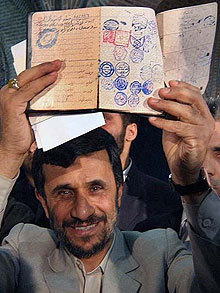
A photograph of the Iranian president holding up his identity card during elections in March 2008 clearly shows his family has Jewish roots. A close-up of the document reveals he was previously known as Sabourjian – a Jewish name meaning cloth weaver.

The short note scrawled on the card suggests his family changed its name to Ahmadinejad when they converted to embrace Islam after his birth.

The Sabourjians traditionally hail from Aradan, Mr Ahmadinejad’s birthplace, and the name derives from “weaver of the Sabour”, the name for the Jewish Tallit shawl in Persia. The name is even on the list of reserved names for Iranian Jews compiled by Iran’s Ministry of the Interior.

Wow. Didn’t see that one coming.

(And click the picture for the full story.)

Gourmette

Condé Nast plans to shutter long-timer Gourmet, along with some other titles:

In addition to Gourmet, Condé Nast plans to announce it will also close Cookie, Modern Bride and Elegant Bride. Cookie is a relatively new introduction, started in 2005, while the bridal magazines were seen as offshoots of the bigger Brides magazine, which Condé Nast also owns.

Left standing: Unwieldy Bride, Modern Brownie, and Angry Spinster Fortnightly.

New Rules

Dan Gillmor writes a list of 22 ideas that would improve journalism (or, more accurately, “journalism”) as it’s practiced today. As with any such list, some are more essential than others. A few of my favorites, not necessarily in order:

We would not run anniversary stories and commentary, except in the rarest of circumstances.

Every day is the x-th anniversary of y. This fact, in and of itself, does not require the fraction of the print-hole currently devoted to reminding us of this. In the internet era, in fact, such practice is less than useless. The 100th anniversary of the end of WWII, and other such seminal, big-number dates do still demand at least some backward looks, but daily papers likely aren’t the place for that either, unless they decide to go long-form and really provide something unique. The ease in producing them coupled with a (seemingly) disdainful regard for their readers’ needs perhaps explains why they choose to roll out such vacuous, culturally debatable, and ultimately banal looks back at the Summer of Love (and etc…) when coupled with the Baby Boom generation’s apparently endless reserve of self-regard (and their eternal willingness to pay for ever more talismen of group identification) are probably prime drivers here. It should stop here and now. Likewise such practices as the news weeklies’ semi-annual “Jesus” issues.

Close second in terms of annoyance: the empty trend piece. More and more people are complaining about the frequency of anniversary-based reporting…

The known knowns, and the unknown knowns:

[…] every print article would have an accompanying box called “Things We Don’t Know,” a list of questions our journalists couldn’t answer in their reporting.

God almighty, this may be the most important one. Certainly such a policy would damn near put Lemkin out of business. Context should be king. Would that we had a media that didn’t aim merely to terrify instead of inform. Then we might actually have a sane national discourse on Iran, among many others.

The next two seem pretty much different sides of the same coin:

We would refuse to do stenography and call it journalism. If one faction or party to a dispute is lying, we would say so, with the accompanying evidence. If we learned that a significant number of people in our community believed a lie about an important person or issue, we would make it part of an ongoing mission to help them understand the truth.

We would replace PR-speak and certain Orwellian words and expressions with more neutral, precise language. If someone we interview misused language, we would paraphrase instead of using direct quotations. (Examples, among many others: The activity that takes place in casinos is gambling, not gaming. There is no death tax, there can be inheritance or estate tax. Piracy does not describe what people do when they post digital music on file-sharing networks.)

This is way up there, though it implies an outsized influence of print journalism…perhaps such a policy would filter into television and internet media, perhaps not. Anything done to reduce the repeating of either party’s talking points and scare lines, even just in print media, would be worth doing. Even if it does nothing to the larger discourse, we’d at least have a little bubble of rational discourse out there for people to find when they tired of the idiocy that is TV news and talk radio.

Which leads us to:

If we granted anonymity and learned that the unnamed source had lied to us, we would consider the confidentially agreement to have been breached by that person, and would expose his or her duplicity, and identity.

Yes, yes, a thousand times: yes. This alone would fix much of what ails the modern political MSM. Quite simply: Karl Rove could not have existed in an environment like that.

Which brings us to a real innovation in the sense of combining the limitless capacity of the web with the inherently limited capacity of the daily paper:

For any person or topic we covered regularly, we would provide a “baseline”: an article or video where people could start if they were new to the topic

You’d free more space in the paper for analysis of the topic at hand (by moving the background into the baseline piece) and be able to provide a hell of a lot more baseline as well. Excellent idea. The New York Times could, if it chose to, absolutely dominate the baseline industry without much of an investment. They choose not to, apparently. They do so at their peril. Somebody will do it, and soon.

Finally:

We would never publish lists of ten. They’re a prop for lazy and unimaginative people.

Agreed. This is precisely why Lemkin posts Lists of Four.

The Elusive Toilet PC

lowindustrial:

Apple has been working on such a Swiss Army knife tablet since at least 2003, according to several former employees. One prototype, developed in 2003, used PowerPC microchips made by I.B.M., which were so power-hungry that they quickly drained the battery.

“It couldn’t be built. The battery life wasn’t long enough, the graphics performance was not enough to do anything and the components themselves cost more than $500,” said Joshua A. Strickland, a former Apple engineer whose name is on several of the company’s patents for multitouch technology.

Another former Apple executive who was there at the time said the tablets kept getting shelved at Apple because Mr. Jobs, whose incisive critiques are often memorable, asked, in essence, what they were good for besides surfing the Web in the bathroom.

Oh god I hope he really said that.

Me too, though I wonder what in the hell else he thinks it needs to do. Oh, right: tip-calculation, the hobgoblin of the lesser platforms since the dawn of mediocre service.

The Elusive Toilet PC

Two Little Caveats

NYT readers seem to understand the problems with American healthcare in ways that NYT writers never seem to:

The Swiss system for universal coverage is certainly intriguing, but there are two little caveats that will make it unappealing to our legislature: the insurance companies are to some extent nonprofit, and the drug prices are regulated. The Swiss system directly attacks what is wrong with the American health care system: profit.