

Month: November 2009
After tonight’s elections results, Joe Biden must resign, Sarah Palin must be confirmed as his replacement, and then Barack Obama must resign. The people have spoken.
Bad for the Democrat
Alexander Ryking notes something that was seemingly lost amongst the shuffle as the Liberal Media rushed to declare the Democrat dead once and for all:
Bill Owens won NY-23 — beating a right-wing extremist and becoming the first non-right-wing candidate to win the district since 1871. Great job, Michael Steele; you couldn’t even hold a district that has voted for YOUR party for 138 years.
It would seem to me the titanic face-off between the far right and moderate wings of modern conservatism (in the form of the GOP and the Conservative Party vs. the Democrat), with the direct and heavy involvement of Palin and other “rising stars” of the conservative mediasphere that shall go unnamed, that actually has national implications in terms of its outcome (in that Owens now goes to Congress (as opposed to assuming a purely statewide job)), and that ultimately resulted in a historic upending of the normal voting order stretching back more than a century would be the key outcome of what is, even still, a backwater, off-off-year election of little national import. Instead, we get breathless reports on two races for governor with unpopular incumbents, one of whom actively distanced himself from Obama, and, in both cases exit polling definitively showed that this was in no way a referendum on the Democratic Party or Obama in particular:
majorities of voters in both states (56 percent in Virginia and 60 percent in New Jersey) said President Obama was not a factor in their vote today
But, by all means liberal media, don’t let the facts of one genuinely interesting story get in the way of the preferred storyline, whatever its particulars may be. And then wonder at your continued marginalization and failure at connecting with the larger public. For some reason (that is clearly unknowable): people just don’t trust the MSM any more.
Neo-Prohibitionism
Somehow these sorts of observations never come up when, constant as the North Star, MADD is yet again pushing to get the limit down to 0.002 for anyone deigning to utilize a public sidewalk or somesuch:
Detective Spellman, who was given a blood test five and a half hours after the crash, had a blood alcohol level of 0.21 percent, according to the law enforcement official who spoke on the condition of anonymity because he did not want to be identified discussing material related to a continuing investigation.
FIVE HOURS! Jesus, Mary, and Joseph. How was he able to reach his fucking car!?! But, by all means, let’s have the policy set to jail the soccer mom who had an utterly harmless glass of wine with her dinner.
I have no a priori sympathy for drunk driving/drunk drivers. Far from it. But it is beyond me why we can’t talk about the actual, observed BAC in accidents (and, for that matter, in drivers pulled over for substantive violations and not just the ever-popular “suspicion” canard) vs. where we are setting the standard. Just like with arguments over speed limits, no rationality is allowed in that debate, ever. In fact, it’s the anti-rational arguments that are ceaselessly rewarded and turned into the law of the land. We must solely THINK OF THE CHILDREN! and accept our marching orders; debate ended. Just why is that, and what sort of country does that governance structure create? I’d say California is currently a fairly obvious indication. Just how many Jordin’s Laws can we have before we get back to calling them “Sensible Limitations on Repeat Offenders Act of 2010" (SLO-ROAd!) and such? Just after we’ve regained our collective sanity, I’d say.
The Future of China
Matt Yglesias ponders a Ryan Avent post that is apropos of that Chris Hayes quote below. Somewhere, off in the distance, Kevin Bacon barked.
At any rate, Avent looks at that ~$650B (again, that doesn’t even include Afghanistan and Iraq) expenditure and wonders:
With that kind of money you could entirely build out a national network of true high-speed rail. One year’s worth of defense spending gets you that. Which makes one wonder: where are all the economists, wringing their hands over cost-benefit analyses of these defense expenditures?
[…]
What was the cost, human and economic, of the I-35 bridge collapse? Of the Metro crash and resulting limitations on service? Of the Bay Bridge shutdown? And of course, investments in infrastructure constitute positive contributions to the economy, which ultimately strengthen our ability to direct resources toward defense. Aimless defense spending, on the other hand, may well make us poorer and less secure.
Which I think is absolutely right. Both Yglesias and Avent toss this chart into the mix:

The nut? Yglesias provides:
…if we took 10 percent of the defense budget and re-allocated that to infrastructure, we could have a national [High Speed Rail] network in ten years. And we’d still be spending over triple what our nearest rival spends.
[…]
a Chinese official [reportedly told] him “over the past decade you’ve spent $1 trillion on Iraq and Afghanistan, we’ve spent $1 trillion building the future of China”
Who can argue with that last statement? We’re pissing it away. And they know it. That’s the reason they buy up our debt: to help us piss away Our Current Advantage (such as it is). All the F22s ever built aren’t going to be worth a damn in 20 years when we can’t afford to gas them up, much less use them on our primary creditor. The paper lion indeed.
But, by all means: defense spending is inviolable. It’s utterly remarkable that Obama (the do-nothing President, natch) managed to cut as many idiotic spending programs from that budget as he did. Amtrak? Now there’s a program that needs to turn a massive profit while serving disinterested and actively hostile Member districts. It’s just a needless sap on federal coffers, after all, sucking up nearly $490 MILLION DOLLARS in FY2008. That sort of spending is clearly unsustainable for a democracy.
Anyone notice that the pres signed a $680 BILLION defense approp bill [that doesn’t include Iraq or Afghanistan] in the midst of our debates about $90b a yr for hc?
(Not) Frakked Up
This curve (Austin Frakt via Kevin Drum) gave me the heebeegeebees yesterday:

Depending on our positions on that curve, reforms could actually increase costs…and it’s unclear just where we are. Turns out, those fears were (likely) misplaced. Results from Our Beloved Commonwealth (we’ve had the Death Panels up and running for a while now…) seem to imply that, hey presto, this healthcare reform thing can actually drive down costs:
the most authoritative objective voice in this debate suggests that reform will significantly reduce, not increase, nongroup premiums.
This conclusion is consistent with evidence from Massachusetts. In their December 2007 report, AHIP reported that the average single premium at the end of 2006 for a nongroup product in the United States was $2,613. In a report issued just this week, AHIP found that the average single premium in mid-2009 was $2,985, or a 14 percent increase. That same report presents results for the nongroup markets in a set of states. One of those states is Massachusetts, which passed health-care reform similar to the one contemplated at the federal level in mid-2006. The major aspects of this reform took place in 2007, notably the introduction of large subsidies for low-income populations, a merged nongroup and small group insurance market, and a mandate on individuals to purchase health insurance. And the results have been an enormous reduction in the cost of nongroup insurance in the state: The average individual premium in the state fell from $8,537 at the end of 2006 to $5,143 in mid-2009, a 40 percent reduction, while the rest of the nation was seeing a 14 percent increase.
Imagine that. Increasing the pool size, having a mandate, and guaranteeing coverage reduces rates by spreading risk. Will wonders ever cease?
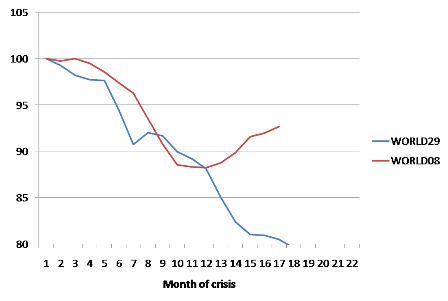
At last: divergence. Must be all the GOP gainsaying that’s bringing output around.
Lieberman to US: Drop Dead
Lieberman has officially and categorically joined the “Go Die in the Streets” brigade:
SCHIEFFER: But is what you’re also saying is that nothing is better than a government health insurance, or a health insurance reform that includes a public option? Nothing is better than that?
LIEBERMAN: Well, the truth is that nothing is better than that because I think we ought to follow, if I may, the doctor’s oath in Congress as we deal with health care reform, do no harm.
You’ll note that Lieberman also opposed the original, public option free version of the Baucus bill. He seriously just wants the CATO-inspired answer: yes, if you are poor and cannot afford care, you should just go die in the streets. Any other course of action would simply be unfair.
[People] are fed up – frustrated and fed up and angry about the way in which our government does not work, about the way in which we come down here and get into a lot of political games and seem to – partisan tugs of war and forget why we’re here, which is to serve the American people. And I think the filibuster has become not only in reality an obstacle to accomplishment here, but it also a symbol of a lot that ails Washington today.“
"But I do want to say that the Republicans were not the only perpetrators of filibuster gridlock, there were occasions when Democrats did it as well. And the long and the short of it is that the abuse of the filibuster was bipartisan and so its demise should be bipartisan as well.”
“The whole process of individual senators being able to hold up legislation, which in a sense is an extension of the filibuster because the hold has been understood in one way to be a threat to filibuster – it’s just unfair.
 Lemkin