By “working on it” they mean “working on capping bits and then charging overages for data access such that we effectively cripple the iPhone and/but reduce demand for data without, you know, spending any money on our side. Some entirely reasonable amount that’s in the ballpark of what we get for SMS; on the order of $2 a bit. You’ll hardly notice it at all!”

AT&T to customers: Drop dead

Ahh, AT&T, you’ve under-provisioned your network and all those iPhones you are more than happy to sell contracts for are making it easy to, you know, do stuff. And you apparently didn’t count on that. For three years running. The result: lots of data in your under-provisioned network. Who do we blame for this oversight? Why, the customers of course:

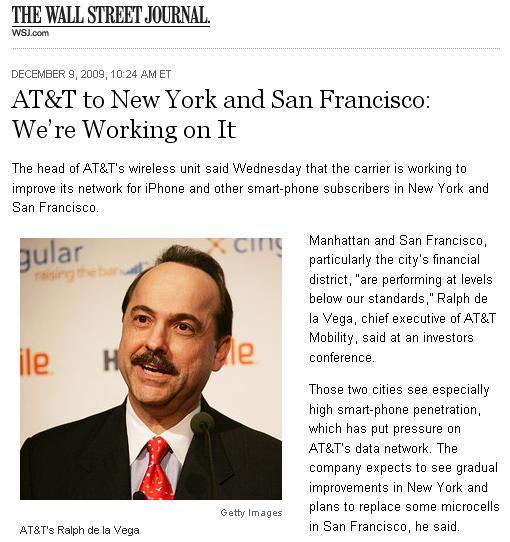
The carrier has had trouble keeping up with wireless data usage, leading to slow load times and dropped connections. It is upgrading its network to cope, but AT&T’s head of consumer services, Ralph de la Vega, told investors at a UBS conference in New York that it will also give high-bandwidth users incentives to “reduce or modify their usage.”

Translation: usage caps and overage charges, here we come. You iPhone users need to be hobbled like the rest of our customers! It’s like AT&T is fundamentally determined to go into a death-spiral the second ‘Merican iPhone users can go to another network. Which, it appears, is most likely to be T-Mobile. Sure took a long time for Fucktardia to figure out that Verizon is built atop an incompatible network, didn’t it? But just why is AT&T so dependent on iPhone? Weren’t they turning a profit before? Yes, but:

iPhone accounted for roughly 68 percent of [AT&T’s smart-phone/3G] sales [that make up the lions share of overall sales revenue]

[-and-]

Wireless revenues were up 37.2 percent, driven by “messaging, internet access, access to applications and services,” or [the iPhone]

These are very data users (and the attendant revenue spike) that AT&T is both dependent on and has resolved to infuriate. The plan, in a nutshell, is

“Gentlemen, we’ve run our brand into the ground on the back of notoriously poor service, especially in the dense urban environments where our 3G network actually, you know, exists. Lets really, really take it to the next level by nickel and diming these same users in the last year or two of their contracts. That way, north of 40% of our new revenue streams will head for the exits the second exclusivity ends.”

Great plan. So long, AT&T. Been so nice knowing you.

All that said, it’s still unclear to me why Apple doesn’t just buy Sprint, turn it into a dumb-pipes company, and reap the ridiculous profits that result. Mayhaps they (still) will.

PO Boxed

azspot:

“If, as reported, the Democrats have dropped the public option, they have abandoned any attempt to improve the health care in the United States in favor of increasing health-care insurance profits. This is good for the economy, as ever more jobs will be created in medical claims processing. Also, delivering 40 million new (taxpayer subsidized) premium-payers to the insurance companies to pretend to cover the currently uninsured will certainly drive up health insurance stocks. But nothing in the bill will actually improve heath care nor lower the cost of what passes for healthcare in the US. The war is over, the people lost.”

I must say that I strongly disagree with this sentiment. First and foremost, it presupposes that adding 40 MILLION PEOPLE to the world of the insured is somehow barely worth doing. All these folks can go see a doctor, and not just whoever is on duty at the emergency room. And, presumably, won’t be financially ruined for doing so. And, presumably, will go sooner, when the treatment course will be both cheaper and more effective. Look no further than breast cancer diagnostic stage and outcome in african american women stratified by socioeconomic standing for a hint at what this could really mean. Answer: a lot. A shit-ton. Just this is (potentially) a giant cost container if you can convince people to use it and find sufficient primary care doctors to handle them.

Then, you’ve got the public/private government plans: extending tightly regulated but still for-profit plans like those offered to government employees. This is your mid-level cost container. These are big pools of folks…public option light with a prettier name. Garden-variety people will see the cost benefits that a large pool can bring. Also for the good.

Forgetting all that, though, you still have the (supposed) Medicare buy-in for individuals over 55; this is the biggest deal by far, and, if actually enacted, marks genuine progressive progress in this country. For the first time, you’ll have actual consumers comparing prices of the dread government care and that provided through private insurers. Worth noting that these same 55-and-ups vote. A lot. This is potentially a game changer. It’s a lot simpler to revisit the law and roll the eligible age for buy-in to 45, then 35, then everybody that might want it than it is to announce that on Jan 1, 2010, we’ll be having a single-payer plan in these United States, as much as many on the left would like to believe otherwise. This plan, much more that what remained of the late but not terribly lamented public option, has the potential to completely rewrite how we deal with healthcare in this country. Seriously. Because people will finally know what the costs are and what it means to be part of a negotiated, nationwide cost structure. And this information will begin to trickle down. Think of it as healthcare Reaganomics…

Best of all, though: This version appears to have the votes for passage. You could (potentially) convince Pelosi to ping-pong this thing straight to Obama’s desk before Jan. 1. Not saying that’s going to happen, but it could. But, by all means, go on like this outcome is a giant failure, not worth doing in the first place, and a deep disappointment to boot. Nothing gets us to President Palin more quickly.

As things stand, 65-year-olds get enrolled in Medicare. Buy-in is something of a different beast: Folks between 55 and 64 with access to the exchange could choose to buy Medicare. That sets up an apples-to-apples comparison. And that apples-to-apples comparison is not going to come out well for private insurers, as Medicare has a large and acknowledged price advantage over them. They might be fine with that, because no one wants to insure 60-year-olds anyway. But I doubt they’re going to be fine with a world in which people see the full difference between the prices private insurers offer and the prices a robust public insurer can offer. That, after all, is why they fought the strong public plan so ferociously.