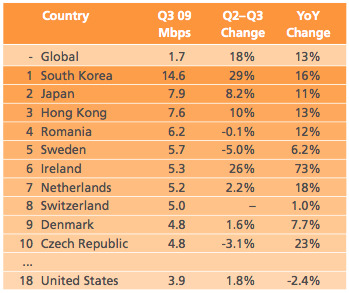
Plenty of reasons the US has slower internet speed on average, some that may rise to the level of: perfectly reasonable. But, I really wonder just how many of these sorts of charts the US has to rank in the average to mediocre range of before somebody, somewhere gives a damn? I mean, honestly. Just how pathetic (née bathetic) does the USA #1 chant have to get before we start doing something in this country again?

Understanding:Salary::

The Washington Post notes what others have: there’s an absolute shit-ton of money sloshing around in these final days of the MA US Senate special election:

Independent and party groups were set to spend nearly $5 million on television ads in the final weeks leading up to Tuesday’s special election between state Attorney General Martha Coakley (D) and state Sen. Scott Brown ®.
[…]
there are 13 – yes, 13 – groups paying for ads in the race’s final days, with Democratic groups outspending Republican-aligned by more than $1 million.

Remarkable that the very same organizations that have a vested interest in selling these ad slots are the ones that also are the editorial gatekeepers on which polls get play. Thus, it’s far more interesting to run a poll showing it as being close than it is to show one that came out on the same day showing it not-so-close.

So which one is right? As a resident of MA, I can tell you that anyone with caller ID is simply not picking up the phone for any reason; anyone, that is, but rabid tea baggers, Scott Brown partisans, and older-skewing demographics who don’t know or don’t care who is calling. We currently get at least two or three automated polling calls A DAY. That’s before the supporter calls, the robo-calls, and the occasional shout out from the President of these United States. My totally unscientific man-on-the-ground assessment is to say this take is right in saying Brown’s numbers are getting inflated by this. Turnout is what will decide this thing, and even the polls favoring Brown tend to show that many of those very folks (presumably the independents) talking to pollsters aren’t actually sure they’ll a) vote and b) actually vote for Brown.

The media establishment would, of course, disavow that editorial and ad revenue divisions even know what floor the other one is on. But, of course, this phenomenon cuts two ways. It’s much more interesting to write stories if the race appears closer than it is. So, if two of ten polls say it’s close: then, BY GOD, it’s the closest race in the history of close races. Sell more papers, attract more viewers, sell more ads. A lot more ads. Direct collusion is, of course and as usual, utterly unnecessary.

Where Content is the King (of Late Night Comedy)

The last word on the late night dustup seems to have been ably provided by the Boston Globe’s Matthew Gilbert:

the late-night war of 2010 is about some of the more dated, lax, and artificial material that makes its way onto the small screen
[…]
This [creative] inertia is part of the reason the “Leno Experiment’’ failed so miserably. What we saw when Jay Leno essentially relocated his 11:35 p.m. “Tonight Show’’ to 10 p.m. was the ugly truth about late night. In the brighter light of prime time, we could see how weak and unimaginative so much of the networks’ post-news TV – and so much of Leno’s work in particular – has become. Leno’s big change for “The Jay Leno Show’’ at 10 was to get rid of his desk, that old icon of late-night TV.

Exactly. NBC craves a non-80 year old demographic for the 11:30 slot. Leno, though beating Letterman, was doing so with older people; even NBC can see where that’s headed. Conan was convinced to leave much of his originality at the altar of “moving to 11:30,” and though he reportedly refused further dumbing-down notes, he likewise failed to attract a new audience to what was largely the same exact tired old shit with a slightly (read: very slightly) edgier feel. All this move managed to do then was to alienate some of the old folks that used to bother to watch Leno. The desired demographic was off watching a stream of the Daily Show or something else entirely. For them, the Tonight Show would have to radically change to become anything approaching the appointment TV it was in the Johnny era. And, let’s be honest, even in the late Johnny era, the Tonight Show was no longer appointment TV. It was where Jimmy Stewart recited his poetry to the same, largely ancient-skewing demographic. There were simply fewer choices back then, so some younger folks ended up there by default and then got into the habit themselves.

Anyone and everyone tuning in for Leno at 10, though, likewise saw that this was just really piss-poor comfort food. As Gilbert notes, this is glaringly not worth watching in an environment with 300 other choices. And then you paint your entire week with that, and wonder after its failure, and blame (of all people) Conan.

Who is at fault, then? All of them. Conan needed to have a lot more of the spirit of his “old” show there to build a new audience for Tonight (7 months aint enough, but at least go down in a blaze of glory). Jay needed to, you know, come up with something. NBC needed to realize the old business model of safe, unobtrusive television doesn’t work in 2010, not even at 11:30. The fact that this is a network still worried about lead-ins tells you all you need to know. They seem to think people watch TV in a linear fashion and will continue to do so forever. Good luck with that.

Note to NBC: tear down anything resembling a schedule grid there at headquarters. You are a content company. Make the best content that you can. Get it to users in the most convenient way possible. Preferably by offering several ways to access it. Content, content, content. Everything else will take care of itself. Is this simple concept really so hard to understand?

And now, a very special episode of “Ow! My Balls!” ONLY on NBC.

On looting

Is there something fundamentally wrong with the brains of those working in the national media? How else can you explain these very highly paid individuals discussing, often in the same sentence, that people in Haiti have been without food or water for days, and then expressing shock and horror that there is “looting” going on.

Listen very carefully. I’ll take it slowly so even a Grade-A fucktard (or idiot man-child) can follow along: when you take food and water from a collapsed store, food and water that you need to survive, it’s not looting. It’s survival.
By this the media model, everyone should just die quietly right next to palette after palette of water and potted meat product. After all, that stuff doesn’t belong to me. I’ll just sit here and quietly dehydrate, thanks.

Looting, in the traditional sense, applies to a riot or, perhaps, a war. Amidst mayhem, you spot a Best Buy and say “fuck it, at least I’m getting a TV out of this” and you break in there and take it. That’s looting. Strangely enough, that sort of thing doesn’t appear to be high on the list of things happening in Haiti. Where there’s no electricity.

Let’s review:

  1. 50" flat screen TVs: looting
  2. Food and/or water: not so much. That’s called survival.

Fucking imbeciles.

I don’t think Osama bin Laden sent those planes to attack us because he hated our freedom. I think he did it because of our support for Israel, our ties with the Saudi family and our military bases in Saudi Arabia. You know why I think that? Because that’s what he fucking said! Are we a nation of 6-year-olds? Answer: yes.

David Cross
(via alex ryking)

True Story

Pat Robertson, fucktard:

[S]omething happened a long time ago in Haiti and people might not want to talk about it. They were under the heel of the French. Napoleon the Third and whatever. And they got together and swore a pact to the devil. They said, “We will serve you if you get us free from the prince.” True story. And so the devil said, “OK, it’s a deal.” They kicked the French out, the Haitians revolted and got themselves free.

But ever since, they have been cursed by one thing after the other, desperately poor. That island of Hispaniola is one island. It’s cut down the middle, on the one side is Haiti, on the other side is the Dominican Republic. The Dominican Republic is prosperous, healthy, full of resorts, etc. Haiti is in desperate poverty. Same island.

Did Lord Jesus pass on the direct quote, Pat? Or is this tale in your special Director’s Cut Bible?

Again, one would hope that sooner or later even most Christians will get tired of this shit. Same island, and all that.

Inverted Pyramid Power

Robert Niles provides an absolutely essential bit of reading for anyone in the content-delivery world. Also known as “traditional” media (Yes, you. You are all in denial.), re: their efforts to invent new revenue models for their 19th century, dead-tree product line [emphasis added]:

You’re wasting your time. Please, stop. There is no new revenue model for journalism.

Done and done. In tweet length, no less. But no! Niles goes on to break it right on down into simple concepts for even the dimmest of bulbs. We are, after all, trying to get through to the likes of Rupert Murdoch here.

There are three ways – and only three ways – that publishers can make money from their content:

1. Direct purchases, such as subscriptions, copy sales and tickets
2. Advertising
3. Donations, including direct contributions and grant funding

Niles breaks down the first and potentially most important point using the basic economics of products you might see today in a bookstore, with emphasis on the relative price-points (e.g. papers are by far the cheapest thing in there and still aren’t selling):

Without a home-delivered hard copy, the commodity information available in most newspaper has no financial worth to most readers.

[…]

Because of this, no one is going to be able to craft a paid content model that elicits significant payment from more than a handful of readers for commodity news. And, despite what “proud parents” in the newsroom might think about their work, almost everything produced by all U.S. newspapers and broadcast newsrooms falls into that category.

Exactly. Why pay for “commodity information” that you can get on many phones? Your pay-walls won’t do a thing to stop that, either. Well, not a thing unless you count directing people to other sources and, worst-case, coercing them into learning how to use Pipes as a “thing.”
I’d extend this overall concept of economic value even further and say: without a home-device delivered copy, tuned to individual specifications, most newspaper-derived information has no inherent financial worth (incidentally, this is also why demographics are slowly and inevitably killing the Tonight Show). News can and will be gotten from anywhere. Again, publishers, you are selling your editorial judgment, not the actual content. Yes, the content had better be good, but I want to know what is critical to know, and not just the various bits of arcana and other nonsense that have simply been automatically included in papers since the 1950s because “that’s the way we do things.” I want to be able to go deep, instantly, on a subject of interest to me while still reaping a quick-hitting, broad view of the state of affairs on my block, in my state, in my country, in my hemisphere, and in the world. You’re not going to be able to have your own employees covering all those things, but you damned well better know how to leverage all the various individual sources that do, compile them, maybe add some value or viewpoint, and then present the best of it to me. Every second of every day, whenever and wherever I want it, whether as bullet point, abstract, or 50,000 word exegesis.

All that said, the thing somebody out there in charge of a major paper has really got to realize is this:

it’s time to take a hard look at the other side of the ledger, and work to find a publishing and production model that allows a news publication to live within its current income means. That’s where the real change will happen in news publishing

Modern journalism in the form of newspapers is entirely an ad printing concern. Subscriptions just pay to bring the paper to the door, not to print that which is brought. Everything about the current model is designed to maximize the capability to create and print a big package of paper ads with some interstitial articles in there (yes, and a little sex, too). This needs to change. The first publisher with a national reach (in terms of name and reputation) to divest itself from the print albatross and concentrate fully (or very nearly so) on providing flexibly deep coverage in a RSS-style, fully user-customizable package will win. Big. People want excellent, well packaged information and are willing to pay for it (witness Cook’s Illustrated, the only successful thing going in the print world today and entirely predicated on a fee for service model). You, the broader news media, provide those people with mediocre information and, generally speaking, inconvenience because of your colossal tunnel vision relative to “how things have always been” and how you get back to that model as soon as possible and forever. I’ve got news for you: always is over.

Metastasis

Simple Finder. It’s been around in one form or another since OS 7 or 8. Here’s what it looks like nowadays:

Remind you of anything? Starting to get some ideas about how the product line could be integrated by the iTablet? How such a device could be made to have just enough Mac in it to be useful while Macs could be made to have just enough iTablet and iPhone in them to be instantly understandable to a hoard of potential new users? How those users would be trained from the get-go to buy apps and other content through Apple/iTunes? How the “what it does” question could be instantly forgotten with a single stroke?

It’s a computing product. It occupies the space between an iPhone and an iBook. And it makes everything else around it fall into place.

It’s what’s coming. It’s what it does.