45 Seconds

Rachel Maddow touches on something critically important while discussing the GOP’s latest complaint: that Obama simply doesn’t use the word “terrorism” enough:

[Republicans are] lying in a way that can be obviously, demonstrably, embarrassingly proven by anyone who has a spare 45 seconds and the Google. When the people in the Republican Party who have the highest profile on national security say things that are easily, provably, flagrantly false, that’s a mistake. That makes it look like the party doesn’t know what it’s talking about a national security issues…. You guys, when you say President Obama doesn’t use the word terrorism, try to remember that when you say that, people are laughing at you.

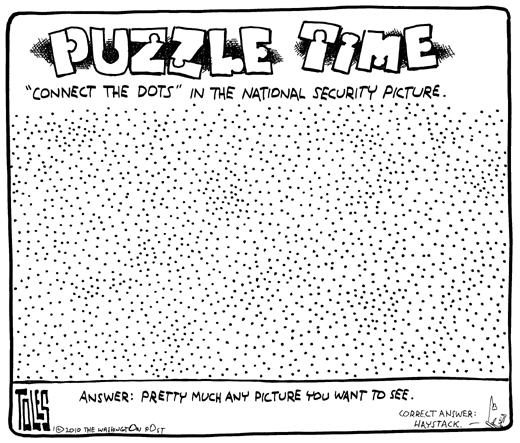
That’s wonderful. Except that it’s easily, provably, and flagrantly false. First: The Conservative Media (and their beloved right-wing noise machine) still, still hews to the notion that the GOP is automatically and always the National Security Party. Cokie Roberts said so just the other day on that “liberal” bastion NPR. Everyone on-air agreed with her. Her comments and those of several others are what led to the creation of this handy guide. Second: The fundamental constituent for this sort of unsupported-by-facts nonsense is not someone who knows what “a Google” is, may think “the internet” is that Explorer shortcut on their desktop, and frequently worries that this time they’ve really missed their chance at riches from a mysterious Nigerian businessman who wanted to send all his money their way, just for a few days.

People are not laughing at the GOP, Rachel. You and I are. Unfortunately, we don’t really matter. The GOPers peddling this nonsense never had our vote to begin with. Low information voters, hell, no information voters are bathed daily in information- and context-free nonsense from Rush, FOXnews, Glenn Beck, talk radio, and 50 other sources. To them, these claims sound not only supportable but utterly reasonable and serious-minded. Google, if they even know what it is, doesn’t enter into the equation. Until Democrats internalize this and message accordingly, nothing will change. Until the media at large internalizes this and begins to challenge, immediately and on the spot, and embarrass into silence these asshats the instant this sort of statement emits from their fetid pie-hole, nothing will change.

This is what Karl Rove fundamentally understood: in the modern media environment, the truth doesn’t matter. The initial lie, no matter how quickly or decisively defenestrated it may be, is out there. And, just like Cokie’s Law states: if it’s “out there” we have to treat it as fact and discuss it. Repeatedly and without recourse to anything approaching helpful context. That’s what we call good, hard-nosed journalism.

Nice, but I have a few questions right out of the boxee:

  1. Does it know which side is currently facing up? Otherwise I can see a lot of incidental space-bar mashing in your future.
  2. Does it have more than one IR emitter? Otherwise, you’ll be turning 90° when you need to type.
  3. Is the Boxee logo really something you can call a feature?

How long is yours

Michael Kinsley wants to cut down newspaper articles by removing “legacy code,” overlong or overly florid lines that, while checking some traditional journalistic content box, don’t actually advance the story or inform the reader. Fair enough. Felix Salmon more or less agrees, again going on mostly about story length, noting that the Atlantic still does long stories in print (so wonderful for the train!) and but has shorter, web-only content online (along with those dreaded longer stories “reprinted” from the physical magazine). He points out what he sees as the crux of difference via a newspaper example:

…newspaper conventions have been built for physical newspapers, and can look silly in the age of the web — especially when the stories themselves appear, pretty much unchanged, on newspapers’ websites. It might make sense for the physical LA Times to run one big story about Afghanistan, but once that decision is made, no one is going to chop that one big story into three smaller ones for the website.

Right off the bat, he implicitly accepts an assumption that the web version needs to be shorter. If anything, the online edition should be longer, with a note in the physical version to go online for more depth about this or that tribal issue, interactive maps, whatever. That way, when you’re reading the Times on your 2025 model iTablet, everything is suddenly knit together in a way that allows you to expand or contract the amount of information you’re taking in based on your wants/needs of the moment.

I’m not exactly sure why this concept is so hard to understand: In the electronic era, there is no a priori limitation to the relative length or brevity of a story. It need not be artificially and randomly cut to 250 words to squeeze into a particular newshole or avoid a page-jump (think: USAToday), nor stretched to 15,000 words to buff up its apparent “importance.” Stories should be exactly as long as they need to be. I agree with Kinsley that all false equivalencies and labored prose that largely represents today’s idea of journalism needs to go, and soon. This means that if you can cover an important (but expected) House vote in 75 words by excising the fat, then by all means: do so. If providing useful, analytical context demands you go to 400,000 words on the same subject: then do so. THIS IS WHAT YOU ARE SELLING NOW. Editorial opinions (e.g. what is news?) are your only asset. Everyone working in media today should be entirely focused on maximizing the electronic product. Period. Forget about page impressions. Forget about the physical product (e.g. the monthly Atlantic or the daily NYT) and focus on making the best stories you can, whatever their length. Then repackage the very most important of those from your website (that naturally updates whenever it needs to, not on some arbitrary, print-based schedule) and you move it from there into the necessarily very scheduled, physical box that you still put out as best you can (hey, what do you know, that’s where your only physical constraints relative to length and layout are).

That neither Kinsley nor Salmon, both at one level or another tasked with rethinking how journalism works in the internet era mention this at all, and furthermore go so far as to make a case for ever more arbitrary cutting is, shall we say, depressing. That all of legacy media seems to be responding to this by utterly decerebrating their writing, then chopping it up into arbitrary “next page” chunks (even when the story is less than 50 words long), and then festooning the whole package with great gloopy wads of aggressively intrusive advertising that would make Vegas blush is, shall we say, demoralizing.

Stop Digging

Or: Brit Hume comes back for more.

You’d think he’d try to walk back his earlier call for Tiger Woods to convert to Christianity such that he might be saved. Instead, Hume doubles down when Bill O’Reilly asks:

“Was that proselytizing?”

“I don’t think so,” Hume said, before reiterating his comments from Sunday that Woods should convert to Christianity.

Hume said that given Woods problems, he “needs something that Christianity, especially, provides and gives and offers.” That includes, he said, the chance for “redemption and forgiveness.” Later in the segment, Hume said: “I think that Jesus Christ offers Tiger Woods something that Tiger Woods badly needs.”

Here we have the prime anchor of a “news” organization who is basically operating the 700 Club whenever he’s on the air. And but that the rest of the Washington Media villagers assiduously defend FOXnews as a news organization. We haven’t even scratched the surface of the network’s non-editorial content. Assuming we can find any, that is.

On the Nexus One, only 190 megabytes of its total 4.5 gigabytes of memory is allowed for storing apps. On the $199 iPhone, nearly all of the 16 gigabytes of memory can be used for apps.

Walt Mossberg pointing out an astonishing fact. Seriously, how does this product ship with a limitation like this? Reminds me of the way Windows maps RAM here in 2010…I’ve got about 2.5x that storage limit on my 3GS, and I’m pretty parsimonious on the apps front. I put at least a modicum of effort into keeping the app count low, things I really use/need. Throw a few games in on top of my absolute must-have five or six apps and you’re most definitely done. Unbelievable.

Oh yes.

In which Marco admits to stalking me:

[The entirely theoretical Apple tablet] can be the computer that we buy our parents or grandparents without worrying that we’re signing ourselves up for years of painful tech support calls as they “lose” documents by saving them in the wrong folder, think they can’t save any more files because the desktop is full of icons, delete their browsers’ icons and tell us the internet is gone, keep five different antivirus products half-installed, and fill their RAM with programs they never Quit because they just close every window instead and don’t notice the tiny “running” dot in the Dock or know what it indicates.

He’s right though. Somewhere between the real points Marco makes, along with Siracusa’s take, and what Gruber talks about lies the truth of the Tablet. But I think the biggest thing to come out of the whole tablet introduction will ultimately be the beginning of real convergence between the various compartments of the Apple product line. Right now, Apple has the iPhoneOS and MacOS; presumably, these are about to be joined by TabletOS (which is likely sort of an iPhoneOS+). All of these, of course ride atop some version of OS X. With the introduction of the Tablet, I suspect we’ll begin to see how they all fit together. My prediction extends Gruber’s gist: not only will iPhone apps work as widgets on the Tablet, they’ll work as widgets on MacOS (under its next revision). And not on the Dashboard (though Apple could presumably choose to put them in there too), but on the desktop.

Doing this allows for a whole new class of applications. You’d still have essentially single-purpose iPhone apps: do one small thing and do it very well. Add to that more powerful, tablet and desktop aimed apps: more pixels, more computing power. Bundling this together as a unitary application bundle allows you to implant an iPhone app inside the desktop version; thus you can offer multi-platform sync. Sure, I can’t actually edit X-app documents on the phone, but I can view them easily and do these other, more minor edits on them. Bento offers a paleo-version of this setup today; you can create databases and various data-structures on the phone or the desktop and they sync data and the underlying table designs back and forth…certain features, though, only work on the desktop version.
It makes much more sense going forward for Apple to abstract away the “I’m ready to sync” part of the current equation; you buy the app, it comes with an iPhone app, they are linked and automatically exchange info. Changes then sync next time you dock the phone or tablet or, presumably, automatically over the air if you so desire. All the fiddly bits with saving, file structure, and whatnot are totally abstracted away.  THIS is why the tablet will matter. THIS is “what it does” that compels people to buy one.

What this means for the broader Macintosh platform as this more abstracted take on the file system gradually metastasizes up the product chain is left as an exercise for the student.

I don’t care what the educational political lobby and their allies on the left say, evolution is hooey. […] The secular humanists may argue that we are a secular nation, but we are a Christian nation founded on Christian principals. The way I evaluate history textbooks is first I see how they cover Christianity and Israel. Then I see how they treat Ronald Reagan—he needs to get credit for saving the world from communism and for the good economy over the last twenty years because he lowered taxes.

Don McLeroy, one of the conservatives rewriting history and science textbooks in Texas. Which, because Texas is a powerful market force, means your textbooks too. Reasoning and critical thinking are doomed in this country. It will already take 100 years to correct the damage these fucktards are doing to the country, and they respond by accelerating the descent.

But it’s also odd that Limbaugh would cite his experience in Hawaii as evidence that the U.S. health care system is “fine” seeing that Hawaii has already passed reform measures similar to those that Congress is currently considering as part of comprehensive reform — measures that Limbaugh has constantly been attacking.

Citing Experience In Hawaii, Limbaugh Says U.S. Health Care System Is ‘Just Dandy’ (via ryking).

So true. My recent voyage to Texas resulted in a similar experience: was asked how I expected I’d feel living under a mandate. Uh, we’ve had a mandate for TWO YEARS in Massachusetts. The information-free zone of FOXnews and talk radio is as poisonous as it is pervasive. Empirical reality: utterly beside the point.

MPERUPIT

  • If terrorists successfully attack during a Democratic president’s first year in office (first attack on World Trade Center), it’s the Democrats’ fault, and the attack is good news for Republicans.
  • If terrorists unsuccessfully attack during a Democratic president’s second term, it’s the Democrats’ fault the terrorists even tried, and the attack is good news for Republicans.
  • If terrorists successfully attack during a Republican president’s first year in office (9/11), it’s the Democrats’ fault, and the attack is good news for Republicans.
  • If terrorists unsuccessfully attack during a Republican president’s second term, it’s only because the Republican is “taking the fight to the enemy,” and the attack is good news for Republicans.
  • If terrorists unsuccessfully attack during a Democratic president’s first year in office, it’s the Democrats’ fault the terrorists even tried, and the attack is good news for Republicans.

This helpful guide brought to you by Steve Benen and the Washington Monthly. Clip and save.