
Day: March 4, 2010
Post Office eBox
Has it occurred to anyone else that our Post Office, lately a money loser, needs some fundamental rethinking?
Rather than stop Saturday delivery or just raise the cost of a stamp, why not really think about what this organization should be doing long term.
America currently has among the lowest internet access speeds in the civilized world. Especially in more rural areas, there simply isn’t anything other than dialup. And won’t be.
So: gradually re-purpose the Post Office over the next 5 to 10 years. They’re already nationwide and maintain offices in every (or nearly every) zip code. Perfect. Make it such that any citizen can contract with them for internet access and email (and a permanent, personalized domain along the lines of lemkin.po.box or somesuch; yes, this means the government takeover of a new TLD: Shock, horror.). Price access rates inversely to market availability. It would cost more to buy PO.Box domains in, say, Manhattan, NY than in Manhattan, KS, based entirely on existing availability and a given market’s existing broadband penetration. This keeps the government from taking over broadband.
And, obviously, the Post Office itself wouldn’t run out there and start laying fiber, they’d more likely sub-contract somebody else to go do it; the real role of the PO here would be to write down some or all of the initial costs in exchange for longer-term cost recovery than any private firm can safely undertake. Structured properly, companies like Google would have a vested interest in seeing to it that such a nationwide project can be done quickly and as cheaply as possible. And would likely put some of their own effort behind it. This also has the knock-on benefit of requiring a lot of infrastructure investment and, more importantly, it creates a lot of jobs that are entirely or nearly entirely created through the private sector.
The point is: lack of broadband access in this country is a real and still developing crisis. We have a large operation tasked with enabling equal access to communication. So let them do that.
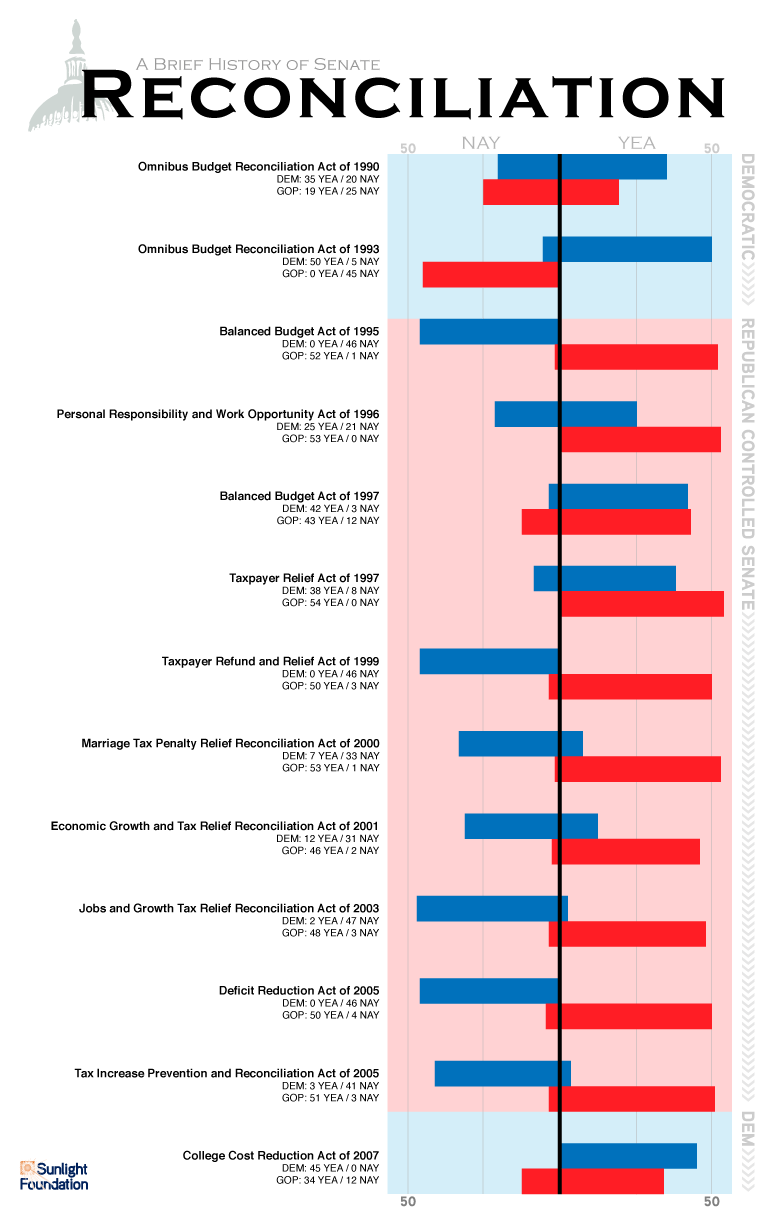
In an op-ed in Tuesday’s Post, Sen. Orrin Hatch (R-Utah) offered an excellent example of this hypocrisy. Right off, the piece was wrong on a core fact. Hatch accused the Democrats of trying to, yes, “ram through the Senate a multitrillion-dollar health-care bill.”
No. The health-care bill passed the Senate in December with 60 votes under the normal process. The only thing that would pass under a simple majority vote would be a series of amendments that fit comfortably under the “reconciliation” rules established to deal with money issues. Near the end of his column, Hatch conceded that reconciliation would be used for “only parts” of the bill. But why didn’t he say that in the first place?
Hatch grandly cited “America’s Founders” as wanting the Senate to be about “deliberation.” But the Founders said nothing in the Constitution about the filibuster, let alone “reconciliation.” Judging from what they put in the actual document, the Founders would be appalled at the idea that every major bill should need the votes of three-fifths of the Senate to pass.
[…]
Hatch said that reconciliation should not be used for “substantive legislation” unless the legislation has “significant bipartisan support.” But surely the 2001 and 2003 Bush tax cuts, which were passed under reconciliation and increased the deficit by $1.7 trillion during his presidency, were “substantive legislation.” The 2003 dividends tax cut could muster only 50 votes. Vice President Dick Cheney had to break the tie. Talk about “ramming through.”
Requirement
(D) MEMBERS OF CONGRESS IN THE EXCHANGE—
(i) REQUIREMENT—Notwithstanding any other provision of law, after the effective date of this subtitle, the only health plans that the Federal Government may make available to Members of Congress and congressional staff with respect to their service as a Member of Congress or congressional staff shall be health plans that are—
(I) created under this Act (or an amendment made by this Act); or
II) offered through an Exchange established under this Act (or an amendment made by this Act).
(ii) DEFINITIONS—In this section:
(I) MEMBER OF CONGRESS—The term ‘‘Member of Congress’’ means any member of the House of Representatives or the Senate.
(II) CONGRESSIONAL STAFF—The term ‘‘congressional staff’’ means all full-time and part-time employees employed by the official office of a Member of Congress, whether in Washington, DC or outside of Washington, DC.
Music to Lemkin’s ears. By forcing Congress and their staffs onto the exchange, you can be quite sure that there will be a broad array of choices there and that the price will be, er, right. I’ve long said that most of the problem with getting healthcare reform done is that members of Congress simply have no clue what it’s like on the outside: they and their families have nearly-free, 24/7 access to what’s essentially a private physician, fantastically complete coverage with a wide menu of choices for care, and low to no co-pays when something really hits the fan. Plus they cant’ be dropped. Why wouldn’t they persist in calling such a setup “the best healthcare in the world”? It pretty much is. The trouble is that almost nobody outside Congress has access to even a part of a plan like that.
What reform is about is allowing the rest of us access to some of that. And doing it in a way that, even projecting out 20 years, will only be costing the taxpayer 1% relative to doing nothing. Thirty million people will have access to care on the basis of that 1%. And, of course, those same projections show a half trillion dollar savings to the overall budget. Frankly, that’s amazing given the compromised nature and inherently “around-the-edges” approach of this plan so frequently (and nonsensically) derided as “government takeover.” Any plan with a total monetary outlay on the part of the government amounting to ~90 billion dollars a year isn’t a takeover of anything. The Pentagon budgeted
“$52.1 billion [for ancillary items] such as ammunition, portable generators, cooling equipment, field medical supplies, hospital equipment, and night vision goggles”
in 2009. Nothing inherently wrong with any of those things, but that’s a military outlay of $50B a year and doesn’t even get around to, oh, I don’t know, guns.
We’re wasting well north of $40B a year on the plainly idiotic War on Drugs. Don’t even get me started on how many times over our little foray into Iraq could pay for healthcare in this country. But such context never matters to the savvy reporter. Who won today’s political horse race? Who played their press releases better?
Never: who lied? Whose facts were more accurate? What is the broader context of this decision?
Even more importantly, though: people won’t be making career decisions based solely on maintaining their and their families’ access to healthcare. Even if it fails in every other way, signing these reforms into law will let a million startups bloom.
 Lemkin