PAMtastic poll data

Apropos of this post:

The [NBC/WSJ] survey — which was conducted Feb. 24-28 of 1,000 adults (200 reached by cell phone), and which has an overall margin of error of plus-minus 3.1 percentage points — also listed 26 different ways to reduce the federal budget deficit.

The most popular: placing a surtax on federal income taxes for those who make more than $1 million per year (81 percent said that was acceptable), eliminating spending on earmarks (78 percent), eliminating funding for weapons systems the Defense Department says aren’t necessary (76 percent) and eliminating tax credits for the oil and gas industries (74 percent).

The least popular: cutting funding for Medicaid, the federal government health-care program for the poor (32 percent said that was acceptable); cutting funding for Medicare, the federal government health-care program for seniors (23 percent); cutting funding for K-12 education (22 percent); and cutting funding for Social Security (22 percent).

So, the approach I laid out for the Democrats is not only popular, it’s the most popular. Well, that and people just have no fucking idea about earmarks and their relative proportion of the federal budget. Add that to the striking unpopularity of the GOP’s putative positions and you have a multifaceted issue about which you can be sure that The Democrat will make not one peep, will grudgingly accept the whatever the GOP’s demands are, and will be roundly slaughtered by voter fury about come 2012 but interpret said slaughter as implicit approval of the GOP message and most definitely not anything to do with The Democrat’s utter fecklessness. Optimism!

Krugman:

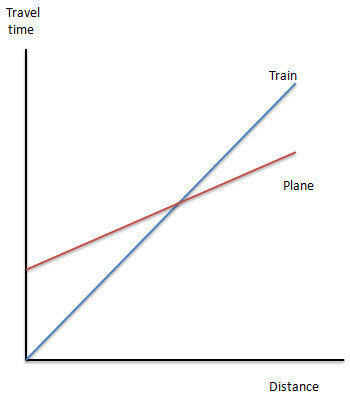
Suppose that I put those fixed costs at 2 hours; suppose that planes fly at 500 miles an hour; and suppose that we got TGV-type trains that went 200 miles an hour. Then the crossover point would be at 667 miles. It would still be much faster to take planes across the continent — but not between Boston and DC, or between SF and LA.

This is just so obviously right, and furthermore strikes me as a prime example of how policy should get made (but too rarely is): empirically. Figure out where those lines cross and then heavily fund everything pre-cross. Just flat out eliminate all other passenger rail until demand is measurably there to support it (ascertained via the same type of calculation). Then the GOP could actually make sense (for once) when they agitate for Amtrak to make money or be eliminated. Instead, they force a vast array of unprofitable routes on it, put the whole of Amtrak’s financial outlook on the back of the northeastern corridor, routinely underfund or defund infrastructure in said corridor, and then wonder why service is relatively slow there and insufficient to turn a profit for the whole rest of the system.

And but also I really think the reflexive GOP train opposition boils down to 1) they perceive it as something that reliably pisses liberals off –and– 2) white suburban conformists in the vast not-the-northeast part of the country just can’t fathom how hard it can be to drive anywhere, much less to set out on the Interstate and face traffic like the western US experiences only in city centers and only at rush hour for the whole X-hundred mile trip. This makes the train seem like the best possible option for many shorter trips. Add that to a predilection for destination cities in which a car is not only unnecessary, but can even be a hindrance and then the true shape of this policy disconnect takes form:
The west sees trains as steam powered slowpokes that drop you off and leave you walking great distances in decidedly pedestrian unfriendly settings. The east sees trains as efficient (and often faster) conveyances that drop you off exactly in the middle of everything, with easier access to the places you are most likely going than you could ever hope to achieve by car.

In this way, both side can’t even fathom the position of the other…and the folks out west go so far as to studiously avoid the train systems when they come east. Even when they move here, they tend to gravitate to the farthest exurb they can find and drive everywhere. This usually boils down to inchoate fear of something with which they have no frame of reference, a well marinated and studiously husbanded fear of the “inner cities,” or just a simple sense of “you drive to work” because that’s what they’ve always done. But, trust me tourists: if you can navigate Boston by car, you sure as hell can use the T. And, as a bonus, you are much more likely to survive.

Unified Field Theory

First principles:

  1. The recently House-passed continuing resolution only makes a government shutdown more likely by both caving to perceived GOP demands to “cut” while also exhausting the supply of low hanging fruit that Obama has already come out in favor of cutting.
  2. The GOP has the media high-ground, as always, because serious people know that cuts must be necessary, and since the GOP is at dollar value X, and the Democrats are, for all intents and purposes, at dollar value $0 (spending freeze as opposed to new cuts), the serious person answer must be $X/2. That’s the “grand bargain” that Democrats wisely point out will still submarine the economy and the GOP flatly refuses to even discuss. See: shutdown and default in 2011.
  3. Serious People furthermore agitate for deep cuts to Social Security, despite its dedicated funding source and minimal deficit impact in the near future, because, well, because that’s what serious people do. Acceding to the demands for cuts to Social Secuirty is 2012 suicide for the Democrats. It just is.

With all that in mind, what the Democrats need is a concentrated, coordinated effort that steals this idiotic media high ground surrounding the (perceived) absolute necessity of “cuts and a lot of them.” Karl Rove taught us nothing if not the fact that making your enemies’ strengths into their weaknesses is a potent political tool. Think Swiftboating. That The Democrat assiduously avoids the use of this tool is why they fail.

Therefore: the GOP is talking at least $100B in cuts, and immediately. Right or wrong, that’s going to have to be your number too. However, and critically, the GOP wants those cuts to come entirely from the non-military discretionary budget, somewhere around 14% of the whole government budget. This, then, is where and how you attack them. And you’re going to do it specifically and with dollar amounts.

You go down the list of GOP hobby horses: faith-based initiatives, the military, oil subsidies, agribusiness subsidies, general corporate welfare, abstinence-based education, all of it; but you don’t stop with spending, you also target revenue: capital gains taxes, estate taxes, social security taxes (as in: uncapped), and ultimately the tax code itself, which could use a few new brackets up top.

Secretary Gates can likely provide you with a long list of outdated or otherwise no-longer-needed military programs. Lots of them will seem ridiculous or hopelessly out of touch. Mock them and mock the GOP for continuing to support them.
Same goes for oil subsidies. These are the richest companies on Earth and the GOP wants to give them corporate welfare while asking for “shared sacrifice” from the poorest of the poor?

When you’ve run out of spending to cut from GOP programs, you go to work on revenue. That’s right, I said it. You need to too. First: revenue is revenue. Capital gains, management fees, bonuses, and everything else falls under regular pay. Next, you set about raising effective rates on corporations and the rich. The corporate side can be most effectively done by eliminating shelters and loopholes. Any country in which ExxonMobil pays $0 in taxes needs, needs corporate tax reform. Period. Still haven’t hit the number? New tax brackets. Still haven’t hit the number? Uncap Social Security. And so on.

You then pack the whole thing together and unveil it as the “alternative” plan and hoist the GOP upon it each and every day, all day. Because they are guaranteed to hate it. But will have to explain why they prefer to make these cuts on the backs of the poorest instead of the richest and furthermore call it “shared sacrifice.”

You’ve got less than two weeks to put this together. Recent history with the tax cut extension “fight” suggests you haven’t even considered something along these lines yet. But it’s how to win. That’s why it looks so strange to you. Yes, it’s simple minded. But simple minded is what works. You are the last few hundred people in America to come to this realization.

I’m not saying this bill would be what was passed, or that it would even reach the floor in a serious way…but it would drive the conversation in a way that benefits you, The Democrat, and not so coincidentally us the American people.
Currently you’re battling over the 14% that contains the most painful cuts possible. You shouldn’t be. You furthermore don’t even need to be. Change the conversation to terms that have the potential to benefit you. Right now revenue doesn’t even come up. It needs to. It needs to be the first question off the lips of the serious people. Until it is, you will fail.

Zero

That would be the number of Republicans that voted to end taxpayer subsidies for Big Oil. Companies that are enjoying record profits of ~$100 billion per year, often pay no taxes whatsoever, and receive taxpayer provided subsidies to the tune of tens of billions of dollars per decade.

But, by all means, let’s cut $100 over here that just gets wasted on food for starving children. Furthermore, let’s agree not to discuss any of this. Shrill.

Zero

…how much more concrete could our current situation be? Republicans — and, unfortunately, some Democrats too — are pushing for an economic austerity plan that will keep unemployment high and the job market loose. The result is downward pressure on wages, which keeps middle-class incomes stagnant and corporate profits high. This benefits the executive and investor class, and while it’s a shortsighted benefit, it’s a benefit nonetheless. And it’s not thanks to globalization or returns to education or anything like that. It’s due to a deliberate political decision that favors the rich at the expense of everyone else.

Kevin Drum
If only we had a particularly skilled orator in high office somewhere who could use some sort of bully pulpit to explain this concept in simple terms once or twice a day from now until the thought finally sinks in and takes root. Meh: So it goes.