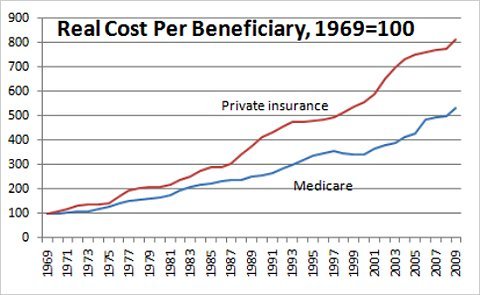
How to square the circle: Assuming Medicare for all tomorrow and that you can find a way to return the dollars in-between the red and blue lines to the people paying it: the American worker with employee provided health insurance. Right now, that’s all invisible income, spirited away into the employer-shared costs of providing coverage. It’s the underlying reason that real wages have been stagnant for most of my lifetime. Turn that into real wages and the broader economy would explode. There would suddenly spring into existence a middle class with (gasp) actual purchasing power. Who knew?!?

Naturally, the plutocrats would, at least initially, turn that space into more profits for themselves. Sooner or later, though, it seems likely that constraints on quality workers would gradually bring the money over into regular salary as companies competed to find highly trained folks. You’d still have to solve the manufacturing issue and/or something to do with all that idle but essentially untrained labor force out there…but it would be a start.
At any rate, a few more than the 17 Americans vaguely cognizant of this cost gap need to be made painfully and continually aware of it. Every day, every hour, every time a microphone is switched on with a Democrat behind it. Complete with this graph. That Medicare, far from being “expensive,” saves money in dramatic fashion. And that, since they, the average hardworking healthcare consumer, cannot buy into that massive bargaining pool or something very much like it, they are being robbed. Every. Single. Day. With malice aforethought. And that they have precisely one party, the GOP, and Joe Lieberman to thank for it.

But that would be shrill. And Weiner lied to his fellow Democrat. That’s what’s important here.

If a bondholder misses a payment for a day or two or three or four — what is more important is you are putting the government in a materially better position to better pay its bills going forward.

Paul Ryan being serious and courageous and, yet again, showing just how absolutely determined the GOP is at all levels, extreme far right or merely far right, to have a default on the debt of the United States. Why, we’ll barely notice it’s even happened.
It’s the only way they see getting the White House in 2012. It’s been the plan all along. They assume Obama will get the “egg on his face” and they’re probably right. Once in control it’s goodbye filibuster (assuming the Democrats lose the Senate), goodbye social safety net, and hello freedom is just as free as what of it you can afford to buy. After that, when the money’s gone: kindly go die in the streets.
But hey, taxes will be pretty low. On the already rich, anyway.

The hard truth about health care

Everyone knows — or should know — that the United States spends much more than any other country on health care. But the Kaiser Family Foundation broke that spending down into two parts: the government’s share and the private sector’s share (both measured as a percentage of total gross domestic product), then compared the results to figures from 12 other countries that are members of the Organisation for Economic Co-operation and Development. And here’s the shocker: Our government spends more on health care than the governments of Japan, Australia, Norway, the United Kingdom, Spain, Italy, Canada or Switzerland.

Think about that for a minute. Canada has a single-payer health-care system. The government is the only insurer of any note. The United Kingdom has a socialized system, in which the government is not only the sole insurer of note but also employs most of the doctors and nurses and runs most of the hospitals. And yet, measured as a share of the economy, our government health-care system is the largest of the bunch.

And it’s worse than that: Atop our giant government health-care sector, we have an even more giant private health-care sector. Altogether, we’re spending about 16 percent of the GDP on health care. No other country even tops 12 percent. Which means we’ve got the worst of both worlds: huge government and high costs.

It’s also important to note that, even with this high spending, we’re getting worse outcomes than all the Western countries spending 5-7x less than we do. And, of course, if we had the costs of any of these countries we’d be facing surpluses today instead of deficits. But we’re told the only road forward for our country is to slash Medicare, Medicaid, and the rest of the social safety net and give the money to the richest 1%. Saying anything else isn’t Serious.

The hard truth about health care

Default Already Hitting Pocketbooks

The GOP’s hostage taking re: the debt ceiling is already causing ripple effects in the economy:

As of late May, the number of CDS contracts — essentially insurance policies on the possibility of a default — had risen by 82 percent. Equally as important, the cost of a CDS — the best indication of how much riskier U.S. debt has become — rose by more than 35 percent from April to May. Last week I spoke to a number of people who calculate such things for a living, and they said this change means that the interest rate the U.S. government has to pay has already increased by as much as 40 basis points compared with what it otherwise would be. This means higher federal borrowing costs and deficits, and overall higher interest rates on everything from car loans to mortgages to credit cards.

Remember all those “confidence” trolls the GOP trotted out in advance of retaining the Bush tax cuts for the wealthiest individuals in the US? Wonder where those guys went.

But, by all means, let’s talk about Weiner and whatever other body parts are on display in the Halls of Serious People. That’s the stuff that really matters.

Default Already Hitting Pocketbooks

Almost 60,000 average Americans had the courage to go out and charge those beaches on Normandy, to drop out of airplanes who knows where, and take on the battle for freedom. Average Americans. The very Americans that our government now, and this president, does not trust to make a decision on your health care plan. Those Americans risked everything so they could make that decision on their health care plan.

Rick Santorum, mulling the true evil of Hitler: an under-appreciated penchant for wanting to provide affordable health care.

…these are the basic points liberals should be arguing:

• These vouchers would be grossly inadequate.
• For that reason, most seniors wouldn’t be able to afford adequate coverage.
• Medicare as it exists today is indeed sustainable.

If you find yourself arguing about something else, you may already have lost.

Bob Somerby, speaking the truth. Keep it simple and to the point. Pizza, the Marine Corps, and their relative similarities or interchange rates need not enter into it and our arguments tend to be weakened or just diffused by the presence of these things.
The Democrats have a uniquely potent message to offer here, one that polls almost uniformly in their favor; as a result, constantly going off to fight ultimately pointless side-battles is precisely what the GOP would love to have happen. It muddies an otherwise crystal clear dichotomy. The GOP wants to end Medicare as we know it. The Democrats do not. This is because Medicare, even as currently figured, is sustainable. Long term fixes and cost (and rate of cost-growth) containment through mechanisms installed in the ACA? Of course. Wholesale gutting that leaves only the name in place: not necessary. Period.

The fact that I’m in favor of going back to the Clinton tax structure is merely an indicator of how scared I am of this debt problem that has emerged and its order of magnitude.

Former Fed Chairman Alan Greenspan, an enthusiastic supporter of the Bush-era tax cuts for the rich, now supports raising top marginal tax rates on high earners. Last week, Joel Slemrod, a top economic adviser to Ronald Reagan, said the same thing. (via andrewgraham)
One wonders just how many seconds will elapse until FOXnews is running “Greenspan: Just how insane was he?” documentaries 24/7. May already be live.

In a Decent World

jeffmiller:

There’s a lot I simply don’t understand here, but let’s talk for a second about the thing in bold.  Forget all of the problems with the chart and sustained unemployment and people dropping out of the job market and people accepting lower pay or benefits and everything else that your red and blue chart doesn’t address.  That “steepest climb” you’re talking about … that climb doesn’t show job growth.  Every one of those months shows continued job losses.   And the time when the stimulus end?—that’s the time where there is actual job growth.  The chart, in other words, can tell a story that’s exactly the opposite of what you’re saying in bold.  

Now, you can argue that the stimulus resulted in smaller job losses than there would have otherwise have been, or that the job growth at the tail end of the chart was sparked by the stimulus that preceded it—you can argue these things, but the chart doesn’t prove these things.  The chart is just data, with its flaws and limitations.

Seriously? Leaving aside the bit about your troubles with pesky “data”, your expectation is that one month: catastrophic job loss. Next month: spectacular, robust return to full employment of the go-go days of old. In the history of the world, I challenge you to show me a recession that ended abruptly. The one you might point out is the one you also wouldn’t want to mention, as it ended as a direct result of massive and sustained government spending (see: World War II, in which basically everyone in the country had a fake “government” job. How’d that work out for us?). They all end more or less like what we’re seeing now, a gradual improvement in “bad” numbers, then progressive and building improvement on “good” numbers. Businesses don’t simply rehire x-million workers overnight; in fact, they only hire when they absolutely have to, and are thus not typically leading indicators of a recovery. You’ll recall that this recession was declared “over” in September of 2010.

Likewise, you can see the same trending in the diminishing output gap. I know, I know, more dread data. The Democrat and his empirical reality crap again. But it’s a fact: the economy is improving, if slowly. It improved more quickly during the time of the stimulus. Were said stimulus still unspooling, we’d be seeing faster improvement now. The sooner we close said output gap, the sooner revenues improve and the sooner the deficit “crisis” is at an end.

The GOP, of course, knows this too. That’s why they’re riding this particular hobby horse so hard right now. It’s the opportunity to jam their view of society down our throats while the public is scared and feeling serious economic pain. Once things noticeably improve there will be even less stomach for “shared sacrifice” at the hands of eviscerating the social safety net coupled to deep tax cuts for the rich. So, from their perspective it’s now or never. That fact, as much as anything, is why they all voted for the Ryan plan. They see this moment as their last, best chance to end Medicare this decade.