
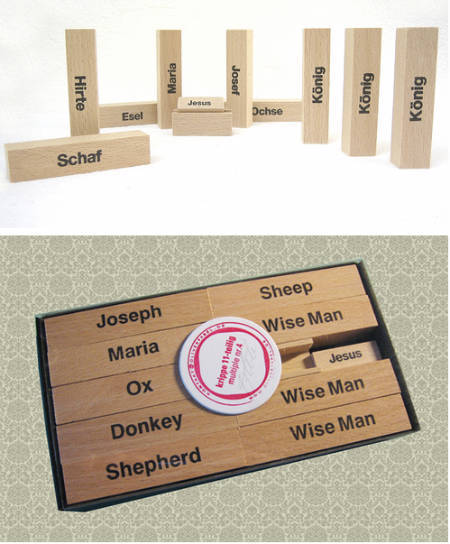
Modernist nativity set. Also makes a great Festivus gift. And, yes, that is Helvetica. Thanks for asking. Me? I would have dropped the text entirely.
Modernist nativity set. Also makes a great Festivus gift. And, yes, that is Helvetica. Thanks for asking. Me? I would have dropped the text entirely.
By far the fastest way to end the war in Afghanistan would be to ask General McChrystal’s staff to produce a plan to make it deficit neutral and find sixty votes in the senate for his financing plan.
Lots of people seem to think that if we don’t get all the way to single payer (or some other abstract, personal measure of “success” in health insurance reforms) that the reform is not worth doing. I think Ezra Klein destroys that meme rather completely while noting that failure doesn’t breed more expansive second-tries; instead, it only breeds more caution on the subsequent go-round:
Truman sought single payer. His failure led to Kennedy and Johnson, who confined their ambitions to poor families and the elderly. Then came Nixon, whose reform plan was entirely based around private insurers and government regulation. He was followed by Carter, who favored an incremental, and private, approach, and Clinton, who again sought to reform the system by putting private insurers into a market that would be structured and regulated by the government. His failure birthed Obama’s much less ambitious proposal, which attempts to reform not the health-care system, but the small group and nongroup portions of the health-care system by putting a small minority of private insurance plans into a market that’s structured and regulated by the government, and closed off to most Americans.
Never get tired of talking about Nixon re: healthcare reform. Anywho, Ezra goes on:
Medicare and Medicaid began as fairly limited programs. Medicaid was pretty much limited to extremely poor children and their caregivers. Medicare didn’t cover prescription drugs, or individuals with disabilities, or home health services.
But once the programs were passed into law, they were slowly and continually improved. They became more expansive, with Medicaid growing to cover not only poor families but also poor adults, and the federal government giving states the option, and matching dollars, to include more people under the program’s umbrella. Medicare was charged with covering people with long-term disabilities, and it was eventually strengthened with a drug benefit, more preventive coverage, the option of supplementary plans and much more.
Pass something. The worst version of the Baucus bill would indisputably improve the lot of millions, millions of Americans. The main thing to focus on is keeping the outcome one that quantifiably improves the experience for many, if not most, consumers. The voters out there can accept an imperfect solution, so long as they sense they are no longer being utterly screwed by their insurance company. This will (presumably) happen the first time they make a claim, or change jobs, or (hopefully) see their premiums drop and their pay rise accordingly post-reform.
Some of the people (at the rally) that wanted to engage me in conversation appeared to have been the losers in the ‘Are you smarter than Michele Bachmann contest?’.
Every vote over the minimum necessary to secure passage represents compromises that the Democrats as a group would prefer not to make. It’s not that Nancy Pelosi was lucky to pass the bill, it’s that the Democrats wrote the strongest bill they could that would get enough votes to pass. That’s good strategy.
Let’s begin:
LIEBERMAN: A public option plan is unnecessary. It has been put forward, I’m convinced, by people who really want the government to take over all of health insurance. They’ve got a right to do that; I think that would be wrong.
But worse than that, we have a problem even greater than the health insurance problems, and that is a debt – $12 trillion today, projected to be $21 trillion in 10 years.
WALLACE: So at this point, I take it, you’re a “no” vote in the Senate?
LIEBERMAN: If the public option plan is in there, as a matter of conscience, I will not allow this bill to come to a final vote because I believe debt can break America and send us into a recession that’s worse than the one we’re fighting our way out of today. I don’t want to do that to our children and grandchildren.
That was Lieberman on FOXnews (where else?) this Sunday past. Doubtless just posturing, but let’s take him at his word: the deficit (and, by extension, the debt) is and should be held in absolute primacy to any and all other spending or policy decisions (which, of course, also have direct spending implications). Fair enough. We take that as a first principle.
The current GOP “plan” (in that it’s not even a plan so much as a policy statement) has been scored over the 10-year window as potentially resulting in a reduction of budget deficits by $68 billion while helping 3 million folks get coverage they wouldn’t otherwise have.
The plan passed by the House, on the other hand, extends coverage to 36 million currently uninsured Americans while cutting the deficit by $104 billion over the same 10-year window.
Which of those plans is more deficit neutral, Joe?
Of course, third option is do nothing. Joe himself has pushed this idea. Here’s what that looks like:

By all means, MSM, continue treating Joe Lieberman as a sober, deficits minded fellow only out for what’s best for the country. Let’s not once pause to ask him: Joe, just how does the public option contribute to the deficit?
Remember when Timothy McVeigh blew up Oklahoma City and 80% of the news was about him being a Christian? Yeah, me neither.
The Atlantic and author Christopher Hitchens, trying to declare Western Civilization dead because Jon Stewart pokes fun at our political discourse (and out-polls his Serious Journalism counterparts in the “most trusted” category while doing it), goes completely off the deep end intellectually just two paragraphs in:
And if any one thing undid Governor Palin as a person who could even be considered for the vice presidency, it was the merciless guying of her manner and personality by Tina Fey.
Uh, no. If any one thing undid Governor Palin, it was her brazenly obvious lack of qualifications for that job coupled with an obvious absence of the sort of desire or drive needed to get her ready in the several months available prior to the general election (or, for that matter, her debate with Biden). Her unceasing reliance on “You Betcha!” and other equally trenchant bits of commentary in the face of any and all questions is what created, powered, and was ultimately the thing that resonated in the Tina Fey bit. Fey was simply the person most visibly pointing out that the emperor has no clothes. The imitation was so effective that viewers couldn’t help but realize that there was nothing else in there but the scare quotes, nonsensical rambles, and the closing catch-phrases. Had Palin been an unquestionably qualified (but green) candidate with a similarly idiosynchratic library of quips and old-fashioned truisms, she still would have been mocked, just as any national political figure’s most obvious tics are mocked, but simultaneously would have been accepted as an otherwise serious player on the national scene, admittedly one with a folksy shtick. Big deal. Suggesting otherwise is the real infantilization of the American discourse. And Jon Stewart and his ilk aren’t the ones responsible for any of that. Makes you wonder why his “Trust” numbers are so high.

Got this offer from the Boston Globe today. What the Globe (and, by extension, its parent company the New York Times) can’t quite sort out: this price should read: $0. If you subscribe for a year or two, we will GIVE YOU a kindle so long as you agree not to receive the actual paper-paper. That’s because printing the damned thing costs twice as much as simply giving all subscribers the kindle and calling it a day.
Newsprint: To survive, you are going to have to shed your old ideas about what your business model is. I’m not sure how much more simply it can be put. Change or die.


 Lemkin