
Is the Earth flat or spherical? Opinions differ.
Time’s fellatory profile of Glenn Beck, via Media Matters
Is the Earth flat or spherical? Opinions differ.
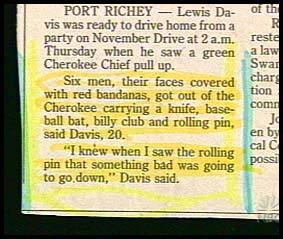
Clearly extracted from just below a Polytron ad in 342B…
Kottke talks about the iPhone (as a device-class, mind you, not specifically the device) impacting many, many more markets than just smart-phones or PDAs. It’s also a compact camera killer, to name only one segment touched on in his fine essay. And I think he’s basically right. But I want to talk about a point he makes in the second footnote (without going all DFW on you):
You’ve got to wonder when Apple is going to change the name of the iPhone. The phone part of the device increasingly seems like an afterthought, not the main attraction. The main benefit of the device is that it does everything. How do you choose a name for the device that has everything? Hell if I know. But as far as the timing goes, I’d guess that the name change will happen with next year’s introduction of the new model. The current progression of names – iPhone, iPhone 3G, iPhone 3GS – has nowhere else to go (iPhone 3GS Plus isn’t Apple’s style).
Gruber picks up on this point too, basically answering him directly with:
If this platform is here for the long run, the general purpose name that best works for a general purpose device is already here: iPod. In fact, iPod, semantically, is a better name for the iPod Touch than it ever was for the original focused-on-music models. As I see it, the phone in iPhone isn’t about telephony, but about the necessary contract with a mobile carrier.
Agreed. Lemkin was all over this subject back in 2007 (!), talking about Steve Jobs’ almost certain desire to skip 3G (and any other carrier-tied technology) entirely in favor of some form of ever-present WiFi that could come from any company, municipal co-op, or whatever. This, of course, is the ultimate existential threat to AT&T: if they become (as a company) nothing more than a provider of the dumb pipe, then you can substitute any old dumb pipe for them without noticing any change at all. This is why they’re fighting Google tooth and nail over Google Voice, though hiding behind Apple to do it (presumably, the relevant lawyers (correctly) predicted a prompt FCC smackdown should AT&T intervene directly). But they will lose this fight over the long term. Google has already seen to it via the bidding process on the wireless spectrum. How well did AT&T like that?
“Google is demanding the government stack the deck in its favor, limit competing bids, and effectively force wireless carriers to alter their business models to Google’s liking.”
By “alter their business models” he meant to say: “stop relentlessly fucking over the end-user through long, inflexible contracts on POS phones of AT&T’s choosing.” Oh, GenericNetCo has really cheap wireless internet this month. I’ll switch. So it’s fundamental to AT&T that they seemlessly transition you from the locked, carrier specific technology (basically today’s situation) to the quietly generic wireless technology (aka Dumb Pipes) they’re hoping you don’t even notice you can actually get from anyone and everyone that cares to provide said service.
What will be their value-add in this situation? Unclear. Presumably they intend it to be nationwide reach, reliability, convenience, and some kind of competitive pricing for same. That said, and somewhat obviously, if AT&T were dependent on consumer goodwill and raw network reach, reliability, and convenience as of today, they’d be out of business inside of a fortnight. They seem busier blaming their iPhone users for their network’s various problems than, you know, improving the service that they are contractually obligated to provide in some fashion or other. And that’s within a market and on a network whose design they’ve had decades to cultivate, tune, and understand (though with an outcome that clearly implies that they still don’t “understand” what it is these iPhone users expect from their device, and how that’s different from, say, the user of a more generically crippled feature-phone). So can they build out a nationwide, everpresent, high-speed, and five-9s reliable WiFi service that’s compelling enough to keep people around once access to the underlying technology no longer requires multi-year contracts? Without recourse to tethering them to a number or some other lock-in? I seriously doubt it.
But, yeah. It will be called the iPod. Within a handful of years, the core iPod platform will be entirely Touch-based, and thus simply morph back into iPod (with Nanos or Shuffles being the variant, but today’s Touch being The iPod). And you’ll use said device to make calls.
Untitled from Ars Technica on Vimeo.
Say goodbye to the iPod Touch: Microsoft’s Zune HD is simply better in every way. Want to play chess? We think you’ll enjoy this 30-second full video commercial before that application opens. Whoops, email arrived? We think you’ll enjoy another commercial while you switch to that view and another one when you’re ready to switch back. It’s what we think today’s demanding consumer wants, no, demands.
How can Apple hope to compete against this sort of usability? It’s unpossible.
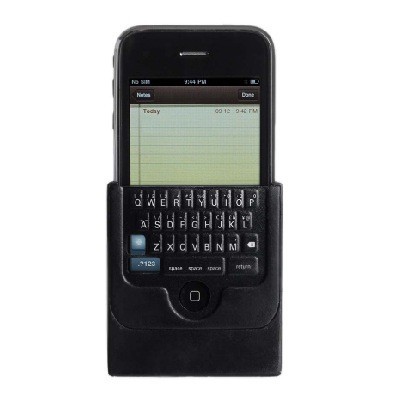
So then, the usage model here is to lug around the iTwinge until the moment you need to use the keypad…at which point you slide the thing on and use it to type (it apparently just presses right through to the screen). Then, when you’ve finished typing…you take this thing off again. That just sounds wonderful. Why, I already can’t imagine using an iPhone without it.
iTwinge users are advised to apply the sleeve as soon as the iPhone is taken out; typos can still occur through incidental contact, improper use of the iTwinge, and many kinds of type-play: even when the iPhone is not fully inserted into the iTwinge.
In defense of the iTwinge, I suppose one could limit oneself to the top two rows for application storage and avoid all apps that employ more than the first half of the screen. Probably some good tip calculators out there that would work just great.
The president, like me, didn’t seem to be in love with any of the available options. He always believed Hillary Clinton would be the Democratic nominee. “Wait till her fat [ass] is sitting at this desk,” he once said […] He didn’t think much of Barack Obama. After one of Obama’s blistering speeches against the administration, the president had a very human reaction: He was ticked off. He came in one day to rehearse a speech, fuming. “This is a dangerous world,” he said for no apparent reason, “and this cat isn’t remotely qualified to handle it. This guy has no clue, I promise you.” He wound himself up even more. “You think I wasn’t qualified?” he said to no one in particular. “I was qualified.”
An excellent Boston Globe op-ed describes the current, historically bad state of the Grand Old Party, held hostage as it is by the most extreme elements of its fringe membership. I’ve even put it in graph form:

Pretty easy to gather that, compared to everybody else, Democrat and “Independent” alike, self-described Republicans hold very different views on the issues of the day. And it’s not as though, were these folks asked about immigration or abortion, they’d suddenly step back into some region of the non-lunatic spectrum. GOP identifiers largely believe (to the tune of 58%) that the President of the United States is a secret Muslim born in Kenya, after all. And that he’s furthermore planning to usher in a Socialist Empire of some sort. People are certainly entitled to their insane views; the problem is, as the article notes:
In America, we don’t really have splinter parties. When one of our parties goes crazy, it doesn’t slide to the margins.
Yep. It’s not as though this is some tiny, ad-hoc group’s take on some arcane local zoning issue we’re talking about here. This is a national party competing for the Presidency. We either need more choices, or need the GOP to sort itself out, and fast.
But, far from dusting itself off and letting some cooler heads prevail, the modern GOP just pushes the crazy meter even further along. Here’s the man that delivered the response to Obama’s joint-session address on the subject of the President’s citizenship:
STARK: What do you personally believe, I mean – do you think there’s a question [surrounding Obama’s citizenship] here?
BOUSTANY: I think there are questions, we’ll have to see.
Alright, they must have chosen Boustany because of some sort of unique ability or achievement in the healthcare and its administration in LA. Or not:
…ranked Louisiana dead last in 2008 among the 50 states for the overall health of its people, hugely because of its high percentages of people without health insurance, preventable hospitalization, infant mortality, cancer deaths, cardiovascular deaths, and overall premature deaths. The Trust for America’s Health had similar findings in its 2008 rankings. The infant mortality rate in Louisiana, according to the United Health Foundation report, is more than triple that of Slovenia and the Czech Republic.
And yet, apparently, this is the best the GOP had sitting on the bench, waiting to make an important speech to an audience who’d just watched Obama make his case.
Worth noting the ending of the afore-linked op-ed:
Maybe Democrats should be happy that Republicans have been reduced to a lunatic fringe. But the lunatics still have their seat at the table, and someday they may be sitting at its head again. What then?
I’m never quite sure with AppleScript just what’s supposed to work, though.

Greg Sargent pulls out some interesting figures from a recent WaPo poll:
* That Dems hold an overwhelming 20-point lead on which party is most trusted on major issues, with Obama preferred over Republicans by 12 points on health care.
* That a majority, 53%, agrees that “government reform of the nation’s health care system is necessary to control costs and expand coverage,” underscoring yet again that the public wants government action.
* That a plurality now believes reform won’t prevent people from keeping their own health care, suggesting the public may be it reform as less and less threatening.
* That a big majority, or 62%, believe Republicans have not made a good faith effort to cooperate with Dems on health care.
That last one seems the most damning. Everyone talks about 2010 being full of doom for the Democratic party. To be sure, historic majorities like the current Democratic position don’t last. By definition, any “historic” majority is going to include seats that, for one reason or another, are more likely to be held by the non-historic-majority party more often than not.
But, and it’s a big but: to go back to the “predictable” seat holder party-wise, you still have to give those “predictable” voters a reason to prefer you. And the GOP isn’t doing it so far. Even worse: people are noticing. Naturally, we need to see some of these toss-up districts broken out to be sure, but I suspect this polling data is more or less on the nose.
The bad news for Democrats in this poll is this:
a big majority wants Dems to craft a bill that will win GOP support
Since we know a priori that no proposal will win GOP support (party leaders have done everything but put that in writing on granite tablets), there would appear to be a rather hazardous, built-in capacity for outrage. That is: voters, never ones to pay a lot of attention, will see that some healthcare reforms passed, not realize that nothing rolls out until 2012 or later (circa 2010: “I ain’t seen nuthim from it ‘tall!”), see (and be told repeatedly) that not one member of the GOP voted for it in the House and that (at most) one or two GOPers voted for it in the Senate, and will assume that all the “problems” with the bill are well and truly the fault of the Democrats. And, here’s the rub: they’ll assume it’s all because they wouldn’t work with the GOP, not because the GOP refused to work in good faith with the Democrats. The ever feckless Reid et al. will try to point out that no GOP proposal or counter-offer (beyond Go Die in the Streets) ever appeared. But the media cares not for nuance, and you need to be setting up the short, two or three word rhyming drumbeat right now, every day, every hour, and every minute about GOP intransigence such that, when the time comes (and it will come), you can merely call back to your groundwork, which will seem familiar, and will almost automatically become the basis for the discussion. No Democrat should even be approaching a microphone without uttering something like “The GOP needs to Play, or Pay.”
Of course, that will not happen. And, we all know that, even if the Democrats managed to gain seats in 2010, it will be portrayed as “good for Republicans.” Everything always is.
 Lemkin