I really don’t understand how bipartisanship is ever going to work when one of the parties is insane. Imagine trying to negotiate an agreement on dinner plans with your date, and you suggest Italian and she states her preference would be a meal of tire rims and anthrax. If you can figure out a way to split the difference there and find a meal you will both enjoy, you can probably figure out how bipartisanship is going to work the next few years.

John Cole, peering in to the future on February 5, 2009.

The United States never had a debt ceiling until 1939, and doesn’t need one now. Congress can control debt by its control over revenues and expenditures; all the debt ceiling does is create the possibility that the government will not be able to borrow the money needed to carry out the laws Congress has already passed.

Mark Kleinman says what should be the first thing out of Obama’s (and every other Democratic) mouth every time a microphone is switched on. Or, perhaps, paired with the depressingly ever-present “God bless you and may God bless America” tagline. Whatever works for them.

Give the utter lack of any unified message on the issue, it’s genuinely remarkable that public opinion has turned so mightily in favor of what you could broadly call the “Obama position” on the debt ceiling. People still don’t seem to grasp what the hell the debt ceiling is or what purpose, if any, that it serves… but they’re beginning to dislike GOP demagoguery on it no matter what. At least we’ve got that going for us.

Again with the Gangs

Steve Benen reports that the Gang of Six, er, Five, er, Six, er five plus Coburn who left but is back again is claiming to have come to terms on a broad budget agreement:

Coburn … noted the Congressional Budget Office would score the plan as a $1.5 trillion tax cut because it would eliminate the Alternative Minimum Tax. It would generate a significant amount of revenue out of tax reform and reduction of tax rates, which authors believe would spur economic growth.

Ah. So we’re going to eliminate the AMT, apparently without paying for it (because when has any gang ever actually paid for something), further cut other tax rates, and then, magically, revenues will just rise and rise. Just like they’ve never done in the past. At least we’re finally getting the serious people together over the kitchen table, as it were. Now if we can just placate the unicorn caucus and raise the ceiling to eleventy trillion billion dollars, we’ll have a deal.

In the same way that Wall Street hoovering up a third of all corporate profits is the new normal. Or that 9% unemployment is the new normal. Or that obstruction, rather than legislation, is the new normal for Congress. Or that massive spending cuts during a recession is the new normal. Or that conducting three overseas wars at the same time is the new normal.

The new normal kind of sucks, doesn’t it?

Kevin Drum reflects on the “new normal.”
I think this phenomenon, more than anything explains why we’re going to default. Maybe not this time, but sooner than later. And even then, in the economic ruins that follow, there’s only a passing chance that the important lesson, the moral of the story will sink in.
More likely it’ll be blamed on ACORN, the EPA, and dread socialist fifth columnists and so forth. But I just don’t see how the boil gets lanced without the paroxysm. And, even then, the end result may be that the boil is simply inflamed further.

Dean Baker AND Ron Paul

An interesting read in which Dean Baker agrees with Ron Paul’s idea:

…the Fed has bought roughly $1.6 trillion in government bonds through its various quantitative easing programs over the last two and a half years. This money is part of the $14.3 trillion debt that is subject to the debt ceiling. However, the Fed is an agency of the government. Its assets are in fact assets of the government. Each year, the Fed refunds the interest earned on its assets in excess of the money needed to cover its operating expenses. Last year the Fed refunded almost $80 billion to the Treasury. In this sense, the bonds held by the Fed are literally money that the government owes to itself.

Unlike the debt held by Social Security, the debt held by the Fed is not tied to any specific obligations. The bonds held by the Fed are assets of the Fed. It has no obligations that it must use these assets to meet. There is no one who loses their retirement income if the Fed doesn’t have its bonds. In fact, there is no direct loss of income to anyone associated with the Fed’s destruction of its bonds. This means that if Congress told the Fed to burn the bonds, it would in effect just be destroying a liability that the government had to itself, but it would still reduce the debt subject to the debt ceiling by $1.6 trillion. This would buy the country considerable breathing room before the debt ceiling had to be raised again. President Obama and the Republican congressional leadership could have close to two years to talk about potential spending cuts or tax increases. Maybe they could even talk a little about jobs.

In addition, there’s a second reason why Representative Paul’s plan is such a good idea. As it stands now, the Fed plans to sell off its bond holdings over the next few years. This means that the interest paid on these bonds would go to banks, corporations, pension funds, and individual investors who purchase them from the Fed. In this case, the interest payments would be a burden to the Treasury since the Fed would no longer be collecting (and refunding) the interest.

More detail at the link. I’m no economist, but it sounds like dodging the interest alone is worth doing in exchange for a fairly minor “bank tax” down the road as the reserve rate requirements would necessarily ratcheted up slightly to offset the eventual inflationary pressure caused by The Great Bond Shredding of ‘11.

Were I Obama, I’d get out on the hustings this very second talking about how under no circumstances should the Fed order these bonds be destroyed. Go have lunch with Joe Biden. Come back out and say “well, it is with a heavy heart I have to bow to the demands of my GOP overlords. We shall shred the bonds effective immediately. Bipartisan!”

After all, the only way to get something done in this government is for Obama to come out against it and wait for the GOP’s reflexive adoption of the opposite position no matter what the issue. That the Democratic leadership in DC haven’t yet figured this out is why they fail.

Dean Baker AND Ron Paul

Obama’s Other Card

Even as the political battle mounts over federal spending, the end result for federal policy is already visible — and clearly favors Republican goals of deep spending cuts and drastically fewer government services.

President Obama entered the fray last week to insist that federal deficits can’t be reduced through spending reductions alone. Federal tax revenue also must rise as part of whatever deficit reduction package Congress approves this summer, he said. Obama has been pushing to end a series of what he calls tax loopholes and tax breaks for the rich.

But even if Obama were to gain all the tax-law changes he wants, new revenue would make up only about 15 cents of each dollar in deficit reduction in the package. An agreement by the Republicans to accept new revenue would be a political victory for Obama because “no new taxes” has been such an article of faith for the GOP.

I think this analysis leaves out a critical piece of the calculation: the December 2012 expiration of the Bush tax cuts. Recall that Obama, above all else, is the “outcomes” President. He’s more than willing to take a temporary political setback or even a seeming political loss in the short term if that in turn leads to the long-term policy outcomes he prefers.

So: to get a deal on the debt ceiling he gives the GOP a fatter ratio of cuts to revenues for now. Keep in mind, these “cuts” are really a framework that then plays out over most of a decade and will ultimately be changed and tuned by several Presidents and Congresses (and that’s assuming they stick to the framework at all).
Next year though, assuming Obama’s reelected, everything changes on the revenue front. If the Congress simply fails to act, the full set of cuts expires. If they act, but the GOP includes extension of the cuts for those making more than ~$200k/yr, Obama vetoes it. And, really, if we assume that the GOP will fail in its efforts to destroy the economy in the next few weeks, Obama likely prefers one of those two outcomes. Why? Again, it’s because they are the best long-term outcomes for the country. That both reflect poorly on the GOP is a bonus side benefit going into the 2014 midterms. To be sure, a tax rise represents real short term pain for the less well off, but that pain yields long term stability and, let’s face it, sanity in the revenue structures of the United States.

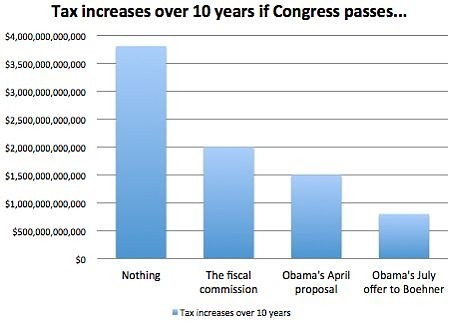
Expiration of the Bush tax cuts is a key pillar in the “do nothing” solution for our current deficit/revenue issues. The assumption that all or most of them are going to expire if Obama is reelected needs to be included in any meaningful political calculus regarding the ratio of cuts to revenue increases in the current negotiation. Assuming expiration, you ultimately end up with a number of difficult but doable fixes that can be handled one at a time. If those “fixes” are, you know, paid for, the country will once again be on firm financial footing, complete with a reasonably robust social safety net for as far as the eye can see. This is precisely the outcome Obama is playing for.

Obama’s Other Card

We’re at 15 percent revenue, and historically it’s been closer to 20 percent. We’ve never had a war without a tax, and now we’ve got two. Absolute bullshit.

Alan Simpson, former Senator from Wyoming and a Republican, reflecting on the state of the GOP and their “negotiating” posture.

Mittmentum!

Mitt Romney in GOP debate: [Obama] didn’t create the recession, but he made it worse and longer.
Mitt Romney in NH on Monday: The people of New Hampshire have waited long enough. They want to see good jobs. They want to see rising incomes. They want to see an economy that’s growing again, and the president’s failed. He did not cause this recession, but he made it worse.
Mitt Romney when challenged on veracity of “worse”: I didn’t say that things are worse.