Curveball II

I’d say this paragraph pretty well sums up American “terrorist policy” from 9/12/2001 on:

…whatever the truth about the detainee’s role before his capture in 2002, it is receding into the past. So, presumably, is the value of whatever information he possesses. Still, his jailers have continued to press him for answers. His assessment of January 2008 — six years after he arrived in Cuba — contended that it was worthwhile to continue to interrogate him, in part because he might know about Mullah Omar’s “possible whereabouts.”

Curveball II

Compassionate Conservatism

Breathtaking. Words do not suffice:

Under a new budget proposal from State Sen. Bruce Casswell, children in the state’s foster care system would be allowed to purchase clothing only in used clothing stores.

[…]

His explanation?

“I never had anything new,” Caswell says. “I got all the hand-me-downs. And my dad, he did a lot of shopping at the Salvation Army, and his comment was — and quite frankly it’s true — once you’re out of the store and you walk down the street, nobody knows where you bought your clothes.”

Well, as long as the reasoning is as airtight as that, I guess I have no argument to make.

Compassionate Conservatism

When Republicans reached basic consensus about what they wanted to do [relative to Ryan’s plan], they then delegated the details to a small group of people who fleshed out the plan, it was then presented to the caucus and within a week they had the vote. Democrats, by contrast, put their health reform plans through an agonizing months-long process of public intra-party disputes. That gave people who didn’t care about the details tons and tons of time to organize a backlash while tending to signal to low-information voters that Democrats were doing something controversial even among their own partisans. The backlash against Medicare privatization is overwhelmingly likely to grow over time, but it’s also the case that between today and November 2012 other events will intervene and crowd the agenda space possibly letting members off the hook for an unpopular vote.

Matt Yglesias on the key differences between how the GOP and Democratic Caucuses operate.

Two Peanuts Were Walking Down the Straße

Brace yourself for The World’s Funniest Joke:

Two hunters are out in the woods when one of them collapses. He doesn’t seem to be breathing and his eyes are glazed. The other guy whips out his phone and calls the emergency services. He gasps, ‘My friend is dead! What can I do?’ The operator says ‘Calm down. I can help. First let’s make sure he’s dead.’ There is a silence, then a shot is heard. Back on the phone, the guy says ‘OK, now what?’

Two Peanuts Were Walking Down the Straße

In my fantasies, not only would the Republicans block all these [“compromise” spending cuts], Obama would fix the medium term deficit entirely with one swipe of the pen in December of 2012 by vetoing the inevitable extension of all the Bush tax cuts and letting them expire. He would have already won his final election and could afford to take the heat.

Digby
I actually think this is the plan. As I’ve said before, Obama is the outcomes President. If a package of spending cuts is presented that he and his advisers thinks makes sense, I have no doubt he’ll sign off on them; given the current environment I’d say this outcome is vanishingly unlikely. Therefore you plan on Republican intransigence (and their sending Kyl and Cantor as “negotiators” pretty much says it all), you try to make said intransigence reflect poorly on the GOP at large (Ryan has really helped here), and you talk about middle class tax cuts all the way to raising middle class taxes just after the election either through utter inaction (they just expire, Obama does nothing other than ask for middle class extension and Congress fails to act either way) or because you’ve been “forced” to veto Bush tax extensions by the presence of cuts for the very wealthy. Why? Because that’s the necessary outcome. As Digby notes, it’s what puts the country on a more sound middle-term economic footing; it is not a coincidence this issue was set to go off just after the (presumptive) second term is settled. They’ve been working towards this all along.

The Shinning

In which Matt Miller channels The Shining:

The House Republican budget adds $6 trillion to the debt in the next decade yet the GOP is balking at raising the debt limit. The House Republican budget adds $6 trillion to the debt in the next decade yet the GOP is balking at raising the debt limit.

[…]

“The spending spree is over,” Ryan said the other day, after the House passed his blueprint. “We cannot keep spending money we don’t have.” Except that by his own reckoning Ryan is planning to spend $6 trillion we don’t have in the next decade alone.

[…]

If I were Barack Obama, my mantra on this week’s debt tour and in the months ahead would be that we should lift the debt limit only by as much debt as is needed to accommodate Paul Ryan’s budget.

The Shinning

jeffmiller:

newshour:

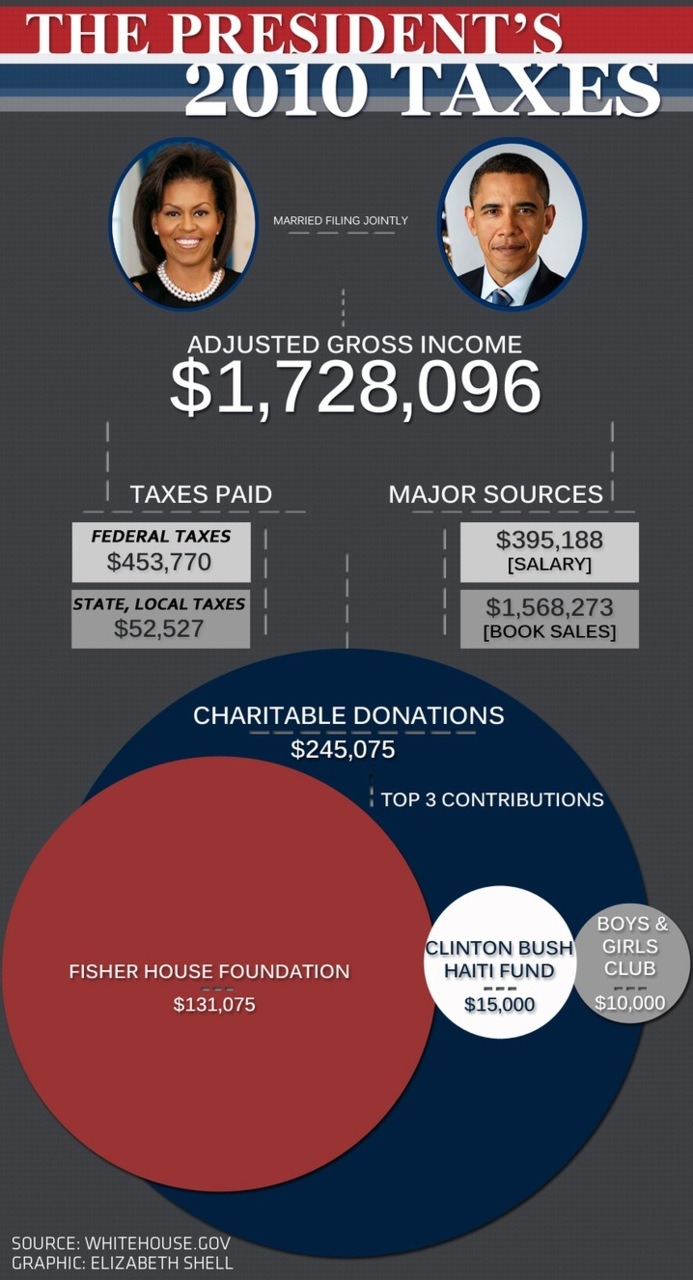
The First Family’s 2010 tax return was released today. Reporter/Producer Elizabeth Shell pulled out some of the more interesting numbers.

So President Obama paid $500,000 last year in taxes.  A question for those on the left:  How much should Obama have paid in order to pay his fair share?

By my quick, back of envelope math, his pre-deduction, assuming everything was regular income tax bill was ~$622,114; using current proposals to return to Clinton era rates, that number goes up to the blinding, economy destroying, and Western Civilization threatening number of ~$691,238.

Wow. I can really understand the ferocity of the opposition there. That’s almost $70,000 for a man making about $2 million. Just no way to make that up.

Is S&P Running Interference for the Right?

jasencomstock:

[…] Besides, Democrats could easily interpret (and should, vindictively) the warning from S&P as a call for higher taxation.

Precisely. S&P is commenting on the inability of said gubmint to actually do anything and most definitely not on the underlying capability of the United States economy to produce growth and/or sustain a marginally higher tax rate necessary to retire enough of the debt to keep the entirely mythical bond vigilantes at bay.

But, yeah, why does anyone alive care what S&P or Moody’s et al. says? Serious question. They may as well manufacture high quality buggy whips for all their relevance post-meltdown; there is no greater indictment of the lack of serious change to our financial system than this.

Is S&P Running Interference for the Right?

Confessions of a Climate Convert

Forget all the road to Damascus stuff in the piece, this is what I find important:

I’d argue that conservatives and libertarians should strongly support regulation to reduce carbon pollution, since pollution by one entity invariably infringes upon the rights of others (including property rights), and no entity has a constitutional right to pollute. It does not put America on the road to serfdom to suggest that the federal government has a compelling interest in protecting the country from ecological damage. If anything, it puts America on the road to common sense.

Exactly right. This is how Democrats should be messaging on this issue. It removes the ever-present and undeniable impulse in the MSM to punch the dirty fucking hippies whenever possible, the nigh irresistible impulse to note that it “snowed today,” and the much beloved “well, Al Gore sure is fat” gambit and frames the debate in terms even libertarians can understand.

Part Two of said strategy needs to incorporate the notion that even if we’re 100% wrong these measures will be good for the country and likely even of existential importance relative to our industrial and economic standing in the world. Getting off our oil addiction is, plain and simple, a good idea, no matter what you think the output carbon of our oil economy is doing. We’re going to be getting off of oil sooner or later, may as well start now and be the arbiter or at least one of the arbiters of the post-oil economy. Furthermore, if you want America “making things” again, the most likely and highest value target for said industry is in the post-oil transition. Not only can you sell such technology to the developed world, the whole of the developing world will be knocking at your door as well.
There is not enough reserve oil in American hands to measurably move the global market, even if we could extract it all tonight. There just isn’t. We wouldn’t even make an appreciable impact on our own rate of import were we to employ all of our oil; even that small but measurable impact would only last for a year or two. We may hold 1-2% of proven world reserves. Period. We cannot and will not ever produce our way off of foreign oil. It is simply not possible given current or projected usage. And, oh by the way, there isn’t enough global capacity either, though only the US military seems willing to admit it publicly.
The time to start dealing with both the implicit misconception (Drill baby drill!) and the overriding and much more important harsh reality is right now, not 20 years from now when our oil addiction and its impacts is both (still) utterly undeniable and but it is also too late to do anything about it.

Confessions of a Climate Convert

Birther Boogaloo: You Tell Me

Reality Check: Okay, now, what are the specific requirements in the [TN Ballot Access] bill?
TN State Senator Mae Beavers: That they have to have the long-form birth certificate.
RC: What is the long-form birth certificate?
Beavers: Now, you’re asking me to get into a lot of things that I haven’t really looked into yet.
RC: […] Are you aware that a lot of states now only give the short-form birth certificate?
Beavers: No, I only know about Tennessee, and I was born in Alabama. So I only know what I have seen.
RC: What if someone was not born in a hospital? It wouldn’t have an attending physician signature, so they wouldn’t be eligible to run in Tennessee if this bill passes. Is that correct?
Beavers: But they would have a birth certificate.
RC: Sure, but your bill doesn’t say birth certificate. It says “an original long-form birth certificate that includes date and place of birth, name of the hospital, the attending physician, and signatures of the witnesses.”
Beavers: And that’s normally what’s on a long-form birth certificate.
RC: It used to be, but as a matter of fact, the state of Hawaii, where President Obama was born, for people born since, I believe, around 2001, only gives the time of birth, the name of the parents, and the place of birth. Are you aware of the section of the Constitution called the full faith and credit clause? It’s in Article 4, Section 1.
Beavers: Yes.
RC: Well, do you know what it says about state documents?
Beavers: You tell me.
RC: It says that any state is required to accept the documents from another state. So that basically means that Tennessee has to accept a valid birth certificate from Hawaii or any other state.
Beavers: I have no knowledge of short-form birth certificates in Hawaii.
RC: […] Mitt Romney may not be eligible under this bill. Are you aware of that?
Beavers: No, I wasn’t.
RC: Well, George Romney, his father, was born in Mexico. Mexico confers citizenship by jus soli, which is place of birth. So he was born with dual citizenship, and it also passes down. Unless George Romney somehow gave up his Mexican citizenship, Mitt Romney has dual citizenship.
Beavers: Obviously you’ve studied this whole thing.