
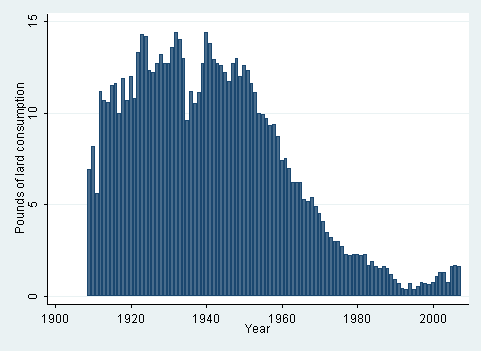
US Lard Consumption, 1907-2007
Or: things are looking up over to the Lard Board.

Jeff Zeleny runs down some of the bigger bullet-points coming out of the new book by the execrable Mark Halperin and “journalist” John Heilemann. Among them, this little tidbit:
In the days leading up to an interview with ABC News’ Charlie Gibson, aides were worried with Ms. Palin’s grasp of facts. She couldn’t explain why North and South Korea were separate nations and she did not know what the Federal Reserve did. She also said she believed Saddam Hussein attacked the United States on Sept. 11, 2001.
Of course, the real question here, the real fucking point: if you asked her today, could she tell you why North and South Korea are separate nations, what the Federal Reserve “does,” and, most importantly, who planned and executed the attacks on 9/11/01?
Her public comments since the election strongly imply that we already know. This sort of substantive information will not and will never come out in a media forever obsessed with the horse-races of the day. This will inevitably work towards Palin’s biggest asset: her “mish-mash of populism, everywomanism, and paranoia – coupled with a light touch on policy specifics – [that] has proven to be highly prescient in terms of everything that has come thereafter.”
Sad but true: ignorant ciphers like Palin and W. Bush are simply the odds on favorites for nationwide campaigns in this day and age. Anyone with an actual viewpoint, or that attempts to make a nuanced, non-rhyming statement, or dares wear a four-button suit, simply doesn’t have a chance. Not in that environment. Accept this information and begin planning (and messaging) accordingly. Or suffer the consequences.
This is the unusual case where a Dowd column actually provides some valuable insight, albeit inadvertently. Her desire for a Daddy in the White House who will tell her scary bedtime stories and then reassure her that Daddy will keep her safe seems to be widely shared; the Republicans’ vaunted edge on “national security” is mostly about the “security” in the phrase “security blanket.”
- Torture memos released
- No more waterboarding
- White house visitor logs released
- Iraq withdrawal in progress
- Mexico City policy reversed
- Certain arguments against DOMA rejected
- Money set aside for high-speed rail
- Environmental Protection Agency enforcement is up
- Restrictions on Legal Services Funds eased
- Being HIV+ no longer disqualifies people for a green card
- Net neutrality
- EPA to regulate carbon
- The HAMP program has helped a lot of people avoid foreclosure
- Review of mandatory minimum sentencing
- Credit card bill of rights created
- SCHIP eligibility expanded
- No permanent bases in Iraq
- Cuba restrictions eased
- Release of Presidential records expedited
- National Park funding increased
- Protections for gays and lesbians added to hate crimes law
- AmeriCorps funding increased
- EEOC funding restored to pre-Bush levels
- Ledbetter Act
- Unemployment insurance extended
- Stem cell restrictions eased
Etc.
I tell people that if it’s in the news, don’t worry about it. The very definition of “news” is “something that hardly ever happens.” It’s when something isn’t in the news, when it’s so common that it’s no longer news – car crashes, domestic violence – that you should start worrying.

NYT:
This month, at the Princeton Plasma Physics Laboratory, physicists and engineers built [model train] tracks inside one of its fusion reactors and ran a toy train on them for three days.
[…]
The modified model of a diesel train engine was carrying a small chunk of californium-252, a radioactive element that spews neutrons as it falls apart.
“We needed to refine the calibration technique to make sure we are measuring our neutrons as accurately as possible
Awesome.
Rachel Maddow touches on something critically important while discussing the GOP’s latest complaint: that Obama simply doesn’t use the word “terrorism” enough:
[Republicans are] lying in a way that can be obviously, demonstrably, embarrassingly proven by anyone who has a spare 45 seconds and the Google. When the people in the Republican Party who have the highest profile on national security say things that are easily, provably, flagrantly false, that’s a mistake. That makes it look like the party doesn’t know what it’s talking about a national security issues…. You guys, when you say President Obama doesn’t use the word terrorism, try to remember that when you say that, people are laughing at you.
That’s wonderful. Except that it’s easily, provably, and flagrantly false. First: The Conservative Media (and their beloved right-wing noise machine) still, still hews to the notion that the GOP is automatically and always the National Security Party. Cokie Roberts said so just the other day on that “liberal” bastion NPR. Everyone on-air agreed with her. Her comments and those of several others are what led to the creation of this handy guide. Second: The fundamental constituent for this sort of unsupported-by-facts nonsense is not someone who knows what “a Google” is, may think “the internet” is that Explorer shortcut on their desktop, and frequently worries that this time they’ve really missed their chance at riches from a mysterious Nigerian businessman who wanted to send all his money their way, just for a few days.
People are not laughing at the GOP, Rachel. You and I are. Unfortunately, we don’t really matter. The GOPers peddling this nonsense never had our vote to begin with. Low information voters, hell, no information voters are bathed daily in information- and context-free nonsense from Rush, FOXnews, Glenn Beck, talk radio, and 50 other sources. To them, these claims sound not only supportable but utterly reasonable and serious-minded. Google, if they even know what it is, doesn’t enter into the equation. Until Democrats internalize this and message accordingly, nothing will change. Until the media at large internalizes this and begins to challenge, immediately and on the spot, and embarrass into silence these asshats the instant this sort of statement emits from their fetid pie-hole, nothing will change.
This is what Karl Rove fundamentally understood: in the modern media environment, the truth doesn’t matter. The initial lie, no matter how quickly or decisively defenestrated it may be, is out there. And, just like Cokie’s Law states: if it’s “out there” we have to treat it as fact and discuss it. Repeatedly and without recourse to anything approaching helpful context. That’s what we call good, hard-nosed journalism.
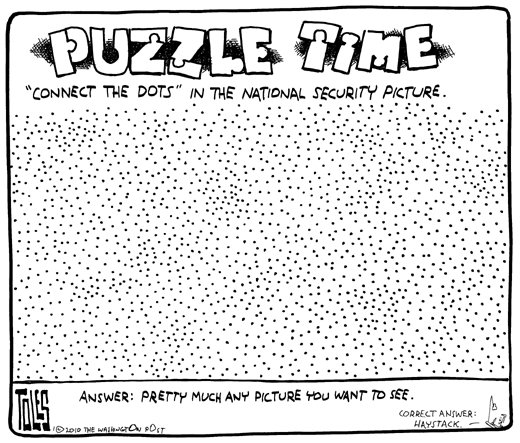

Nice, but I have a few questions right out of the boxee:
Michael Kinsley wants to cut down newspaper articles by removing “legacy code,” overlong or overly florid lines that, while checking some traditional journalistic content box, don’t actually advance the story or inform the reader. Fair enough. Felix Salmon more or less agrees, again going on mostly about story length, noting that the Atlantic still does long stories in print (so wonderful for the train!) and but has shorter, web-only content online (along with those dreaded longer stories “reprinted” from the physical magazine). He points out what he sees as the crux of difference via a newspaper example:
…newspaper conventions have been built for physical newspapers, and can look silly in the age of the web — especially when the stories themselves appear, pretty much unchanged, on newspapers’ websites. It might make sense for the physical LA Times to run one big story about Afghanistan, but once that decision is made, no one is going to chop that one big story into three smaller ones for the website.
Right off the bat, he implicitly accepts an assumption that the web version needs to be shorter. If anything, the online edition should be longer, with a note in the physical version to go online for more depth about this or that tribal issue, interactive maps, whatever. That way, when you’re reading the Times on your 2025 model iTablet, everything is suddenly knit together in a way that allows you to expand or contract the amount of information you’re taking in based on your wants/needs of the moment.
I’m not exactly sure why this concept is so hard to understand: In the electronic era, there is no a priori limitation to the relative length or brevity of a story. It need not be artificially and randomly cut to 250 words to squeeze into a particular newshole or avoid a page-jump (think: USAToday), nor stretched to 15,000 words to buff up its apparent “importance.” Stories should be exactly as long as they need to be. I agree with Kinsley that all false equivalencies and labored prose that largely represents today’s idea of journalism needs to go, and soon. This means that if you can cover an important (but expected) House vote in 75 words by excising the fat, then by all means: do so. If providing useful, analytical context demands you go to 400,000 words on the same subject: then do so. THIS IS WHAT YOU ARE SELLING NOW. Editorial opinions (e.g. what is news?) are your only asset. Everyone working in media today should be entirely focused on maximizing the electronic product. Period. Forget about page impressions. Forget about the physical product (e.g. the monthly Atlantic or the daily NYT) and focus on making the best stories you can, whatever their length. Then repackage the very most important of those from your website (that naturally updates whenever it needs to, not on some arbitrary, print-based schedule) and you move it from there into the necessarily very scheduled, physical box that you still put out as best you can (hey, what do you know, that’s where your only physical constraints relative to length and layout are).
That neither Kinsley nor Salmon, both at one level or another tasked with rethinking how journalism works in the internet era mention this at all, and furthermore go so far as to make a case for ever more arbitrary cutting is, shall we say, depressing. That all of legacy media seems to be responding to this by utterly decerebrating their writing, then chopping it up into arbitrary “next page” chunks (even when the story is less than 50 words long), and then festooning the whole package with great gloopy wads of aggressively intrusive advertising that would make Vegas blush is, shall we say, demoralizing.

