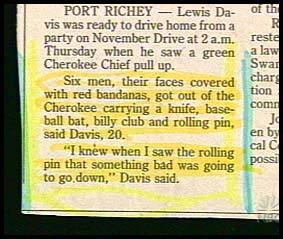
So why have you (unless you’re a massive news junkie) never have heard of [any of this]? Because for all the right’s whining about the liberal media, the mainstream media aren’t ideologically committed to party warfare in remotely the way that the conservative media are.

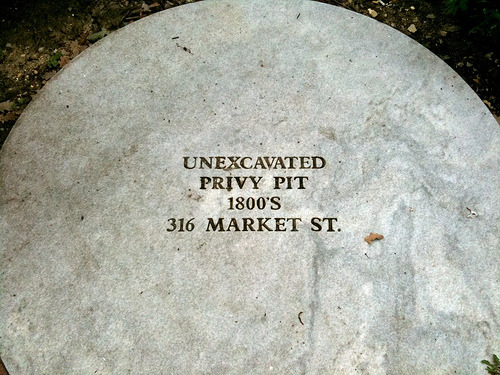
How do we know, Merlin. How. Do. We. Know?!? Why is the government afraid of what it will find in the pit? Not sure, but probably something to do with socialism. Certainly smells like that to me.

In Snow Leopard (OS X 10.6+), if you need to open a hidden file, all you need to do is type Cmd-Shift-. (that’s a period) in the standard Open File dialog. All hidden files will be displayed.
This is a toggle, so typing the shortcut a second time will hide the hidden files again.
Holy crap is that useful information.
The Flashpoint
“[Obama said] ‘everyone should get the same deal as members of Congress.’ But you take the text of these bills, and not only are you not getting the same deal as members of Congress, who get a dozen or more choices in the D.C. area, but people aren’t going to get any choice at all. It’ll be tethered to a policy that many people might think is pretty crummy. Some of those policies will be high-deductible, going up 10 or 12 percent a year. And people are going to think that’s pretty crummy.
[…]
As for the people who don’t have coverage and are making $65,000, those people look at Washington and see us saying you’ll have to pay 13 percent of your income, and then we’re going to clobber you with all these co-pays and deductibles, and some government official comes and says, ‘We’ll give you an exemption’? No middle-class people will be attending rallies holding signs saying “thank you for my exemption!”
— Ron Wyden, speaking the Truth from on high, via Ezra Klein
Miller Time
If you’re in New England, you’d be well advised to go ahead and say your goodbyes to Buzzards Bay:
WESTPORT – Buzzards Bay Brewing will discontinue production of its eponymous microbrews.
“We’ve had a good run ” owner Bill Russell said, “but we have decided to head in a different direction.”
The surprise announcement Wednesday was influenced by a number of factors, Russell said, primarily a drop in demand. Sales had declined from a high of 5,000 barrels of Buzzards Bay brews in 2002 to a projected sale of around 100 barrels in the next seven months, Russell said.
That’s a hell of a drop in production. Where did it all go? Apparently right into the gaping maw that has swallowed many otherwise successful (but ultimately very small and by definition fragile) regional breweries:
“Our best years were when we distributed it ourself,” he said. “It’s hard to compete with national brands, representing huge corporate interests, that muscle their way into the marketplace.”
The big distributors could give a shit about anything that’s not called Bud/MillerCoors. And, let’s face it, nowadays almost all distributors are “big” (for a good rundown of the near-monopolistic situation, read this). If your beer doesn’t sell itself in business-sustaining volumes (complete with customers screaming for it at every store and bar if and when that tap or rack space goes away because your distributor had some big-assed Bud installations to do that week), you’d better self distribute or you will go out of business. Full stop.
Low volume, regional breweries like this depend on fanatical attention to every detail all the way from the grain to the tap handle. And, to you small regional brewers out there: If you are not on tap with at least one beer at every bar worth entering that’s located within 20 miles of your home brewery, change distributors or self-distribute. You are going to go out of business otherwise. It may already be too late. Seriously. Don’t kid yourself that breweries with good beers won’t fail. They do all the time. Even once mighty Celis was laid low on the altar of “better” distribution, and they had absolutely rabid, Smokey and the Bandit level fans.
But what about this so-called “different direction”; isn’t that just a pleasant euphemism for “closing the brewery”? Turns out it’s not:
“We are now producing a new product line called Just Beer that we can distribute ourselves locally,” he said. The new brands include John Beere, Moby D. and CIA (which the company Web site describes as “mysteriously smooth.”)
Ummm, okay. That sounds like a real winner. Something to base your future on. Nothing more profitable out there than gimmick beers and/or beers that try to out-Bud Budweiser. Newsflash: you will not be succesfull at trying to convert Bud drinkers to your Bud-alike. You cannot compete on price, and there is no bandwidth there to compete on taste. You think your quality is going to be better than a brewery producing a substantially identical yet biologically-derived product to the tune of millions of barrels at twelve very different locations? Why does anyone go after the American Premium Lager space? Even in a brewpub setting it makes no sense at all (time consuming and therefore costly with extremely marginal chance for success in terms of winning a steady and, by definition, choosy customer-base for craft beer).
Fortunately, it turns out they also contract brew for Cisco and Pretty Things, two fine product lines (we’ll forget for the moment some rather, uh, troubling bottles of Cisco I’ve encountered on various occasions and bask in the glory that is Indie IPA). But then comes this:
New ventures are also waiting, he said, including a partnership with an Irish brewer called Strangford Lough to produce and distribute some of their labels in the United States, one of which will be called St. Patrick’s Best.
“It’s very exciting for me since it’s part of my heritage,” he said. “They will ship us the syrup in 300-gallon boxes. It comes in a bladder inside the box. We will reconstitute it and ferment it here. It’s produced in County Down with Irish grain and hops, so it will have that unique taste and we will distribute it here.”
Indeed, reconstituted syrup will have a “unique” taste. Unique to Malt Liquor, that is… But with a name like “St. Patrick’s Best” I guess one should expect to wake up in the gutter (empty 40 nearby, natch) with what seems to be a tomahawk lodged in the front of one’s skull. Part of the heritage.

Voight-Kampff (finally) Arrives
The Boston Globe heralds the arrival of the newest in new Terrrist detection services, the picture of which strikes me as slightly…familiar:
The article suggests some (clearly) half-assed potential questions for said interrogations. Might I humbly suggest these more patriotic replacements:
It’s your birthday. Someone gives you a calfskin wallet. How do you react?
You’ve got a little boy. He shows you his butterfly collection plus the killing jar. What do you do?
You’re watching television. Suddenly you realize there’s a wasp crawling on your arm… [wait for first response]
You’re in a desert walking along in the sand when all of the sudden you look down, and you see a tortoise; it’s crawling toward you. You reach down, you flip the tortoise over on its back. The tortoise lays on its back, its belly baking in the hot sun, beating its legs trying to turn itself over, but it can’t, not without your help. But you’re not helping. Why is that?
When necessary, this phrase can be interjected:
They’re just questions, (Name). In answer to your query, they’re written down for me. It’s a test, designed to provoke an emotional response. Shall we continue? Describe in single words, only the good things that come into your mind. About your mother.
Is the Earth flat or spherical? Opinions differ.

Clearly extracted from just below a Polytron ad in 342B…
iThink therefore iAm
Kottke talks about the iPhone (as a device-class, mind you, not specifically the device) impacting many, many more markets than just smart-phones or PDAs. It’s also a compact camera killer, to name only one segment touched on in his fine essay. And I think he’s basically right. But I want to talk about a point he makes in the second footnote (without going all DFW on you):
You’ve got to wonder when Apple is going to change the name of the iPhone. The phone part of the device increasingly seems like an afterthought, not the main attraction. The main benefit of the device is that it does everything. How do you choose a name for the device that has everything? Hell if I know. But as far as the timing goes, I’d guess that the name change will happen with next year’s introduction of the new model. The current progression of names – iPhone, iPhone 3G, iPhone 3GS – has nowhere else to go (iPhone 3GS Plus isn’t Apple’s style).
Gruber picks up on this point too, basically answering him directly with:
If this platform is here for the long run, the general purpose name that best works for a general purpose device is already here: iPod. In fact, iPod, semantically, is a better name for the iPod Touch than it ever was for the original focused-on-music models. As I see it, the phone in iPhone isn’t about telephony, but about the necessary contract with a mobile carrier.
Agreed. Lemkin was all over this subject back in 2007 (!), talking about Steve Jobs’ almost certain desire to skip 3G (and any other carrier-tied technology) entirely in favor of some form of ever-present WiFi that could come from any company, municipal co-op, or whatever. This, of course, is the ultimate existential threat to AT&T: if they become (as a company) nothing more than a provider of the dumb pipe, then you can substitute any old dumb pipe for them without noticing any change at all. This is why they’re fighting Google tooth and nail over Google Voice, though hiding behind Apple to do it (presumably, the relevant lawyers (correctly) predicted a prompt FCC smackdown should AT&T intervene directly). But they will lose this fight over the long term. Google has already seen to it via the bidding process on the wireless spectrum. How well did AT&T like that?
“Google is demanding the government stack the deck in its favor, limit competing bids, and effectively force wireless carriers to alter their business models to Google’s liking.”
By “alter their business models” he meant to say: “stop relentlessly fucking over the end-user through long, inflexible contracts on POS phones of AT&T’s choosing.” Oh, GenericNetCo has really cheap wireless internet this month. I’ll switch. So it’s fundamental to AT&T that they seemlessly transition you from the locked, carrier specific technology (basically today’s situation) to the quietly generic wireless technology (aka Dumb Pipes) they’re hoping you don’t even notice you can actually get from anyone and everyone that cares to provide said service.
What will be their value-add in this situation? Unclear. Presumably they intend it to be nationwide reach, reliability, convenience, and some kind of competitive pricing for same. That said, and somewhat obviously, if AT&T were dependent on consumer goodwill and raw network reach, reliability, and convenience as of today, they’d be out of business inside of a fortnight. They seem busier blaming their iPhone users for their network’s various problems than, you know, improving the service that they are contractually obligated to provide in some fashion or other. And that’s within a market and on a network whose design they’ve had decades to cultivate, tune, and understand (though with an outcome that clearly implies that they still don’t “understand” what it is these iPhone users expect from their device, and how that’s different from, say, the user of a more generically crippled feature-phone). So can they build out a nationwide, everpresent, high-speed, and five-9s reliable WiFi service that’s compelling enough to keep people around once access to the underlying technology no longer requires multi-year contracts? Without recourse to tethering them to a number or some other lock-in? I seriously doubt it.
But, yeah. It will be called the iPod. Within a handful of years, the core iPod platform will be entirely Touch-based, and thus simply morph back into iPod (with Nanos or Shuffles being the variant, but today’s Touch being The iPod). And you’ll use said device to make calls.
Untitled from Ars Technica on Vimeo.
Say goodbye to the iPod Touch: Microsoft’s Zune HD is simply better in every way. Want to play chess? We think you’ll enjoy this 30-second full video commercial before that application opens. Whoops, email arrived? We think you’ll enjoy another commercial while you switch to that view and another one when you’re ready to switch back. It’s what we think today’s demanding consumer wants, no, demands.
How can Apple hope to compete against this sort of usability? It’s unpossible.