Most Republican voters believe, with good reason, that Romney stands a strong chance of winning the nomination and beating President Obama. The question is whether he would put repeal front and center—whether he would emphasize it in the general election campaign, and whether he would go to the mat for repeal once in office. Would Romney’s campaign build enough momentum for repeal to achieve 60 votes in the Senate and defeat a potential filibuster? If not, would Romney be willing to advance repeal in the Senate via reconciliation, the complicated and unconventional process that takes only 50 votes but which would also require a far greater expenditure of political capital?

Jeffery H. Anderson makes me wonder if he’s even been paying attention. If we assume that the posited chain of events occurs: GOP holds some kind of House majority and gains a new but non-60 vote majority in the Senate (and, of course, President Mittmentum) then it doesn’t take a rocket scientist to derive the complex psychohistorical formulas for what happens next?!?!?
The GOP eliminates (by simple majority) the filibuster on the first day of the new Congress. The MSM declares this an entirely reasonable, “sensible center” approach to governing. Wholesale dismantlement of the New Deal follows, coupled to and justified by the oncoming tax revenue collapse from a 0% effective tax rate on the rich and consumption-based, maximally regressive tax on everyone else.
It’s what they’ve been talking about for years. They are entirely serious. They mean to do it at the first opportunity, and this would be it. There will be no fiddling with reconciliation or anything approaching “normal order” as we define it in 2011. How many times do they have to say this stuff before someone in the MSM takes them seriously and asks a follow-up or two? Or, for that matter, before The Democrat starts using these positions against them. (Shrill! Class War!!).
The far-right GOP candidates and elected officials are not “blowing smoke” or “providing red meat” for the “true believers.” This is who they are. Everyone else can kindly go die in the streets.
What’s going on here? The answer, surely, is that Wall Street’s Masters of the Universe realize, deep down, how morally indefensible their position is. They’re not John Galt; they’re not even Steve Jobs. They’re people who got rich by peddling complex financial schemes that, far from delivering clear benefits to the American people, helped push us into a crisis whose aftereffects continue to blight the lives of tens of millions of their fellow citizens.

Yet they have paid no price. Their institutions were bailed out by taxpayers, with few strings attached. They continue to benefit from explicit and implicit federal guarantees — basically, they’re still in a game of heads they win, tails taxpayers lose. And they benefit from tax loopholes that in many cases have people with multimillion-dollar incomes paying lower rates than middle-class families.

This special treatment can’t bear close scrutiny — and therefore, as they see it, there must be no close scrutiny. Anyone who points out the obvious, no matter how calmly and moderately, must be demonized and driven from the stage.

Paul Krugman, hosting another edition of Krugman Explains it All in 200 Words or Less. Shrill.

Fox wants to cut our salaries in half because it says it can’t afford to continue making [The Simpsons] under what it calls the existing business model. Fox hasn’t explained what kind of new business model it has formulated to keep the show on the air, but clearly the less money they have to pay us in salary, the more they’re able to afford to continue broadcasting the show. And to this I say, fine — if pay cuts are what it will take to keep the show on the air, then cut my pay. In fact, to make it as easy as possible for Fox to keep new episodes of “The Simpsons” coming, I’m willing to let them cut my salary not just 45% but more than 70% — down to half of what they said they would be willing to pay us. All I would ask in return is that I be allowed a small share of the eventual profits.

My representatives broached this idea to Fox yesterday, asking the network how low a salary number I would have to accept to make a profit participation feasible. My representatives were told there was no such number. There were, the Fox people said, simply no circumstances under which the network would consider allowing me or any of the actors to share in the show’s success.

Harry Shearer makes a fantastic point in his statement about the ongoing negotiations around the 24th (sigh) season of The Simpsons.
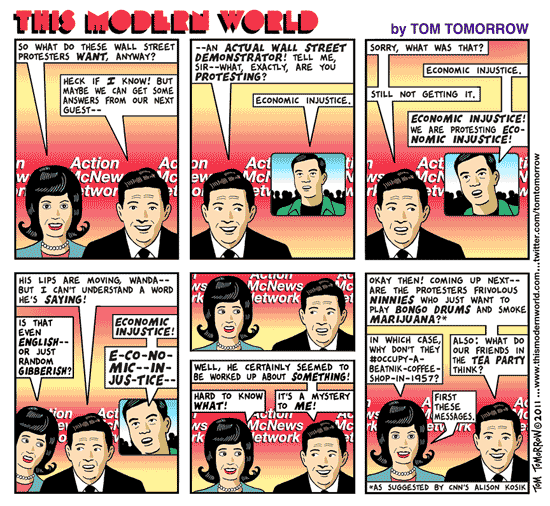
I post this because it fairly precisely captures one of the core issues that’s grown quite pervasive in the country at the moment and is a key fact of current US society that the MSM categorically refuses to admit about the dirty fucking hippies, er, Occupy Wall Street folks.
The voice talent on this show self-admittedly make good money under the current contract terms; however, it’s a fraction of what the folks “upstairs” make off the back end of the show, a back end to which they, the folks upstairs, have contributed nothing (or at most: vanishingly little).
Faced with an entirely reasonable request that would a) keep the gravy train going –and– b) dramatically cut current salaries in exchange for a vanishingly small sliver of the real profits of the enterprise, they respond: “Nooo, I’d still prefer not.”
I guess it’s very hard to hear anyone when you’re wearing a jacuzzi suit

I didn’t go to Harvard. You know, I went to the school of hard knocks.

Scott Brown, describing his time in the urban hellscape that is the Medford campus of Tufts University. Later in life, he took on the mean streets of Boston College Law School. Chestnut Hill is about to get real.
Also worth noting that Harvard tuition is ~$39,849. Tufts: $42,962. Warren’s actual alma mater, University of Houston? That would set you back $9,211.

No one wants to die. Even people who want to go to heaven don’t want to die to get there. And yet death is the destination we all share. No one has ever escaped it. And that is as it should be, because Death is very likely the single best invention of Life. It is Life’s change agent. It clears out the old to make way for the new. Right now the new is you, but someday not too long from now, you will gradually become the old and be cleared away. Sorry to be so dramatic, but it is quite true.

Your time is limited, so don’t waste it living someone else’s life. Don’t be trapped by dogma — which is living with the results of other people’s thinking. Don’t let the noise of others’ opinions drown out your own inner voice. And most important, have the courage to follow your heart and intuition. They somehow already know what you truly want to become. Everything else is secondary.

Steve Jobs

Rick Perry’s candidacy is stuck up to its wheel-wells because he once did something decent for people unlike himself and, when challenged about it, on stage, by the rest of lightweights in his party, he told the truth. If you’re attempting to get the Republican party’s nomination for president of the United States in 2012 — or any time in the future, judging by the Triple-A Ostrogoths currently populating the country’s state legislatures — and if there is anything in your background that indicates that you were once decent to people unlike yourself, you should identify that problem immediately and then lie your ass off for the balance of your presidential campaign.

By the way, have you met Republican frontrunner Mitt Romney?

Charles Pierce, getting it exactly right at his still newish blogging perch.

Recall that it’s A.D. 2027 and that there’s been a nuclear holocaust in 1997 and that chip-driven machines now rule, and “Skynet,” the archonic diabolus ex machina, develops a limited kind of time-travel technology and dispatches the now classically cyborgian A. Schwarzenegger back to 1984’s Los Angeles to find and terminate one Sarah Connor, the mother-to-be of the future leader of the human “Resistance,” one John Connor [3]; and that apparently the Resistance itself somehow gets one-time-only access to Skynet’s time-travel technology and sends back to the same space-time coordinates a Resistance officer, the ever-sweaty but extremely tough and resourceful Kyle Reese, to try desperately to protect Ms. Sarah Connor from the Terminator’s prophylactic advances [4], and so on.

David Foster Wallace turns in the most complex single sentence that ever was or ever will be written about the film Terminator.

King of Content

Predictably thoughtful take from John Gruber on the broader tablet strategy that Amazon is taking up in light of the new Kindle/Kindle Fire product line. You should read the whole thing, but a couple of points really stand out. First:

Apple’s primary business is selling devices for a healthy profit, and they back that up with a side business of selling digital content for those devices. Amazon’s primary business is as a retailer, including as a retailer of digital content. They back that up with a side business of low-cost digital devices that are optimized for on-the-fly purchasing of anything and everything Amazon sells.

This is exactly right. I’d extend the idea all the way out to its limit: Amazon should buy Qwikster from Netflix.
While this move would, to Netflix, be akin to selling Babe Ruth to your direct competitor for a few grand and a bag of balls, what other company out there understands shipping better than Amazon, has a built-in pipe for selling overstocked used discs of yesterday’s blockbuster movie, could seamlessly merge the “this isn’t available to stream, shall we ship it to you right now” experience, and, most importantly, has the leverage with the content owners to actually, you know, offer a lot of content from their streaming service? Clearly the answer ain’t Netflix. It’s Amazon, who can go to content-owners and say: “Do you really want Apple to dominate your pipeline to the consumer? We have the customers, data about those customers, and the access to them. Use us a leverage against Apple and we’ll give you a marginally richer cut in exchange.” Even in an era of increasing disintermediation, the Apple model shows quite strongly that if you pile up enough content that people want, it’s ultimately easier to sell from those fewer, larger silos. Nobody wants to search ten sites to figure out which has Transformers 18: This Time It’s Personal available to stream this week only to have said stream expire mid-movie because you had to pause it at an inopportune moment. In that model, T18:TTIP pirated torrents become king. And yet this is fairly precisely the situation we consumers and our content-overlords increasingly find ourselves in. The future is most definitely not 35 separate “Apps for that,” each of which has to be painstakingly consulted on movie night. There’s room for two, maybe three, giant content aggregators. As of today, I’d say one of them is pretty obviously Apple. The other sure seems likely to be Amazon; even more likely once they’ve sold a few million Kindle Fires. Hell, since Netflix likely won’t sell a direct competitor the keys to Quikster, Bezos should just buy both Quikster and Netflix, re-brand the sexily named “Amazon Instant Video” service Netflix and milk the Quikster “physical media” approach for as long as it makes sense to do so (as part of a broader package ultimately tied to Amazon Prime membership…which, of course, is mostly a deal-sweetening mechanism designed to drive unrelated sales for Amazon as a whole). As always: fewer choices for the consumer means more money for the provider; you draw them in with the enticing product or service, then completely empty their pockets on all the other stuff they hadn’t previously even thought of buying. It’s precisely Apple’s strategy, but attacked from the perspective of the content instead of the device.

Interesting point two:

Amazon is a data-driven company. I’ll bet the $40 premium [for a Kindle that never serves you “offers”] is based on how much money they expect to make from the ads they sell and products they promote via the special offers. Last year the special offer Kindle was only $25 less; the data must show that the special offers are worth more than $25 per Kindle to Amazon.

Taken together with the previous point, it’s clear that there’s potentially much, much more value in that premium. With Silk, Amazon will quickly have a huge dataset covering the browsing habits of their users. They already have a huge dataset on the buying habits of those users. In the user’s hand at the moment of the “offer” is a device purpose-built to grease the skids of said content purchase; just as easy to grease the skids for any kind of purchase once you know what the user wants or is looking for outside of the “content” world. And Amazon just so happens to sell that stuff, and will drop it on your doorstep quicker than seems possible with your annual Prime membership…which, oh yeah, you need because of all the content! Worth something to Amazon to be sure, but worth even more to the content owners and other potential advertisers who will presumably pay handsomely to get targeted sales…and Amazon will be able to show them exactly how well the campaign worked.
It’s simply not possible to do ad-word jiggery-pokery when an actual purchase (as opposed to a view) is the outcome metric. So I’d say it’s crystal clear that it’s in Amazon’s interest to gradually raise the heat on “offer-free” Kindles until, at some point Kindle purchases more closely resemble contract and contract-free purchases of mobile phones. That, I suppose, is when the ads start to intrude on the reading. But that’s a whole other post.

King of Content

It is as if the 2004 Democratic presidential nomination was about to fall into the hands of Paul Wolfowitz. What happened?

Jonathan Chait contemplates the seemingly quite favorable strategic position Mitt Romney (suddenly?) finds himself in despite being an occasionally outspoken pro-choice Mormon tightly associated with Taxachusetts and “Romneycare” and yet working to curry favor from an increasingly lunatic “base” that seems quite willing to start Civil War II over any and all of those issues.

Most important MSM/Serious Person fact about Romney: he once strapped a dog, inside its carrier, to the top of the family truckster. So you know.