
Song for the day.
Tag: ACA
In Plain English: The Affordable Care Act, including its individual mandate that virtually all Americans buy health insurance, is constitutional. There were not five votes to uphold it on the ground that Congress could use its power to regulate commerce between the states to require everyone to buy health insurance. However, five Justices agreed that the penalty that someone must pay if he refuses to buy insurance is a kind of tax that Congress can impose using its taxing power. That is all that matters. Because the mandate survives, the Court did not need to decide what other parts of the statute were constitutional, except for a provision that required states to comply with new eligibility requirements for Medicaid or risk losing their funding. On that question, the Court held that the provision is constitutional as long as states would only lose new funds if they didn’t comply with the new requirements, rather than all of their funding.
Amy Howe, SCOTUSblog.
Again with the Middle Class
It’s almost as if our media aristocracy of inbred Serious People have a vested interest in seeing to it that the middle class, and only the middle class, gets soaked in any economic “compromise.” Amidst reacting to a particularly poor NYT Magazine piece, Dean Baker nails it:
…the piece too quickly dismisses the possibility of getting substantial additional tax revenue from the wealthy. It presents the income share for those earning more than $1 million as $700 billion, saying that if we increase the tax rate on this group by 10 percentage points (from roughly 30 percent to 40 percent), then this yields just $70 billion a year.
However, if we lower our bar slightly and look to the top 1 percent of households, with adjusted gross incomes of more than $400,000, and update the data to 2012 (from 2009), then we get adjusted gross income for this group of more than $1.4 trillion. Increasing the tax take on this group by 10 percentage points nets us $140 billion a year. If the income of the top 1 percent keeps pace with the projected growth of the economy over the decade, this scenario would get us more than $1.7 trillion over the course of the decade, before counting interest savings. Of course there would be some supply response, so we would collect less revenue than these straight line calculations imply, but it is possible to get a very long way towards whatever budget target we have by increasing taxes on the wealthy.
Shocking. And but also, Baker smartly includes the most important issue in any truly serious discussion of American economics and the proper balance of same: the cost of health care:
We pay twice as much per person as people do in other wealthy countries. Since more than half of the tab for our health care is paid by the government, our broken health care system becomes a budget problem. If we paid the same amount per person for our health care as people in other wealthy countries, we would be looking at long-term budget surpluses rather than deficits. The reason that we pay so much more is not that we get better outcomes – we don’t generally. Rather it is that we pay too much to drug companies, hospitals, medical specialists, and others in the health care industry.
Baker’s being generous. We spend as much as five times more per capita than the best performing countries do, all of which achieve uniformly better outcomes than we do. Obviously, the only possible answer here is just get Big Guvmint out of the way so the poor can kindly go die in the streets. It’s the only serious answer to the problem. Well, that and lowering taxes on the wealthiest 1% of the country.
Read the whole thing.
Most Republican voters believe, with good reason, that Romney stands a strong chance of winning the nomination and beating President Obama. The question is whether he would put repeal front and center—whether he would emphasize it in the general election campaign, and whether he would go to the mat for repeal once in office. Would Romney’s campaign build enough momentum for repeal to achieve 60 votes in the Senate and defeat a potential filibuster? If not, would Romney be willing to advance repeal in the Senate via reconciliation, the complicated and unconventional process that takes only 50 votes but which would also require a far greater expenditure of political capital?
Jeffery H. Anderson makes me wonder if he’s even been paying attention. If we assume that the posited chain of events occurs: GOP holds some kind of House majority and gains a new but non-60 vote majority in the Senate (and, of course, President Mittmentum) then it doesn’t take a rocket scientist to derive the complex psychohistorical formulas for what happens next?!?!?
The GOP eliminates (by simple majority) the filibuster on the first day of the new Congress. The MSM declares this an entirely reasonable, “sensible center” approach to governing. Wholesale dismantlement of the New Deal follows, coupled to and justified by the oncoming tax revenue collapse from a 0% effective tax rate on the rich and consumption-based, maximally regressive tax on everyone else.
It’s what they’ve been talking about for years. They are entirely serious. They mean to do it at the first opportunity, and this would be it. There will be no fiddling with reconciliation or anything approaching “normal order” as we define it in 2011. How many times do they have to say this stuff before someone in the MSM takes them seriously and asks a follow-up or two? Or, for that matter, before The Democrat starts using these positions against them. (Shrill! Class War!!).
The far-right GOP candidates and elected officials are not “blowing smoke” or “providing red meat” for the “true believers.” This is who they are. Everyone else can kindly go die in the streets.
The GOP eliminates (by simple majority) the filibuster on the first day of the new Congress. The MSM declares this an entirely reasonable, “sensible center” approach to governing. Wholesale dismantlement of the New Deal follows, coupled to and justified by the oncoming tax revenue collapse from a 0% effective tax rate on the rich and consumption-based, maximally regressive tax on everyone else.
It’s what they’ve been talking about for years. They are entirely serious. They mean to do it at the first opportunity, and this would be it. There will be no fiddling with reconciliation or anything approaching “normal order” as we define it in 2011. How many times do they have to say this stuff before someone in the MSM takes them seriously and asks a follow-up or two? Or, for that matter, before The Democrat starts using these positions against them. (Shrill! Class War!!).
The far-right GOP candidates and elected officials are not “blowing smoke” or “providing red meat” for the “true believers.” This is who they are. Everyone else can kindly go die in the streets.
Robert Reich: Why the New Healthcare Law Should Have Been Based on Medicare (And What Democrats Should Have Learned By Now)
So what do Obama and the Democrats do if the individual mandate in the new health care law gets struck down by the Supreme Court?
Immediately propose what they should have proposed right from the start — universal health care based on Medicare for all, financed by payroll taxes. The public will be behind them, as will the courts.
This is utterly wrong on all counts. It utterly and willfully ignores the year of political sausage making that only managed to barely result in a marginally workable plan that squeaked by under reconciliation rules. The law enacting Reich’s paragraph couldn’t have passed a majority of Democrats at the time, and you’ll recall there were commanding majorities in both houses of Congress then. Aren’t now. And this wouldn’t even see the floor, no matter how passionately Obama or Bernie Sanders or Nancy Pelosi or Jesus Christ Himself argued for it.
What, then, needs to happen if the mandate section of the ACA is struck down? The death spiral needs to happen is what. The ACA without a mandate will destroy the private insurance companies within a decade. But,long before that happens, when the moment arrives that the mega-rich can no longer afford premiums, the party in power on that day, whichever that may be, will be forced to enact Medicare for all. Immediately. Not because they want to, but because it will be the only way forward. And that is the one and only way it ever gets passed. Not through rousing speeches or acting tough or with anything less than a 70-80 seat majority in the Senate and a few hundred in the House coupled to a far more progressive Democratic President than is currently serving.
And until the moment that we as citizens, they the politicians, they the DCCC (and like groups that run the party, its messaging, goals, and determine its candidates), and especially they in the form of the broader media internalize this and begin to act on it accordingly, we and they will fail. Period.
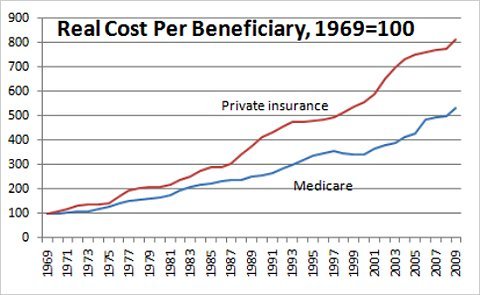
How to square the circle: Assuming Medicare for all tomorrow and that you can find a way to return the dollars in-between the red and blue lines to the people paying it: the American worker with employee provided health insurance. Right now, that’s all invisible income, spirited away into the employer-shared costs of providing coverage. It’s the underlying reason that real wages have been stagnant for most of my lifetime. Turn that into real wages and the broader economy would explode. There would suddenly spring into existence a middle class with (gasp) actual purchasing power. Who knew?!?
Naturally, the plutocrats would, at least initially, turn that space into more profits for themselves. Sooner or later, though, it seems likely that constraints on quality workers would gradually bring the money over into regular salary as companies competed to find highly trained folks. You’d still have to solve the manufacturing issue and/or something to do with all that idle but essentially untrained labor force out there…but it would be a start.
At any rate, a few more than the 17 Americans vaguely cognizant of this cost gap need to be made painfully and continually aware of it. Every day, every hour, every time a microphone is switched on with a Democrat behind it. Complete with this graph. That Medicare, far from being “expensive,” saves money in dramatic fashion. And that, since they, the average hardworking healthcare consumer, cannot buy into that massive bargaining pool or something very much like it, they are being robbed. Every. Single. Day. With malice aforethought. And that they have precisely one party, the GOP, and Joe Lieberman to thank for it.
But that would be shrill. And Weiner lied to his fellow Democrat. That’s what’s important here.
The hard truth about health care
Everyone knows — or should know — that the United States spends much more than any other country on health care. But the Kaiser Family Foundation broke that spending down into two parts: the government’s share and the private sector’s share (both measured as a percentage of total gross domestic product), then compared the results to figures from 12 other countries that are members of the Organisation for Economic Co-operation and Development. And here’s the shocker: Our government spends more on health care than the governments of Japan, Australia, Norway, the United Kingdom, Spain, Italy, Canada or Switzerland.
Think about that for a minute. Canada has a single-payer health-care system. The government is the only insurer of any note. The United Kingdom has a socialized system, in which the government is not only the sole insurer of note but also employs most of the doctors and nurses and runs most of the hospitals. And yet, measured as a share of the economy, our government health-care system is the largest of the bunch.
And it’s worse than that: Atop our giant government health-care sector, we have an even more giant private health-care sector. Altogether, we’re spending about 16 percent of the GDP on health care. No other country even tops 12 percent. Which means we’ve got the worst of both worlds: huge government and high costs.
It’s also important to note that, even with this high spending, we’re getting worse outcomes than all the Western countries spending 5-7x less than we do. And, of course, if we had the costs of any of these countries we’d be facing surpluses today instead of deficits. But we’re told the only road forward for our country is to slash Medicare, Medicaid, and the rest of the social safety net and give the money to the richest 1%. Saying anything else isn’t Serious.
…these are the basic points liberals should be arguing:
• These vouchers would be grossly inadequate.
• For that reason, most seniors wouldn’t be able to afford adequate coverage.
• Medicare as it exists today is indeed sustainable.If you find yourself arguing about something else, you may already have lost.
Bob Somerby, speaking the truth. Keep it simple and to the point. Pizza, the Marine Corps, and their relative similarities or interchange rates need not enter into it and our arguments tend to be weakened or just diffused by the presence of these things.
The Democrats have a uniquely potent message to offer here, one that polls almost uniformly in their favor; as a result, constantly going off to fight ultimately pointless side-battles is precisely what the GOP would love to have happen. It muddies an otherwise crystal clear dichotomy. The GOP wants to end Medicare as we know it. The Democrats do not. This is because Medicare, even as currently figured, is sustainable. Long term fixes and cost (and rate of cost-growth) containment through mechanisms installed in the ACA? Of course. Wholesale gutting that leaves only the name in place: not necessary. Period.
The Democrats have a uniquely potent message to offer here, one that polls almost uniformly in their favor; as a result, constantly going off to fight ultimately pointless side-battles is precisely what the GOP would love to have happen. It muddies an otherwise crystal clear dichotomy. The GOP wants to end Medicare as we know it. The Democrats do not. This is because Medicare, even as currently figured, is sustainable. Long term fixes and cost (and rate of cost-growth) containment through mechanisms installed in the ACA? Of course. Wholesale gutting that leaves only the name in place: not necessary. Period.
Paul Cryan
Paul Ryan, at the GOP meetup with Obama: Mr. President, the demagoguery only stops if the Leaders stop it. [GOP attendees give standing ovation]
Paul Ryan, immediately BEFORE said meeting: it’s Obamacare itself that ends Medicare as we know it. Obamacare takes half a trillion dollars from Medicare — not to make it more solvent but to spend on this other government program, Obamacare. And then it creates this 15 panel board of unelected, unaccountable, bureaucrats starting next year to price control and ration Medicare for current seniors.
Paul Ryan on Morning Joe: The president and his party have decided to shamelessly distort and demagogue Medicare
Paul Ryan, 2009: [the ACA will] take coverage away from seniors, […] raise premiums for families, [… and] cost us nearly 5.5 million jobs. [… It’s] a government takeover of healthcare [that will] lead to rationing [and a] European social welfare state.
Lemkin: Paul Ryan, serial liar and ruthless demagogue. And considered the Serious Adult of the GOP. A real policy wonk, that one…
Robert Reich: The Republican Death Wish
Oh hell yes:
Can we be clear about that budget problem? It’s driven not by Medicare. It’s driven by the same relentlessly soaring health-care costs that are pushing premiums through the roof and causing middle-class families to shell out more and more money for deductibles and co-payments.
Some features of Obama’s new healthcare law will slow the rise — insurance exchanges, for example, could give consumers clearer comparative information about what they’re getting for their insurance payments — but the law doesn’t go nearly far enough.
That’s why Democrats should be saying this: We need to allow anyone to sign up for Medicare. Medicare is cheaper than private insurance because its administrative costs are so much lower, and it has vast economies of scale.
If Medicare were allowed to use its potential bargaining leverage over America’s hospitals, doctors, drug companies, and medical providers, it could drive down costs even further.
And it could force the nation’s broken health-care system to do something it must do but has resisted with a vengeance: Focus on healthy outcomes rather on costly inputs. If Medicare paid for results — not tests, procedures, drugs, and hospital stays, but results — it could give Americans better health at lower cost.
Emphasis added to point out that this is exactly what Democrats need to be saying. The steadily rising cost of Medicare is only indicative of the problem, it is not the problem. Never was, never will be. Paul Ryan wants to “solve” the issue by simply setting an amount that the government will pay and then telling anyone who can’t meet the difference to kindly go die in the streets.
Democrats, on the other hand, want to solve the problem by solving the problem. And how does the GOP respond? By trying to undo the ACA and any other cost-containment measure. By trying to end Medicare. And, of course, by redirecting the money harvested from the end of Medicare to the richest of the rich. Who so desperately need it.
 Lemkin