iPaddery

I think “the web” doesn’t mean what John Battelle thinks it does:

There’s a very easy way for the iPad to [have a HyperCard like development environment for casual users to make apps with], and it doesn’t involve creating another HyperCard. It just involves the iPad becoming a world class Internet client. So far, from all I’ve heard, it sounds like it won’t be, and if you want to make anything that works great on the iPad, you have to make it in Apple’s proprietary authoring environment – just as you did for the iPhone. I think that’s a classic Apple mistake.

Er, methinks that, to John, Flash==“the web.” Sadly, no. Apple is, in fact, ensuring that iPad, iPhone, iTouch have a world class internet client. That’s called WebKit. The proper response on the part of web developers (and casual users, for that matter) is to move away from proprietary (e.g. Flash) to the open, or at least more open alternatives present in HTML5. You can make, today, a standalone application built entirely on that basis. Like Glyphboard or Pie Guy show, you can have a fully functional, offline capable, completely web-standards-based application on an iPhone without ever touching any of Apple’s “proprietary authoring environment” or relying on the Apple-run iTunes store for distribution.

Remaking HyperCard isn’t necessary. Apple already has a world class, non-proprietary authoring environment on their mobile OS. It’s called “the web.”

Equivalency of Everything

Ashlee Vance is mystified by HP’s poor performance in the mobile phone market:

Hewlett-Packard is one of the world’s most successful makers of desktop computers, laptops, servers and printers. It owns a powerful consumer brand, and it is a growing provider of services for businesses. In the first quarter, the company’s sales rose 8 percent.

But in smartphones, H.P. has been on a steady slide into irrelevance.

[…]

Sales of HP’s hand-held products, including its iPaq smartphone, dropped to $25 million in the quarter, down from $57 million in the same period last year. Apple, by contrast, had sales of $5.6 billion for iPhones and related products during its most recent quarter.

HP’s anemic performance in the smartphone market has left analysts perplexed.

Indeed, most analysts tend to use this construction:

  1. Apple is a large computer company
  2. HP is a very large computer company
  3. Apple is making billions selling a mobile phone that doesn’t even have FM radio built in
  4. Q.E.D.: HP should be making even-more-billions selling a mobile phone with FM radio built right in; any other outcome is either an aberration or a mirage, but is clearly not the result of consumer opinion re: HP’s product offerings

The experience of the phones in question just doesn’t enter into it. Ever. That no customer has yet successfully activated that all-important FM radio without being directed step-by-step just isn’t even worth considering. Those are just user errors. Customers want a robust feature check-list at the expense of all other considerations, don’t they? Overall customer satisfaction isn’t something worth wondering after.
HP sells a bunch of commodity hardware running Windows, so they automatically should sell a bunch of commodity hardware running Windows Mobile. That that OS is a well documented train wreck of an operating system, again, just isn’t worth wondering after. It’s got “Windows” in the name, thus people will buy it just as they do the various desktop OSes with “Windows” in the name. Any other outcome is attributed to Apple’s marketing expertise. What else could be responsible? It must be those damned catchy ads. How else do you explain the largest purveyor of Windows Mobile phones, HTC, seeing that segment collapse as Android phone sales on their platforms grow? Again, just Apple and their catchy ads misleading the consumer. After all, it’s called Windows,

Remember, these are professional analysts we’re talking about here.

The article closes with this priceless quote from Phil McKinney, the chief technology officer in H.P.’s personal systems group:

“There is clearly a gap that has opened up for a device that has north of a 3.5-inch screen and less than a 9-inch screen.”

And, unfortunately for HP, that gap’s name is vastly more likely to be iPad than it is to be HP Commodity Doodad, now! with Windows Mobile Classic and a built in FM radio. You know: for kids!

It doesn’t matter how amazing the steak is, if it’s served on a cold plate it’s crap. If it’s served with a dull knife it’s crap. If the gravy isn’t piping hot, it’s crap. If you’re eating it on an uncomfortable chair, it’s crap. If it’s served by an ugly waiter who just came in from a smoke break, it’s crap. Because I care about the steak, I have to care about everything around it.

Gordon Ramsey channeling one Steve Jobs

the much more important question is why Microsoft, America’s most famous and prosperous technology company, no longer brings us the future

Dick Brass, a vice president at Microsoft from 1997 to 2004, who seems to think that Microsoft at one time did “bring us the future” as opposed to bring us lightly re-warmed ideas stolen from somebody else and grafted onto a vertical monopoly made possible through ruthless, anti-competitive techniques found to be illegal time and time again. Honestly, where would Microsoft be without an Apple or VisiCalc out there to crib ideas from and a IBM-derived business equipment monopoly to inhabit, corrode, and ultimately seize from the software flank (IBM’s maginot line being hardware, natch)? Not where it is today, I can tell you that much.

if you use it for just a few minutes, it becomes obvious that the iPad is not a big stretched-out iPhone, but rather that the iPhone is a shrunken stripped-down version of the iPad. The iPad is what they’ve been building toward all along.

John Gruber, agreeing with Lemkin.

iPAM

Alright then, how did we do? We were basically calling for:

It makes much more sense going forward for Apple to abstract away the “I’m ready to sync” part of the current equation; you buy the app, it comes with an iPhone app, they are linked and automatically exchange info. Changes then sync next time you dock the phone or tablet or, presumably, automatically over the air if you so desire.

Some of which we got, I guess. Certainly not the xenomorph part of my theory (yet); instead, you get to buy iWork for your Mac, and then buy it three more times for your iPad. Why the hell didn’t I think of that? But we didn’t get tight, vertical integration of any kind, really, even though Steve did use the product matrix with the hole between iPhone and a laptop. Just have to wait for some future revision (if ever) to really get the full-on, 24/7 back-and-forth arrows going there. Or else they suspect the entire “home computer” side of the equation will gradually extinguish itself over a number of years and obviate the whole issue. And maybe it will. iPad certainly represents a first step in that direction.

That’s what makes its interface choices, and the relative popularity of same very important going forward. As the Macintosh set the standard for computing, well, so far, I strongly suspect the iPhone and its descendants is setting the standards for future consumer computing. At the very least as said computing gets done through Apple.

AT&T stays on as carrier. If Apple was ever going to go with Verizon, this was the product. Not happening. Mark my words, Apple will buy or found its own damn dumb-pipes company before it has product on the Verizon network. Period.
The lack of contracts part of the equation is certainly interesting. I suspect AT&T sees it as a way to lessen the network impact by encouraging people to buy a month of service when they really need it, then let the service lapse for a while. No other explanation for it, really. We can therefore expect iPhone 3G service to get markedly worse in densely populated areas since they think they’ve got the overloading issue prefigured. Wonderful.

My overall iPad-specific thoughts in convenient numerical form:

  1. I think the iPad is really aimed at MacBook Air users; they’re not exactly power users, but they need to be able to open and edit a spreadsheet or a document of some sort on the go. Weight is their critical factor. iPhone, though pocket-sized, can’t provide the file editing and really never will; again: it’s pocket-sized. And but so the same folks clearly aren’t willing to lug a MacBook around, since any MacBook out there is cheaper and vastly more capable than an Air, and yet they went for the Air anyway.
    Obviously, the non-laptopped are also targets here; they may well have an iPhone and wish it did just a bit more, or they want something like an iPhone but don’t want to or couldn’t mess with the contracts and/but also saw iTouch as too limiting for one reason or another.
  2. The sandboxing implicit in the iPhone/iPad OS automatically and fairly drastically limits what you can do with it when compared with a “real” laptop computer. But I suspect we’ll only see more and more of that approach in consumer devices. Notably missing from the demos, though, was “what happens to the files” you are opening/saving/editing with the various iWork apps that were demoed. Pretty clear they aren’t automatically syncing via the cloud, or we’d have been shown it. I suspect you have to plug it into a Mac, where you then bump them back into your traditional filesystem. Presumably iTunes then deals with pushing any Mac-side updates back again and sorting out versions. Or not. Small deal to give you the capability to move this stuff into .me, though. Seems so painfully obvious, one wonders where it was today.
  3. Brushes looks like an absolute killer app on the iPad (as opposed to the iPhone version of the same app being interesting, for sure, but not really a reason to buy an iPhone/iTouch). Seriously, it’s DTP for tablets.
    Likewise, I think comic books, textbooks, and newspapers will prove to be unexpectedly powerful. The interweaving of text, video, charts, chat, depth, and you-name-it really could revitalize the whole news-papering trade. Likewise comics seem to be crying out for a killer platform and easy, impulse purchases that don’t involve Comic Book Guy (worst tablet ever). Just seems like an awful lot of business to be done in the currently-printed realm, especially when iPads are down ~$200. Perhaps already, seeing as KindleDX is  ~$450, of similar dimensions, and an utterly hobbled, so-last-decade device by comparison.
  4. Another dark horse not related to comics: The MLB app looks like something out of the not-too-distant future that I’ve been promised every time anyone does a “what will  the teevee be like in 10 years” piece for OMNI. Wowie. Unlimited possibilities. Pop-Up video goes wide. Really a big deal.
  5. The matrix: I really never thought that, as of this announcement, iPhone would be instantly, clearly, and definitively the iPad mini. But it is. Funny how things work out sometimes.
  6. The name? Boy, Apple is really feeling its oats right now. The least of the problems with the name is its relative proximity to iPod. Generally speaking: not so fresh. In related news: the countdown clock for the end of the iEra is probably set back another five or ten years now. Jesus.

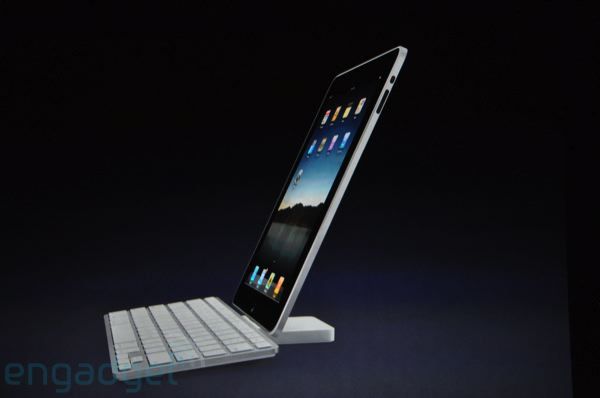
I am thrilled to announce to you that iPad will start at $499

Steve Jobs.
Going to sell a few of those after all, even with a largely non-functional (but also non-contract) AT&T 3G data network.

We’ve been able to achieve 10 hours of battery life. I can take a flight from San Francisco to Tokyo and watch video the whole time.

Steve Jobs.
Methinks that we are “able to achieve” and “I can take a flight … to Tokyo” are utterly unrelated statements here.

Metastasis

Simple Finder. It’s been around in one form or another since OS 7 or 8. Here’s what it looks like nowadays:

Remind you of anything? Starting to get some ideas about how the product line could be integrated by the iTablet? How such a device could be made to have just enough Mac in it to be useful while Macs could be made to have just enough iTablet and iPhone in them to be instantly understandable to a hoard of potential new users? How those users would be trained from the get-go to buy apps and other content through Apple/iTunes? How the “what it does” question could be instantly forgotten with a single stroke?

It’s a computing product. It occupies the space between an iPhone and an iBook. And it makes everything else around it fall into place.

It’s what’s coming. It’s what it does.