Command and (Voice) Control

mrgan wants some new iPhone Voice Commands:

  • “What time is it?”
  • “Rate song three stars.”
  • “What’s the weather?”
  • “Notifications!” (“You have one unread message and two unread emails.”)
  • “Redial.”
  • “New voice memo…”

For all its vaunted software design, the iPhone is the victim of a few punishingly odd absences; for the record, I agree with all of these, especially time and song rating.

In other departments, I’d like to see a FrontRow style functionality in the phone/touch. Right now if your phone/touch is docked (and connected to a tv or stereo), you are limited to starting, stopping, and tracking through your music with the remote. Why in the name of all that’s holy is there not a dedicated interface such that you can look at pictures, play a movie, browse your music, look at YouTube (and etc…), and fifty other obvious niceties such an app could provide, all right there on the teevee and from the comfort of your couch. Apple? Seeing as you are the only company that can cross these sandbox lines, why in the hell haven’t you done this yet?

Likewise: Keynote. Why does Apple’s own doodad focus on using the iPhone as a glorified remote? Where is a straightforward way of presenting my slides from the phone/touch? As it stands now, I can bodge it with a custom movie…so long as I don’t mind timed transitions. And, let me tell you: I mind them. There is no reason on this Earth that a laptop need be required to deliver a 50 slide stack at any moment to some unsuspecting audience somewhere. None! That’s the whole point of the device. Isn’t it? Well, that and dropped phone calls.

Oh yes.

In which Marco admits to stalking me:

[The entirely theoretical Apple tablet] can be the computer that we buy our parents or grandparents without worrying that we’re signing ourselves up for years of painful tech support calls as they “lose” documents by saving them in the wrong folder, think they can’t save any more files because the desktop is full of icons, delete their browsers’ icons and tell us the internet is gone, keep five different antivirus products half-installed, and fill their RAM with programs they never Quit because they just close every window instead and don’t notice the tiny “running” dot in the Dock or know what it indicates.

He’s right though. Somewhere between the real points Marco makes, along with Siracusa’s take, and what Gruber talks about lies the truth of the Tablet. But I think the biggest thing to come out of the whole tablet introduction will ultimately be the beginning of real convergence between the various compartments of the Apple product line. Right now, Apple has the iPhoneOS and MacOS; presumably, these are about to be joined by TabletOS (which is likely sort of an iPhoneOS+). All of these, of course ride atop some version of OS X. With the introduction of the Tablet, I suspect we’ll begin to see how they all fit together. My prediction extends Gruber’s gist: not only will iPhone apps work as widgets on the Tablet, they’ll work as widgets on MacOS (under its next revision). And not on the Dashboard (though Apple could presumably choose to put them in there too), but on the desktop.

Doing this allows for a whole new class of applications. You’d still have essentially single-purpose iPhone apps: do one small thing and do it very well. Add to that more powerful, tablet and desktop aimed apps: more pixels, more computing power. Bundling this together as a unitary application bundle allows you to implant an iPhone app inside the desktop version; thus you can offer multi-platform sync. Sure, I can’t actually edit X-app documents on the phone, but I can view them easily and do these other, more minor edits on them. Bento offers a paleo-version of this setup today; you can create databases and various data-structures on the phone or the desktop and they sync data and the underlying table designs back and forth…certain features, though, only work on the desktop version.
It makes much more sense going forward for Apple to abstract away the “I’m ready to sync” part of the current equation; you buy the app, it comes with an iPhone app, they are linked and automatically exchange info. Changes then sync next time you dock the phone or tablet or, presumably, automatically over the air if you so desire. All the fiddly bits with saving, file structure, and whatnot are totally abstracted away.  THIS is why the tablet will matter. THIS is “what it does” that compels people to buy one.

What this means for the broader Macintosh platform as this more abstracted take on the file system gradually metastasizes up the product chain is left as an exercise for the student.

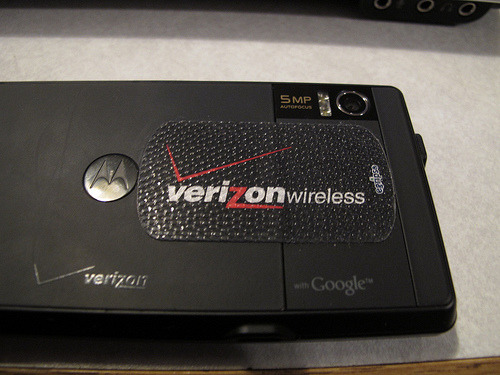
Verizon is the perfect corporate partner for Apple. This is precisely how Steve Jobs himself would deal with a balky battery door. With a branded sticker. Accept no cheap substitutes; only Verizon-brand stickers give you the confidence today’s multitaskers demand.

AmericaLand in bad decline

Re: this and this prior post, Fake Steve Jobs reports on the chat he had with AT&T CEO Randall Stephenson. Here’s some highlights:

Now, the thing about [“Meet the Beatles”] was, on the day [the album] hit the U.S. the whole world changed. Like, before that day, the world was one way, music was one way, culture was one way — and then after that day the world was never the same ever again, and as soon as you heard that album you knew that, and even if you were only nine years old, which I was, you just knew. You knew. Sales were crazy.

[…] there was a lot of demand for that record — so much that the plant that printed the records could not keep up. Now here’s the lesson. Do you think the guys who were running Capitol Records said, Gee whiz, the kids are buying up this record at such a crazy pace that our printing plant can’t keep up — we’d better find a way to slow things down. Maybe we can create an incentive that would discourage people from buying the record. Do you think they said that? No, they did not. What they did was, they went out and found another printing plant. And another one and another one, until they could make as many records as people wanted.

Absolutely goddamned right. AT&T’s metaphorical Meet the Beatles response to the iPhone data-deluge seems to be:

“we need to figure out a way to keep people out of record stores. Prevent them from entering, dissuade them from buying the records if they’re already in there. That is the winning formula.”

Which is precisely the reaction that puts AT&T out of business. Maybe not today, maybe not tomorrow, but soon (and for a long time). Back to (fake) Steve:

Yes, 3% of your users are taking up 40% of your bandwidth. You see this as a bad thing. It’s not. It’s a good thing. It’s a blessing. It’s an indication that people love what we’re doing, which means you now have a reason to go out and double or triple or quadruple your damn network capacity. Jesus! I can’t believe I’m explaining this to you. You’re in the business of selling bandwidth. That pipe is what you sell. Right now what the market is telling you is that you can sell even more! Lots more! Good Lord. The world is changing, and you’re right in the sweet spot.

Indeed they are. Reaction? Let’s piss it away for some modest, short-term gains. The model, you’ll recall, is to sell crippled phones that, since people can’t actually use, don’t tax our network at all. AT&T simply doesn’t understand that the world has turned and left them there, in the past, with a shitty flip phones business while everyone else is up here, in the “future,” waiting on good pipes. Praying someone will take their money for those (still mythical) good pipes. That AT&T doesn’t see it that way is mostly because of the sentence to which I added emphasis: AT&T doesn’t want to believe that they are only selling pipe. They think they are selling something else entirely. I’m quite sure they can’t vocalize exactly what that thing is, but they inevitably deny the notion that they are, in fact, already a dumb-pipes company, though a very bad one. And this is why they fail. They think their subscribers care who is providing them with the dumb pipes instead of how well the dumb pipes work. And it is on this point that (fake) Steve really, really gets going:

Guys like you took over the phone company and all you cared about was milking profit and paying off assholes in Congress to fuck over anyone who came along with a better idea, because even though it might be great for consumers it would  mean you and your lazy pals would have to get off your asses and start working again in order to keep up.

[…] everyone focused on just getting what they can in the short run and who cares what kind of piece of shit product we’re putting out […and…] it was all about taking all this great shit that our predecessors had built and “unlocking value” which really meant finding ways to leech out whatever bit of money they could get in the short run and let the future be damned. It was all just one big swindle, and the only kind of engineering that matters anymore is financial engineering.

Empahsis added to point out (fake) Steve likely recapitulating the secret mission statement of AT&T. They sell pipes, for chrissakes. And yet they think it is in their interest to restrict and deny people access to those pipes, which said people feel they have contracted for access to and have every right to access. Worse, AT&T seems to feel this is a winning strategy. And maybe it is. For 2009, and even some of 2010. But 2011? Not so much. I guess Randall and his lot will have vested and retired to Nantucket by then.

That this sort of shit seems to be the organizing concept of American industry for the past half-century or so is, uh, totally unrelated and nothing to worry about, I’m sure. Fake Steve sums it up:

I had this vision of the future — a ruined empire, run by number crunchers, squalid and stupid and puffed up with phony patriotism, settling for a long slow decline.

AT&T to customers: Drop dead

Ahh, AT&T, you’ve under-provisioned your network and all those iPhones you are more than happy to sell contracts for are making it easy to, you know, do stuff. And you apparently didn’t count on that. For three years running. The result: lots of data in your under-provisioned network. Who do we blame for this oversight? Why, the customers of course:

The carrier has had trouble keeping up with wireless data usage, leading to slow load times and dropped connections. It is upgrading its network to cope, but AT&T’s head of consumer services, Ralph de la Vega, told investors at a UBS conference in New York that it will also give high-bandwidth users incentives to “reduce or modify their usage.”

Translation: usage caps and overage charges, here we come. You iPhone users need to be hobbled like the rest of our customers! It’s like AT&T is fundamentally determined to go into a death-spiral the second ‘Merican iPhone users can go to another network. Which, it appears, is most likely to be T-Mobile. Sure took a long time for Fucktardia to figure out that Verizon is built atop an incompatible network, didn’t it? But just why is AT&T so dependent on iPhone? Weren’t they turning a profit before? Yes, but:

iPhone accounted for roughly 68 percent of [AT&T’s smart-phone/3G] sales [that make up the lions share of overall sales revenue]

[-and-]

Wireless revenues were up 37.2 percent, driven by “messaging, internet access, access to applications and services,” or [the iPhone]

These are very data users (and the attendant revenue spike) that AT&T is both dependent on and has resolved to infuriate. The plan, in a nutshell, is

“Gentlemen, we’ve run our brand into the ground on the back of notoriously poor service, especially in the dense urban environments where our 3G network actually, you know, exists. Lets really, really take it to the next level by nickel and diming these same users in the last year or two of their contracts. That way, north of 40% of our new revenue streams will head for the exits the second exclusivity ends.”

Great plan. So long, AT&T. Been so nice knowing you.

All that said, it’s still unclear to me why Apple doesn’t just buy Sprint, turn it into a dumb-pipes company, and reap the ridiculous profits that result. Mayhaps they (still) will.

Apple:Sprint::Google:Verizon

Why doesn’t Apple just buy Sprint? While they use fundamentally different 3G technologies, it seems to me that Sprint’s WiMax and Clearwire based 4G service lines up better with an iPhone/iTouch world than do any of AT&T or Verizon’s planned services. Such a union certainly makes radically better sense than the total platform switch into a technological dead end that would be involved in switching to seemingly everyone’s favorite prediction hobby-horse: a Verizon-based iPhone network. First off the idea actually works because Sprint’s already rolling out an essentially platform agnostic 4G wireless network, while AT&T is basically testing improvements on its lock-in 3G network and merely promising a similarly proprietary 4G (using LTE, which is also what Verizon and T-Mobile’s current plans map) in select major cities sometime in 2011 or later. Given a choice, do you really think Steve Jobs selects another vendor-tied (and vendor-constrained) proprietary network over a dumb pipe, especially if said pipe can be had for a song and especially after seemingly four decades of dealing with AT&T, the company that can’t even handle MMS, much less tethering?

But, more importantly, an Apple with Sprint suddenly has what the platform has wanted all along: dumb pipes. The phone becomes an app, and many users could/would get by with an iTouch +Skype or GoogleVoice, instantly becoming a product for which there’s (currently) no comparison, really. Then Apple starts building 4G modems into its desktops, laptops, AppleTVs, tablets, and etc… And BOOM: An always on, fully wireless, nationwide distribution network. It puts Apple directly in competition with the other content providers, which seems to me to be where they’ve been going for a while now. Sure, they are still a hardware company, but more and more of that hardware is purpose built to provide access to the Apple’s ever increasing supply of content. It positions them to own, and I mean own the mobile phone space in a way that would end the very term “mobile phone,” as you market connection to the network at a flat rate for unlimited data that covers your mobile and home phone, cable bill, movie downloads, and has potential add-ons like iTunes based rentals and an all-devices app store all the while utterly eviscerating the current mobile telco’s market that rests on $4000/byte SMS, crippled phones, and so forth. They wouldn’t know what hit them, and have shown no capacity to compete in a market shaped in those terms. Makes Apple’s sudden interest in new datacenters start to come into focus, doesn’t it? That’s certainly not the move of a dedicated hardware company…

Add to that mix Sprint’s money- and customer-hemorrhaging performance of late, Apple’s pile of cash and credit, and then stir in this natural future-products synergy…and you’ve got an interesting development cycle going forward. I think the answer may well come when the tablet ships. If Sprint is provisioning the network service to that device, then look out AT&T. You are a very few years away from utter collapse.

In this way, Apple would be Sprint’s white knight in much the way that Verizon hopes Google/Android is theirs. What both of these phone companies don’t seem to realize is that the light they are currently seeing at the end of their tunnels is the dumb-pipes truck bearing down on them.

That’s why they’ve got 75,000 applications — they’re all trying to make the Internet look decent on the iPhone.

Microsoft CEO and Asshat, Steve Ballmer who might just want to compare the average web display experience on a desktop install of Explorer to an iPhone Safari. Seriously.

The two App Stores

marco make a convincing case about the “two” app stores; but this section really struck me:

The primary screenshots of each game also show a clear difference for people who did select either app for more information:

Skee-Ball is immediately recognizable, well-known, and obvious. But Ramp Champ looks likely to lose out on nearly every impulse purchase from people who don’t want to spend much time looking into it — which is nearly every buyer for App Store A.

It’s really remarkable just how terrible most screenshots are. You’ve got four or five slots to focus attention on what’s best in your application, and that’s assuming a buyer is willing to look at more than one or even two. But even major developers tend to waste them all on views that either aren’t instructive, or repeatedly bash the same point into the ground without really illuminating overall functionality. Bento, to name but one, uses three of five screens to show us that:

  1. different kinds of libraries are possible
  2. –[AND]–

  3. you can use something akin to coverflow to choose between them

And this from a $5 app created by FileMaker, a subsidiary of a company called Apple. Nothing in there to imply that you can sort, sync, and customize databases between your phone and computer. Not that those are important features, apparently. Why not show us a to-do list, a shopping list sorted by need, a library inventory, and tasting notes complete with pictures and a calculation field for scores? Anything, really, would be better than what they do show: Hey! We have some different stationery pads in here.

And it’s not just Apple/FileMaker. Most apps, it seems, suffer from the “does this even do what I think it will?” syndrome with regard to screen-shots. Presumably, the creators hope you’ll just roll the dice on a sub-$X purchase such that the most basic visual information is all that’s required. The fact that most people won’t, at least not the people in the “B” app store, those with exceedingly specific ideas about what this app “needs to do,” figures into Marco’s overall equation mightily. It lands those apps with lousy descriptions or poor screen-shots directly in the “A” store, where I think it’s pretty well established: nobody cares what you’re doing unless it’s cheap and/or very popular for some reason.

Worth noting that Tumblr’s app: excellent selection of screen shots that detail exactly what it is you can do with it in informative little usage scenarios. And it’s a free app.

The Elusive Toilet PC

lowindustrial:

Apple has been working on such a Swiss Army knife tablet since at least 2003, according to several former employees. One prototype, developed in 2003, used PowerPC microchips made by I.B.M., which were so power-hungry that they quickly drained the battery.

“It couldn’t be built. The battery life wasn’t long enough, the graphics performance was not enough to do anything and the components themselves cost more than $500,” said Joshua A. Strickland, a former Apple engineer whose name is on several of the company’s patents for multitouch technology.

Another former Apple executive who was there at the time said the tablets kept getting shelved at Apple because Mr. Jobs, whose incisive critiques are often memorable, asked, in essence, what they were good for besides surfing the Web in the bathroom.

Oh god I hope he really said that.

Me too, though I wonder what in the hell else he thinks it needs to do. Oh, right: tip-calculation, the hobgoblin of the lesser platforms since the dawn of mediocre service.

The Elusive Toilet PC