iPAM

Alright then, how did we do? We were basically calling for:

It makes much more sense going forward for Apple to abstract away the “I’m ready to sync” part of the current equation; you buy the app, it comes with an iPhone app, they are linked and automatically exchange info. Changes then sync next time you dock the phone or tablet or, presumably, automatically over the air if you so desire.

Some of which we got, I guess. Certainly not the xenomorph part of my theory (yet); instead, you get to buy iWork for your Mac, and then buy it three more times for your iPad. Why the hell didn’t I think of that? But we didn’t get tight, vertical integration of any kind, really, even though Steve did use the product matrix with the hole between iPhone and a laptop. Just have to wait for some future revision (if ever) to really get the full-on, 24/7 back-and-forth arrows going there. Or else they suspect the entire “home computer” side of the equation will gradually extinguish itself over a number of years and obviate the whole issue. And maybe it will. iPad certainly represents a first step in that direction.

That’s what makes its interface choices, and the relative popularity of same very important going forward. As the Macintosh set the standard for computing, well, so far, I strongly suspect the iPhone and its descendants is setting the standards for future consumer computing. At the very least as said computing gets done through Apple.

AT&T stays on as carrier. If Apple was ever going to go with Verizon, this was the product. Not happening. Mark my words, Apple will buy or found its own damn dumb-pipes company before it has product on the Verizon network. Period.
The lack of contracts part of the equation is certainly interesting. I suspect AT&T sees it as a way to lessen the network impact by encouraging people to buy a month of service when they really need it, then let the service lapse for a while. No other explanation for it, really. We can therefore expect iPhone 3G service to get markedly worse in densely populated areas since they think they’ve got the overloading issue prefigured. Wonderful.

My overall iPad-specific thoughts in convenient numerical form:

  1. I think the iPad is really aimed at MacBook Air users; they’re not exactly power users, but they need to be able to open and edit a spreadsheet or a document of some sort on the go. Weight is their critical factor. iPhone, though pocket-sized, can’t provide the file editing and really never will; again: it’s pocket-sized. And but so the same folks clearly aren’t willing to lug a MacBook around, since any MacBook out there is cheaper and vastly more capable than an Air, and yet they went for the Air anyway.
    Obviously, the non-laptopped are also targets here; they may well have an iPhone and wish it did just a bit more, or they want something like an iPhone but don’t want to or couldn’t mess with the contracts and/but also saw iTouch as too limiting for one reason or another.
  2. The sandboxing implicit in the iPhone/iPad OS automatically and fairly drastically limits what you can do with it when compared with a “real” laptop computer. But I suspect we’ll only see more and more of that approach in consumer devices. Notably missing from the demos, though, was “what happens to the files” you are opening/saving/editing with the various iWork apps that were demoed. Pretty clear they aren’t automatically syncing via the cloud, or we’d have been shown it. I suspect you have to plug it into a Mac, where you then bump them back into your traditional filesystem. Presumably iTunes then deals with pushing any Mac-side updates back again and sorting out versions. Or not. Small deal to give you the capability to move this stuff into .me, though. Seems so painfully obvious, one wonders where it was today.
  3. Brushes looks like an absolute killer app on the iPad (as opposed to the iPhone version of the same app being interesting, for sure, but not really a reason to buy an iPhone/iTouch). Seriously, it’s DTP for tablets.
    Likewise, I think comic books, textbooks, and newspapers will prove to be unexpectedly powerful. The interweaving of text, video, charts, chat, depth, and you-name-it really could revitalize the whole news-papering trade. Likewise comics seem to be crying out for a killer platform and easy, impulse purchases that don’t involve Comic Book Guy (worst tablet ever). Just seems like an awful lot of business to be done in the currently-printed realm, especially when iPads are down ~$200. Perhaps already, seeing as KindleDX is  ~$450, of similar dimensions, and an utterly hobbled, so-last-decade device by comparison.
  4. Another dark horse not related to comics: The MLB app looks like something out of the not-too-distant future that I’ve been promised every time anyone does a “what will  the teevee be like in 10 years” piece for OMNI. Wowie. Unlimited possibilities. Pop-Up video goes wide. Really a big deal.
  5. The matrix: I really never thought that, as of this announcement, iPhone would be instantly, clearly, and definitively the iPad mini. But it is. Funny how things work out sometimes.
  6. The name? Boy, Apple is really feeling its oats right now. The least of the problems with the name is its relative proximity to iPod. Generally speaking: not so fresh. In related news: the countdown clock for the end of the iEra is probably set back another five or ten years now. Jesus.
I am thrilled to announce to you that iPad will start at $499

Steve Jobs.
Going to sell a few of those after all, even with a largely non-functional (but also non-contract) AT&T 3G data network.

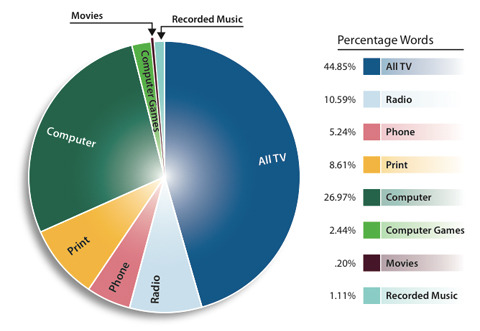
NYT: American households collectively consumed 3.6 zettabytes of information in 2008. That’s 34 Gb per individual. A day. Whoa. Don’t worry, AT&T, this sort of thing doesn’t affect you at all. You’ll be long gone before then.

Also: consider the proportion of that “Recorded Music” slice. Think about all the swirl around the RIAA and etc. Then look at the “TV” slice and contemplate the utter foolishness of those running commercial visual media (and especially: cable companies) in this country. Then, perhaps, buy a nice cave somewheres and go live in it.

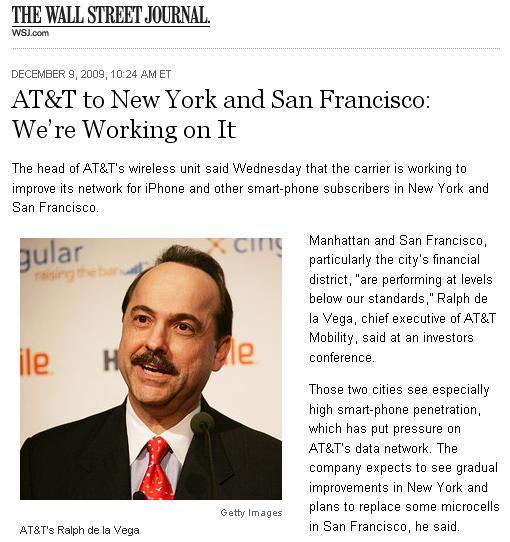
By “working on it” they mean “working on capping bits and then charging overages for data access such that we effectively cripple the iPhone and/but reduce demand for data without, you know, spending any money on our side. Some entirely reasonable amount that’s in the ballpark of what we get for SMS; on the order of $2 a bit. You’ll hardly notice it at all!”

AT&T to customers: Drop dead

Ahh, AT&T, you’ve under-provisioned your network and all those iPhones you are more than happy to sell contracts for are making it easy to, you know, do stuff. And you apparently didn’t count on that. For three years running. The result: lots of data in your under-provisioned network. Who do we blame for this oversight? Why, the customers of course:

The carrier has had trouble keeping up with wireless data usage, leading to slow load times and dropped connections. It is upgrading its network to cope, but AT&T’s head of consumer services, Ralph de la Vega, told investors at a UBS conference in New York that it will also give high-bandwidth users incentives to “reduce or modify their usage.”

Translation: usage caps and overage charges, here we come. You iPhone users need to be hobbled like the rest of our customers! It’s like AT&T is fundamentally determined to go into a death-spiral the second ‘Merican iPhone users can go to another network. Which, it appears, is most likely to be T-Mobile. Sure took a long time for Fucktardia to figure out that Verizon is built atop an incompatible network, didn’t it? But just why is AT&T so dependent on iPhone? Weren’t they turning a profit before? Yes, but:

iPhone accounted for roughly 68 percent of [AT&T’s smart-phone/3G] sales [that make up the lions share of overall sales revenue]

[-and-]

Wireless revenues were up 37.2 percent, driven by “messaging, internet access, access to applications and services,” or [the iPhone]

These are very data users (and the attendant revenue spike) that AT&T is both dependent on and has resolved to infuriate. The plan, in a nutshell, is

“Gentlemen, we’ve run our brand into the ground on the back of notoriously poor service, especially in the dense urban environments where our 3G network actually, you know, exists. Lets really, really take it to the next level by nickel and diming these same users in the last year or two of their contracts. That way, north of 40% of our new revenue streams will head for the exits the second exclusivity ends.”

Great plan. So long, AT&T. Been so nice knowing you.

All that said, it’s still unclear to me why Apple doesn’t just buy Sprint, turn it into a dumb-pipes company, and reap the ridiculous profits that result. Mayhaps they (still) will.

Apple:Sprint::Google:Verizon

Why doesn’t Apple just buy Sprint? While they use fundamentally different 3G technologies, it seems to me that Sprint’s WiMax and Clearwire based 4G service lines up better with an iPhone/iTouch world than do any of AT&T or Verizon’s planned services. Such a union certainly makes radically better sense than the total platform switch into a technological dead end that would be involved in switching to seemingly everyone’s favorite prediction hobby-horse: a Verizon-based iPhone network. First off the idea actually works because Sprint’s already rolling out an essentially platform agnostic 4G wireless network, while AT&T is basically testing improvements on its lock-in 3G network and merely promising a similarly proprietary 4G (using LTE, which is also what Verizon and T-Mobile’s current plans map) in select major cities sometime in 2011 or later. Given a choice, do you really think Steve Jobs selects another vendor-tied (and vendor-constrained) proprietary network over a dumb pipe, especially if said pipe can be had for a song and especially after seemingly four decades of dealing with AT&T, the company that can’t even handle MMS, much less tethering?

But, more importantly, an Apple with Sprint suddenly has what the platform has wanted all along: dumb pipes. The phone becomes an app, and many users could/would get by with an iTouch +Skype or GoogleVoice, instantly becoming a product for which there’s (currently) no comparison, really. Then Apple starts building 4G modems into its desktops, laptops, AppleTVs, tablets, and etc… And BOOM: An always on, fully wireless, nationwide distribution network. It puts Apple directly in competition with the other content providers, which seems to me to be where they’ve been going for a while now. Sure, they are still a hardware company, but more and more of that hardware is purpose built to provide access to the Apple’s ever increasing supply of content. It positions them to own, and I mean own the mobile phone space in a way that would end the very term “mobile phone,” as you market connection to the network at a flat rate for unlimited data that covers your mobile and home phone, cable bill, movie downloads, and has potential add-ons like iTunes based rentals and an all-devices app store all the while utterly eviscerating the current mobile telco’s market that rests on $4000/byte SMS, crippled phones, and so forth. They wouldn’t know what hit them, and have shown no capacity to compete in a market shaped in those terms. Makes Apple’s sudden interest in new datacenters start to come into focus, doesn’t it? That’s certainly not the move of a dedicated hardware company…

Add to that mix Sprint’s money- and customer-hemorrhaging performance of late, Apple’s pile of cash and credit, and then stir in this natural future-products synergy…and you’ve got an interesting development cycle going forward. I think the answer may well come when the tablet ships. If Sprint is provisioning the network service to that device, then look out AT&T. You are a very few years away from utter collapse.

In this way, Apple would be Sprint’s white knight in much the way that Verizon hopes Google/Android is theirs. What both of these phone companies don’t seem to realize is that the light they are currently seeing at the end of their tunnels is the dumb-pipes truck bearing down on them.

Making AT&T Look Good

T-Mobile’s popular Sidekick only caches your personal contact, calendar, links, and to-do type data on your phone. You don’t sync it with your computer or store it anywhere you own, like you might with an iPhone or other similar platforms, it just floats around out there in the cloud. Well, it did, anyway. Microsoft’s Danger subunit, turning out to be quite aptly named, has lost all or most of that stuff. But, never fear, here’s T-Mobile’s fix:

T-Mobile advises customers who [still] have cached data still in their Sidekicks to avoid running out of power, restarting, or shutting down their Sidekicks

Good fix. I can’t see how that could be a problem for anyone. What do you people want from us, anyway? That will be $86.

[h/t TidBITS and Daring Fireball]

MM$

I never quite got why iPhone users were so hell-bent for MMS (Multimedia Messaging Service). Just send an email, for chrissakes. More characters, send pictures or whatever else you want (though, on an iPhone, the flexibility to send anything as an attachment is admittedly more limited than at a desktop). While you presumably add a bit more potential latency into the transaction, you’re not guaranteed instant delivery on a text anyway. Likewise, if you’re that concerned, email to a text gateway (though, with AT&T, that just about guarantees a many-hour holding time for said message). Jeff Carlson hits the nail on the head in this TidBITS article:

While MMS has many of the same properties as and more limitations than a rich, HTML email message, there’s less friction in using MMS. This is intentional, as MMS is a huge boon for carriers in terms of profit margins, which are very high. A 1 MB email message containing several photos would cost nothing to send on an iPhone (included in the flat-rate data plan), whereas a 100 KB MMS message requires a messaging subscription plan or incurs the $0.30 fee without. You can see which the carriers would prefer.

MMS seems utterly designed to:

a) make money for the carriers

2) shoe-horn something more akin to email onto older, crappier phones

-and-

iii) make money for the carriers

What’s the rumpus, iPhone owners? I understand the belly-aching over tethering. But MMS? Who cares. It will only serve to degrade an already tottering network. Stick it to The Man. Send an email.

Femtocells

Glenn Fleishman reports for TidBITS on a new doodad from AT&T, the 3G Microcell, which offers to connect to your home network connection and then make a little bubble of 3G voice and data coverage right there to the house. You get better coverage (or, in some cases, you get coverage), and meanwhile:

Carriers love femtocells because they shift traffic (and the expense of moving calls and data) from their expensive-to-operate, capital-intensive cellular networks to cheap broadband – broadband that the customer has installed and paid for separately.

That’s all well and good, but why in the hell does it cost the consumer anything? Apparently the 3G MicroCell (this is what it looks like; it’s pretty clearly the nefarious output of the Drax Enterprise Corporation) will cost $150, but that “AT&T will provide a $100 rebate for customers who sign up for a calling plan,” and but users on calling plans will get unlimited calls (placed through it) for the low-low price of $10 a month. Apparently the other carriers have like devices and offer broadly similar plans. The question: Why? Putative MicroCell users can get unlimited calls through their requisite pre-existing home network (without any femtocell attached) for the low-low price of $0 (though, admittedly, not in glorious 3G MODE!). And remember, these folks are (likely) already paying AT&T to insufficiently cover their home…this is most likely why they might be interested in the MicroCell in the first place! So: pay me not to cover your home, pay me some more so that you can personally provide said coverage for your home, then pay me a bit more per month to use said coverage that you are providing to your own home. Furthermore, said paying users are providing a carrier with extra connectivity. If lots of people on their (presumably troublesome) block did so, you can imagine said carrier’s service in said troublesome area improving for everyone. And it costs them nothing. Probably less than nothing as, just like the article notes, you’re shifting traffic onto people’s own networks and off the carrier’s; plus they’re winning hearts and minds through the magic of improved service, and getting paid by the participating subset of end-users to do so. You’d think they would be giving these doodads away just for coming by the store. But, once again, we have run into a plain example of America’s mobile industry mission statement:

Never miss a chance to screw your customer.

If we can get these idiots to run our networks for us, charge them for the privilege, and (best of all) silently shift them onto the inevitable dumb pipes while we’re doing it, so much the better. Later, we’ll figure out a way to charge them for providing access to and across their own home network; but we’ll let them get good and used to the improved signal first…oh, and texting over a MicroCell will cost, uh, $30.

iThink therefore iAm

Kottke talks about the iPhone (as a device-class, mind you, not specifically the device) impacting many, many more markets than just smart-phones or PDAs. It’s also a compact camera killer, to name only one segment touched on in his fine essay. And I think he’s basically right. But I want to talk about a point he makes in the second footnote (without going all DFW on you):

You’ve got to wonder when Apple is going to change the name of the iPhone. The phone part of the device increasingly seems like an afterthought, not the main attraction. The main benefit of the device is that it does everything. How do you choose a name for the device that has everything? Hell if I know. But as far as the timing goes, I’d guess that the name change will happen with next year’s introduction of the new model. The current progression of names – iPhone, iPhone 3G, iPhone 3GS – has nowhere else to go (iPhone 3GS Plus isn’t Apple’s style).

Gruber picks up on this point too, basically answering him directly with:

If this platform is here for the long run, the general purpose name that best works for a general purpose device is already here: iPod. In fact, iPod, semantically, is a better name for the iPod Touch than it ever was for the original focused-on-music models. As I see it, the phone in iPhone isn’t about telephony, but about the necessary contract with a mobile carrier.

Agreed. Lemkin was all over this subject back in 2007 (!), talking about Steve Jobs’ almost certain desire to skip 3G (and any other carrier-tied technology) entirely in favor of some form of ever-present WiFi that could come from any company, municipal co-op, or whatever. This, of course, is the ultimate existential threat to AT&T: if they become (as a company) nothing more than a provider of the dumb pipe, then you can substitute any old dumb pipe for them without noticing any change at all. This is why they’re fighting Google tooth and nail over Google Voice, though hiding behind Apple to do it (presumably, the relevant lawyers (correctly) predicted a prompt FCC smackdown should AT&T intervene directly). But they will lose this fight over the long term. Google has already seen to it via the bidding process on the wireless spectrum. How well did AT&T like that?

“Google is demanding the government stack the deck in its favor, limit competing bids, and effectively force wireless carriers to alter their business models to Google’s liking.”

By “alter their business models” he meant to say: “stop relentlessly fucking over the end-user through long, inflexible contracts on POS phones of AT&T’s choosing.” Oh, GenericNetCo has really cheap wireless internet this month. I’ll switch. So it’s fundamental to AT&T that they seemlessly transition you from the locked, carrier specific technology (basically today’s situation) to the quietly generic wireless technology (aka Dumb Pipes) they’re hoping you don’t even notice you can actually get from anyone and everyone that cares to provide said service.

What will be their value-add in this situation? Unclear. Presumably they intend it to be nationwide reach, reliability, convenience, and some kind of competitive pricing for same. That said, and somewhat obviously, if AT&T were dependent on consumer goodwill and raw network reach, reliability, and convenience as of today, they’d be out of business inside of a fortnight. They seem busier blaming their iPhone users for their network’s various problems than, you know, improving the service that they are contractually obligated to provide in some fashion or other. And that’s within a market and on a network whose design they’ve had decades to cultivate, tune, and understand (though with an outcome that clearly implies that they still don’t “understand” what it is these iPhone users expect from their device, and how that’s different from, say, the user of a more generically crippled feature-phone). So can they build out a nationwide, everpresent, high-speed, and five-9s reliable WiFi service that’s compelling enough to keep people around once access to the underlying technology no longer requires multi-year contracts? Without recourse to tethering them to a number or some other lock-in? I seriously doubt it.

But, yeah. It will be called the iPod. Within a handful of years, the core iPod platform will be entirely Touch-based, and thus simply morph back into iPod (with Nanos or Shuffles being the variant, but today’s Touch being The iPod). And you’ll use said device to make calls.