
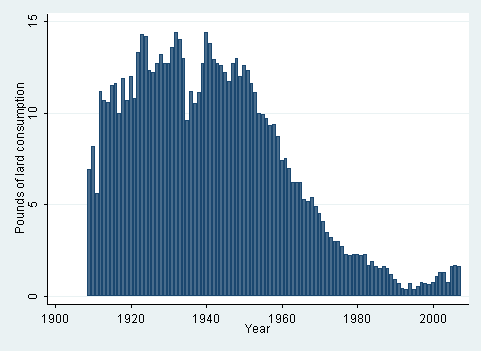
US Lard Consumption, 1907-2007
Or: things are looking up over to the Lard Board.

File under: things the TeaBaggers will ignore. The solution to tax-cut driven deficits? More tax cuts, naturally. And, of course, never forget that Fanny/Freddy loans to those brown people is what drives the whole thing anyway.
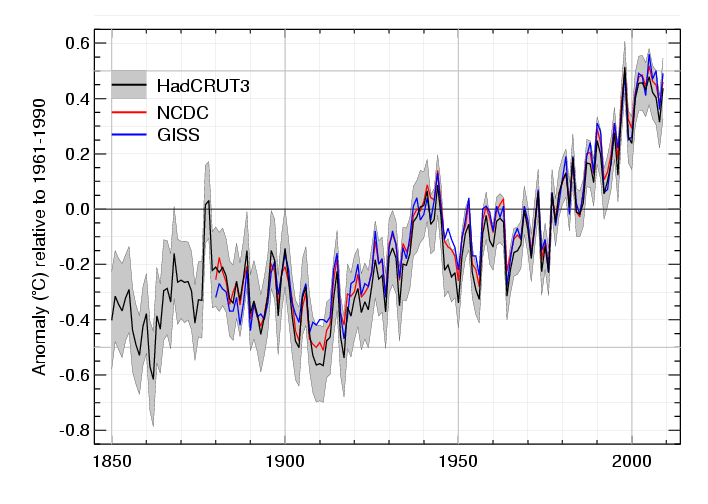
The black line is the so-called “climategate” data. The complete agreement with other datasets is evidence of, uh, even broader conspiracies than anyone ever expected. Damn you, Al Gore, DAMN YOU!
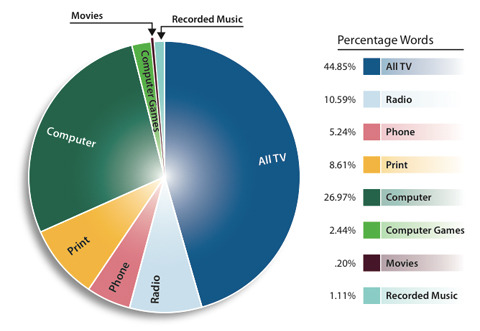
NYT: American households collectively consumed 3.6 zettabytes of information in 2008. That’s 34 Gb per individual. A day. Whoa. Don’t worry, AT&T, this sort of thing doesn’t affect you at all. You’ll be long gone before then.
Also: consider the proportion of that “Recorded Music” slice. Think about all the swirl around the RIAA and etc. Then look at the “TV” slice and contemplate the utter foolishness of those running commercial visual media (and especially: cable companies) in this country. Then, perhaps, buy a nice cave somewheres and go live in it.

(via marco)
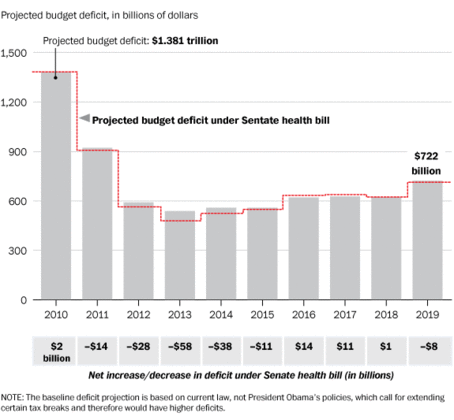
What everyone has been and will continue screaming about, indefinitely, in context with the rest of the budget. God Bless America.
(via Ezra Klein)
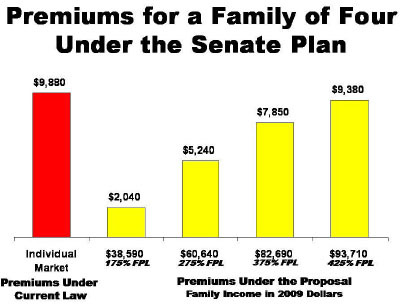
Memo to Joementum and all his friends: Doing nothing will do harm. It will add to the deficit, and, according to this latest bit from the CBO analysis, it will cost families and individuals money, no matter what bracket they are inhabiting. Oh, and doing nothing leaves ~30 MILLION PEOPLE uncovered that would, in fact, get health coverage under the Senate plan. Those people need to shape up and go die in the streets like good American Citizens.
But, by all means, let’s play pretend that doing nothing is not only a viable option, but the only sane option. And media: let’s continue to let people say shit like this without challenge of any sort. To ask if they have any sane reasoning behind their obstructionism just wouldn’t be polite.
Let’s begin:
LIEBERMAN: A public option plan is unnecessary. It has been put forward, I’m convinced, by people who really want the government to take over all of health insurance. They’ve got a right to do that; I think that would be wrong.
But worse than that, we have a problem even greater than the health insurance problems, and that is a debt – $12 trillion today, projected to be $21 trillion in 10 years.
WALLACE: So at this point, I take it, you’re a “no” vote in the Senate?
LIEBERMAN: If the public option plan is in there, as a matter of conscience, I will not allow this bill to come to a final vote because I believe debt can break America and send us into a recession that’s worse than the one we’re fighting our way out of today. I don’t want to do that to our children and grandchildren.
That was Lieberman on FOXnews (where else?) this Sunday past. Doubtless just posturing, but let’s take him at his word: the deficit (and, by extension, the debt) is and should be held in absolute primacy to any and all other spending or policy decisions (which, of course, also have direct spending implications). Fair enough. We take that as a first principle.
The current GOP “plan” (in that it’s not even a plan so much as a policy statement) has been scored over the 10-year window as potentially resulting in a reduction of budget deficits by $68 billion while helping 3 million folks get coverage they wouldn’t otherwise have.
The plan passed by the House, on the other hand, extends coverage to 36 million currently uninsured Americans while cutting the deficit by $104 billion over the same 10-year window.
Which of those plans is more deficit neutral, Joe?
Of course, third option is do nothing. Joe himself has pushed this idea. Here’s what that looks like:

By all means, MSM, continue treating Joe Lieberman as a sober, deficits minded fellow only out for what’s best for the country. Let’s not once pause to ask him: Joe, just how does the public option contribute to the deficit?
This curve (Austin Frakt via Kevin Drum) gave me the heebeegeebees yesterday:

Depending on our positions on that curve, reforms could actually increase costs…and it’s unclear just where we are. Turns out, those fears were (likely) misplaced. Results from Our Beloved Commonwealth (we’ve had the Death Panels up and running for a while now…) seem to imply that, hey presto, this healthcare reform thing can actually drive down costs:
the most authoritative objective voice in this debate suggests that reform will significantly reduce, not increase, nongroup premiums.
This conclusion is consistent with evidence from Massachusetts. In their December 2007 report, AHIP reported that the average single premium at the end of 2006 for a nongroup product in the United States was $2,613. In a report issued just this week, AHIP found that the average single premium in mid-2009 was $2,985, or a 14 percent increase. That same report presents results for the nongroup markets in a set of states. One of those states is Massachusetts, which passed health-care reform similar to the one contemplated at the federal level in mid-2006. The major aspects of this reform took place in 2007, notably the introduction of large subsidies for low-income populations, a merged nongroup and small group insurance market, and a mandate on individuals to purchase health insurance. And the results have been an enormous reduction in the cost of nongroup insurance in the state: The average individual premium in the state fell from $8,537 at the end of 2006 to $5,143 in mid-2009, a 40 percent reduction, while the rest of the nation was seeing a 14 percent increase.
Imagine that. Increasing the pool size, having a mandate, and guaranteeing coverage reduces rates by spreading risk. Will wonders ever cease?
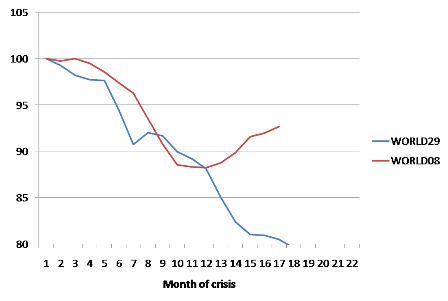
At last: divergence. Must be all the GOP gainsaying that’s bringing output around.
 Lemkin