The hard truth about health care

Everyone knows — or should know — that the United States spends much more than any other country on health care. But the Kaiser Family Foundation broke that spending down into two parts: the government’s share and the private sector’s share (both measured as a percentage of total gross domestic product), then compared the results to figures from 12 other countries that are members of the Organisation for Economic Co-operation and Development. And here’s the shocker: Our government spends more on health care than the governments of Japan, Australia, Norway, the United Kingdom, Spain, Italy, Canada or Switzerland.

Think about that for a minute. Canada has a single-payer health-care system. The government is the only insurer of any note. The United Kingdom has a socialized system, in which the government is not only the sole insurer of note but also employs most of the doctors and nurses and runs most of the hospitals. And yet, measured as a share of the economy, our government health-care system is the largest of the bunch.

And it’s worse than that: Atop our giant government health-care sector, we have an even more giant private health-care sector. Altogether, we’re spending about 16 percent of the GDP on health care. No other country even tops 12 percent. Which means we’ve got the worst of both worlds: huge government and high costs.

It’s also important to note that, even with this high spending, we’re getting worse outcomes than all the Western countries spending 5-7x less than we do. And, of course, if we had the costs of any of these countries we’d be facing surpluses today instead of deficits. But we’re told the only road forward for our country is to slash Medicare, Medicaid, and the rest of the social safety net and give the money to the richest 1%. Saying anything else isn’t Serious.
The hard truth about health care

Default Already Hitting Pocketbooks

The GOP’s hostage taking re: the debt ceiling is already causing ripple effects in the economy:

As of late May, the number of CDS contracts — essentially insurance policies on the possibility of a default — had risen by 82 percent. Equally as important, the cost of a CDS — the best indication of how much riskier U.S. debt has become — rose by more than 35 percent from April to May. Last week I spoke to a number of people who calculate such things for a living, and they said this change means that the interest rate the U.S. government has to pay has already increased by as much as 40 basis points compared with what it otherwise would be. This means higher federal borrowing costs and deficits, and overall higher interest rates on everything from car loans to mortgages to credit cards.

Remember all those “confidence” trolls the GOP trotted out in advance of retaining the Bush tax cuts for the wealthiest individuals in the US? Wonder where those guys went.

But, by all means, let’s talk about Weiner and whatever other body parts are on display in the Halls of Serious People. That’s the stuff that really matters.

Default Already Hitting Pocketbooks

2.96

Emphasis added:

…if even 1/50 of the austerity-induced decline in current output flows through to reduce the economy’s productive potential, that austerity today worsens the debt burden.

This is an unusual result: it applies only to a country with a substantial fiscal multiplier that can fund its debt at very low interest rates. But we are a country with a substantial fiscal multiplier that can fund it’s debt at very low interest rates…

Indeed we are. But no one seems interested in noticing. We can borrow against a 10-year Treasury at a 2.96% yield. The money behind that rate is clearly not concerned with either deficits or the capability of the United States to meet the debt incurred by their purchase yesterday or all the days before that. As Jared Bernstein notes, the current “budget math” still strongly favors a jobs target and not a deficit target.

This is very simple stuff. How many ways do you have to prove that cuts today worsen our long-term fiscal situation before somebody with a D after their name starts talking about this in a compelling, no-nonsense fashion? We can borrow, cheaply, and those dollars (when pumped into the economy) would hasten the closing of our current output gap. This would simultaneously a) obviate the need for further borrowing, b) close the revenue shortfalls of Great Recession, and c) coupled with a do-nothing legislative approach relative to the Bush tax cuts would almost entirely close the existing budget deficits within a few years.

But, by all means, let’s go on pretending that deep, punitive cuts to the social safety net and eliminating access to abortions are the only Serious Person positions possible given the current situation.

2.96

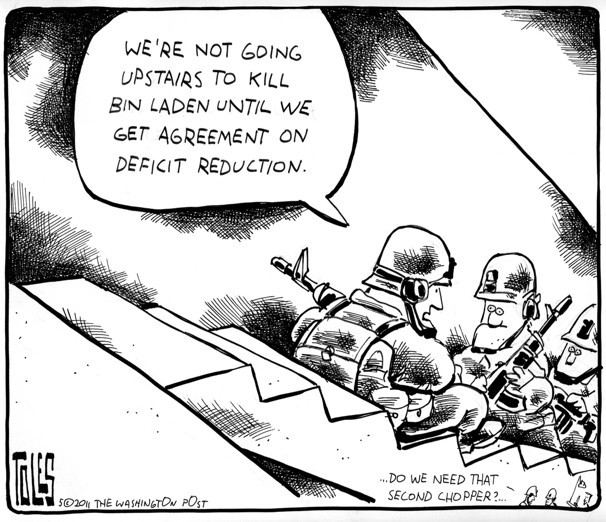
Who has egg on their face if there is a sovereign debt crisis, House Republicans or the president?

A “Senior GOP Lawmaker,” making explicit the GOP’s intention to shitcan the sovereign debt of the United States in the hopes of short-term political gain. Make no mistake, they plan to default. They think it’s a good idea. It’s the only way they can imagine winning the White House in 2012; they’re sure as hell not going to get there on the back of their brilliant “end Medicare, give proceeds to the rich” gambit. Default is the plan, was the plan, will always be the plan.
And, no, they haven’t considered whether it will be worth winning executive leadership of a country utterly crippled by a combination of existing debts and the inability to borrow on the global markets (such as they will even exist after default) for eternal wars and deep tax cuts for the wealthiest. They’re not big thinkers in the GOP. In fact, they are actively and openly against thinking about anything. So that’s just the sort of governance we’re going to get from President Bachman, elected in a landslide post default and post economic apocalypse.

Paul Cryan

Paul Ryan, at the GOP meetup with Obama: Mr. President, the demagoguery only stops if the Leaders stop it. [GOP attendees give standing ovation]
Paul Ryan, immediately BEFORE said meeting: it’s Obamacare itself that ends Medicare as we know it. Obamacare takes half a trillion dollars from Medicare — not to make it more solvent but to spend on this other government program, Obamacare. And then it creates this 15 panel board of unelected, unaccountable, bureaucrats starting next year to price control and ration Medicare for current seniors.
Paul Ryan on Morning Joe: The president and his party have decided to shamelessly distort and demagogue Medicare
Paul Ryan, 2009: [the ACA will] take coverage away from seniors, […] raise premiums for families, [… and] cost us nearly 5.5 million jobs. [… It’s] a government takeover of healthcare [that will] lead to rationing [and a] European social welfare state.
Lemkin: Paul Ryan, serial liar and ruthless demagogue. And considered the Serious Adult of the GOP. A real policy wonk, that one…

Is S&P Running Interference for the Right?

jasencomstock:

[…] Besides, Democrats could easily interpret (and should, vindictively) the warning from S&P as a call for higher taxation.

Precisely. S&P is commenting on the inability of said gubmint to actually do anything and most definitely not on the underlying capability of the United States economy to produce growth and/or sustain a marginally higher tax rate necessary to retire enough of the debt to keep the entirely mythical bond vigilantes at bay.

But, yeah, why does anyone alive care what S&P or Moody’s et al. says? Serious question. They may as well manufacture high quality buggy whips for all their relevance post-meltdown; there is no greater indictment of the lack of serious change to our financial system than this.

Is S&P Running Interference for the Right?

Ideal Framework

Ygleisas dares to dream about the “ideal negotiating framework” for the debt ceiling:

White House demands clean debt ceiling increase, House majority demands big spending cuts, Senate majority demands partial repeal of Bush tax cuts, and we all compromise on just doing the damn debt increase.

That would be nice. But it would also require non-feckless Democrats in the Senate. Which, so far as I can tell, do not exist.

But, since the plutocrats and banksters seem to realize they’ve got skin in this game, maybe we can just cut some insanely rich people’s taxes, raise the debt ceiling, start a fourth war (I’m thinking Spain is due), and call it a day.

His Master’s Voice

The people actually in charge of Our One True Plutocracy seem to be getting antsy:

House Speaker John Boehner (R-Ohio) has had conversations with top Wall Street executives, asking how close Congress could push to the debt limit deadline without sending interests rates soaring and causing stock prices to go lower, people familiar with the matter said.

[…]

The Wall Street executives say even pushing close to the deadline — or talking about it — could have grave consequences in the marketplace.
“[GOP leaders in Congress] don’t seem to understand that you can’t put everything back in the box. Once that fear of default is in the markets, it doesn’t just go away. We’ll be paying the price for years in higher rates,” said one executive.

Nothing some massive tax cuts couldn’t paper over, right?

His Master’s Voice

Mr. Boehner may face just as much risk as Mr. Obama, if not more. He has promised his more conservative members that he will extract significant concessions from the Democrats before he agrees to an increase in the debt limit. A White House that was willing to play hardball could put him to the test, and perhaps cause a substantial loss of face.

[…]

If Mr. Obama is a good poker player, he’ll know not to disregard Mr. Boehner’s earlier rhetoric, which gave away the vulnerability of his hand. And he’ll recognize Mr. Boehner’s more recent and more confident rhetoric for what it is: the oldest “tell” in the poker book, a show of strength betraying the ultimate weakness of his position.

Nate Silver
Mr. Obama is most decidedly not a good poker player.