If the deficit was actually something anybody cared about, they’d be interested in raising revenue. You don’t have to raise tax rates to raise revenue, you just have to increase the number of goddamn jobs.

Duncan Black aka Eschaton, on jobs, revenue, and the deficit.
As Gwen Ifill was being all serious person last night talking to and asking the tough questions of Jack Lew on why he won’t just admit that Social Security must be eliminated, preferably today if we as a nation are to survive, I found myself jumping up and down screaming “revenue, revenue, revenue.” It was a special Valentine’s Day moment for the wife. But: revenue. It’s a word that never, ever comes up in the MSM. Instead, they have laserlike focus on the elimination of Social Security, the one entitlement that is perfectly fine for 40+ years, and then only moderately not fine after that. But they aren’t likely to depend on it, so it has to go. Medicare? Well, not so much. They see a real benefit for themselves in that one.
This is why Our Republic is coming apart at the seams.
The Republican Party is the party of K-N-O-W. We know how to lower the cost of health care. We know how to take care of the uninsurable. We know how to put patients in charge of their health care and have a market-based, patient centered health care system that’s not going to kill jobs like ObamaCare is going to do. And we know how to stimulate the economy. We know how to create jobs in the private sector. We know how to prevent this huge government takeover of health care as well as all of society.

But we are the party of N-O against socialism and that’s what Nancy Pelosi, Harry Reid and Barack Obama have been proposing is a greater take over of everything in human endeavor in America.

Paul Broun (R, GA) (of “spew venom” fame), has a host of apparently secret plans. Which is fine. But once, just once, the host needs to say: “okay, that’s great. We’ve got plenty of time here, so let’s start with item one. With program specifics, budget figures, and policy detail, let me hear how you plan to reduce the costs of health care? And I’m afraid we’re going to have to ask you to be more specific than simply parroting "market solutions” and other tropes; please, let’s discuss this like adults.“ And then spend an hour or four until he stops digging. Then: item two, economic stimulation. Pretty sure that one will be tax cuts for the rich. Where’s the money coming from. Specific program cuts, specific dollar figures, specific deficit projections.
Honestly, how many times do you get to speak the ”lie of the year“ without any friction whatsoever? A million times? A billion? MSM, I’m asking: when do we not just "leave it there”?

Ryan warns that if we don’t deal with our fiscal problems, we’ll have to raise taxes and cut benefits for seniors. So what can we do to reduce the deficit? Well, government spending is dominated by the big 5: Social Security, Medicare, Medicaid, defense, and interest payments; you can’t make a significant dent in the deficit without either raising taxes or cutting those big 5. Defense is untouchable, says the GOP; so that leaves the entitlement programs. And 2.7 of the three entitlement programs are benefits to seniors (70 percent of Medicaid spending goes on seniors).

So let’s see: to avoid cuts in benefits to seniors, we must … cut benefits to seniors.

I’m reasonably sure that Ryan hasn’t thought any of this through.

Paul Krugman hedging like Lehman on that “reasonably.”

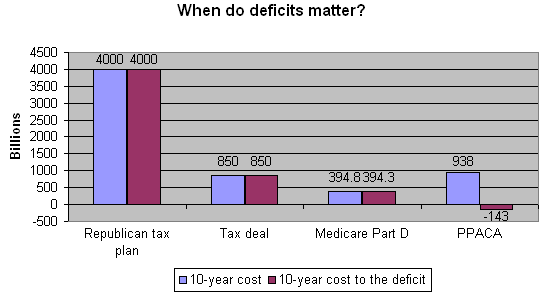
Ezra Klein points out what should be obvious, that all the folks screaming about deficit implications and the Affordable Care Act are, in fact, screaming about positive deficit implications (see: PPACA and red column) and, even if we simply take it on costs alone (as separate from any deficit impact), the ACA amounts to a rounding error when compared to the GOP’s tax proposals.

But it is best not speak of any of this. Ever.

“Fiscally responsible” is code for cutting taxes on rich people and gutting Social Security. Those are their goals, and that’s always been the case.

Duncan Black, simplifying it for you.
I’d only add that these same forces, and (of course) their media enablers, repeatedly include Social Security despite the fact that SS has its own funding source, is not in any imminent danger, and does not contribute to the deficit at all, nor will it for at least 45 years, even if we do nothing. But, by all means, it MUST BE DESTROYED by the end of the week or we all die. It’s the only possible conclusion for any serious person.

Shocking News, Everyone

The Washington Post Editorial Board is beginning, beginning mind-you, to think that maybe the GOP isn’t quite so serious about deficits after all:

Deficit financing is fine, it seems, when it comes to tax cuts. But that’s not all. Under the new rules, not only are tax cuts exempted from the pay-go concept, but the only way to pay for spending increases is with spending cuts elsewhere. No tax increases allowed – not even in the form of eliminating loopholes or cutting back on tax breaks. Of course, if you wanted to expand the loopholes, no problem. No need to pay for that.

Having made clear that no tax cuts need be paid for, the rules then take the extra step of specifying which deficit-busting tax cuts the new majority has in mind. They assume the continuation of all the Bush tax cuts; extension of the new version of the estate tax; and the creation of a big tax break to let “small businesses,” which can be expansively defined, take a deduction equal to 20 percent of their gross income.

Tax cuts for the wealthiest are fully protected. But tax help for those at the other end of the income spectrum? Forget it.

Shocking stuff. Can’t be right…Seems like I read something, somewhere about this, a while back…but that must have been all wrong.

At any rate, that $4T can easily be made up by trimming waste, fraud, and abuse inherent in the discretionary, non-defense budget…which totals around$1.4T for 2010. So, cutting four times that amount (over 10 years, solely to pay for new deficit spending to protect tax cuts for the richest 2%, and most definitely not current levels which would also require similarly scaled cuts in the very same time-frame) shouldn’t be any big deal. And, of course, Boehner’s ~$30M cuts in the House member’s own budgets gets us 0.75% of the way there already.

Shocking News, Everyone

No, Tax Cuts Do Not Pay for Themselves

thebroadermarket:

By Jordan Eizenga 

One can understand the attraction for thinking that tax cuts should stimulate higher rates of economic growth. With greater after tax income, workers are more likely to work harder and longer and, facing fewer taxes, entrepreneurs are in a better position to start companies and hire new workers. The problem is that the data does not bear this out either. For example, the Bureau of Labor Statistics, a statistical agency in the United States federal government, notes that over the past decade of lower tax rates, the number of business start-ups has actually declined.

Even if tax cuts generated increased economic growth rates, both conservative and liberal economists agree that economic growth would not increase anywhere near enough to offset the cost of the cuts.

The whole thing is absolutely required reading.

No, Tax Cuts Do Not Pay for Themselves

Delusion, Failure, Recrimination

Jonathan Chait ably describes the Republican cycle:

The loop begins with Republicans gaining power on the basis of promising to cut unspecified programs, or perhaps programs accounting for a tiny proportion of the federal budget. That is the stage of the cycle we are currently in. Then Republicans obtain power and have to confront the fact that most spending programs are popular, and so they must choose between destroying their own popularity by taking on programs like Medicare, or failing to materially cut spending. So they settle on tax cuts instead of spending cuts. Then eventually their supporters conclude that they have been betrayed by their leaders, and cast about for new leaders with the willpower to really cut spending this time.

I’d add that even if they zeroed the entire non-defense discretionary budget they’d still be less than halfway to balance. And that’s before they formalize the permanent status of the Bush tax cuts and inevitably start adding in new tax cuts, which, of course, never have to be budgeted or paid for.

That the previous paragraph is news to most Americans is why the Democrats fail. And, just to name one, the elimination of the NIH and NSF through this zero budgeting process would basically doom the United States to second or third tier status in science, research, and development for decades, if not forever. So there’s that.

But let’s not talk details.

Delusion, Failure, Recrimination

So on the one hand, a measure that will make a small dent in the deficit. On the other hand, a measure that will lead to a huge increase in the deficit. There’s no theory of the economy in which this really makes sense: If the market is worried about the government’s finances, this makes them worse, not better. If we need lower tax rates, then simply holding the tax rates at the level that produced 2010’s disappointing economic performance isn’t enough.
It’s also worth noting that these policies are both stale: The Bush tax cuts are, well, the Bush tax cuts. They’re tax policy from 10 years ago, designed to deal with a very different set of circumstances. And the 2008 budget is, similarly, just an arbitrary number from some point in the past. Our economic situation has changed dramatically in the past few years. Don’t Republicans have any fresh thinking on what to do about it?

Ezra Klein, doing a better job than Lemkin did. As usual.

Boehner’s Deficit

Rep. Boehner called for bipartisan cooperation on two new proposals: First, to pass a spending bill now at the 2008 level and second, to extend the current tax rates for two years.

Lest you think this was just another case of unsubstantiated example-making, rest assured that Boehner not only wants to continue Bush policy, he wants to continue it exactly, right down to the spending levels in place when W finally scuttled out of office. He provides no context as to why, how this helps the budget deficit long-term, or anything else for that matter. I’m seriously not sure he’s aware that those are even issues worth considering.
Left out entirely, of course, is the fact that while spending on a 2008 budget would be a smaller line item in comparison to 2010 or projected 2011 levels, keeping the full tax cuts puts us on the hook for vastly more deficit spending and, of course, spiraling debt. This is, apparently, completely okay. After all, one need not pay for tax cuts, or even budget against them in terms of available revenue. They are free. Always were, always will be.

Even as he says all this stuff, he goes so far as to call it all a “compromise.” Which, Webster’s apparently will tell us is when the GOP gets whatever it wants and the Democrat agrees to give it to them. This, by the way, is also a principle the GOP is on record as being the only acceptable way for Obama to govern: as a seat-warmer until a GOP President can be elected. No other changes allowed, voters be damned. All this with an apparently straight face. And is not challenged by the media or laughed at and mocked by the public at large. Or even by a back-bench Democrat.

This is why we fail.