We shouldn’t dread the debt limit. We should welcome it. It’s an action-forcing event in a town that has become infamous for inaction.

John Boehner, Speaker of the House of Representatives, tipping his hand. I’d say this is the first time you can see real fear of the status quo. More broadly, that doing nothing will fix most of the deficit over the near term by eliminating the Bush tax cuts and a few other money-sapping provisions. Were it deemed reasonably likely that Obama will win reelection in the fall, they’d quickly calculate that the only chance the GOP has for full extension of the Bush tax cuts is to force the issue before that happens. You do that by holding the full faith and credit of these United States hostage. Again. And the only way they get there is by reneging on their previous agreements and hope nobody remembers that they’re doing so. Nothing that has transpired in the past 20 years leads me to believe they are wrong on this count.
Sadly for them: they think this cunning scheme to yet again needlessly and recklessly and by choice yet again delivering the nation to the economic precipice has the benefit of being a big political winner for them. Sadly for the rest of us: you can only put this particular gun to the hostage’s head so many times before it gets fired. Maybe this time, maybe next. But soon.
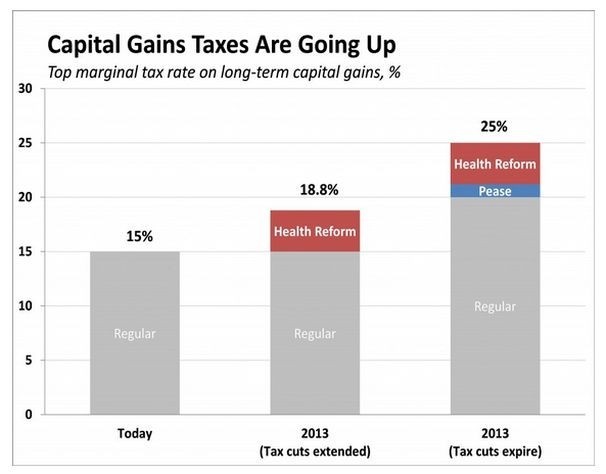
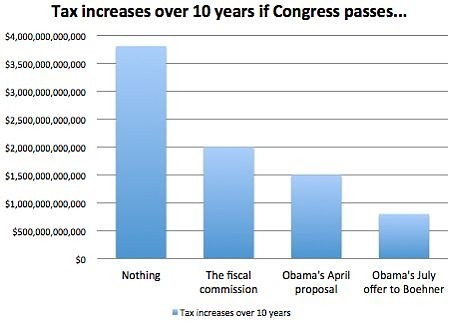
Even more reason to do nothing. The joy of gridlock will hike capital gains taxes up to 25% in the absence of any actions on the part of Congress. Barring anything actually, you know, happening in the Congress, Mitt and other Masters of the Universe will finally see something approaching a reasonable tax rate. Very Serious People will tell you otherwise, but for the next few years gridlock is decidedly Our Friend.

Obama’s Other Card

Even as the political battle mounts over federal spending, the end result for federal policy is already visible — and clearly favors Republican goals of deep spending cuts and drastically fewer government services.

President Obama entered the fray last week to insist that federal deficits can’t be reduced through spending reductions alone. Federal tax revenue also must rise as part of whatever deficit reduction package Congress approves this summer, he said. Obama has been pushing to end a series of what he calls tax loopholes and tax breaks for the rich.

But even if Obama were to gain all the tax-law changes he wants, new revenue would make up only about 15 cents of each dollar in deficit reduction in the package. An agreement by the Republicans to accept new revenue would be a political victory for Obama because “no new taxes” has been such an article of faith for the GOP.

I think this analysis leaves out a critical piece of the calculation: the December 2012 expiration of the Bush tax cuts. Recall that Obama, above all else, is the “outcomes” President. He’s more than willing to take a temporary political setback or even a seeming political loss in the short term if that in turn leads to the long-term policy outcomes he prefers.

So: to get a deal on the debt ceiling he gives the GOP a fatter ratio of cuts to revenues for now. Keep in mind, these “cuts” are really a framework that then plays out over most of a decade and will ultimately be changed and tuned by several Presidents and Congresses (and that’s assuming they stick to the framework at all).
Next year though, assuming Obama’s reelected, everything changes on the revenue front. If the Congress simply fails to act, the full set of cuts expires. If they act, but the GOP includes extension of the cuts for those making more than ~$200k/yr, Obama vetoes it. And, really, if we assume that the GOP will fail in its efforts to destroy the economy in the next few weeks, Obama likely prefers one of those two outcomes. Why? Again, it’s because they are the best long-term outcomes for the country. That both reflect poorly on the GOP is a bonus side benefit going into the 2014 midterms. To be sure, a tax rise represents real short term pain for the less well off, but that pain yields long term stability and, let’s face it, sanity in the revenue structures of the United States.

Expiration of the Bush tax cuts is a key pillar in the “do nothing” solution for our current deficit/revenue issues. The assumption that all or most of them are going to expire if Obama is reelected needs to be included in any meaningful political calculus regarding the ratio of cuts to revenue increases in the current negotiation. Assuming expiration, you ultimately end up with a number of difficult but doable fixes that can be handled one at a time. If those “fixes” are, you know, paid for, the country will once again be on firm financial footing, complete with a reasonably robust social safety net for as far as the eye can see. This is precisely the outcome Obama is playing for.

Obama’s Other Card

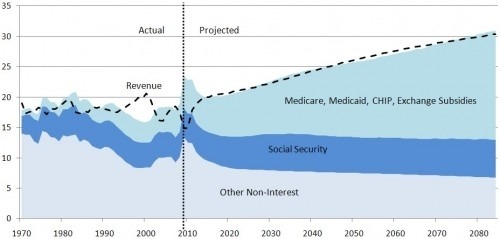
As Ezra Klein suggests, all economic conversations should begin (and end) with this graph. If we do nothing, the budget comes basically into balance:

But nothing is hard to do. This nothing, for instance, includes three crucial elements: (1) All the Bush tax cuts expire, as they’re currently scheduled to do; (2) The Medicare doc fix is either implemented or its repeal is paid for over the next 70 years; and (3) the Affordable Care Act is implemented, and all of its spending targets are met and all of its taxes are collected.

I’ll wager 1 million dollars that this topic or any discussion even remotely resembling it comes up exactly zero times in Obama’s Wednesday remarks.

It’s short, it’s simple, it’s understandable, and it’s true. All good reasons it won’t be used to bludgeon the GOP in the run-up to 2012.