Full Faith and Credit

John Chait sees some hope:

My guess is that Republicans are hearing from the business lobby that even risking a default would be totally unacceptable.

This because he notes Paul Ryan’s recent statement implicitly accepts that the debt ceiling will be raised (not can be, or might be):

“I want to make sure we get substantial spending cuts and controls in exchange for raising the debt ceiling”

Fair enough, Chait, and I’m sure they are already hearing it from the business lobby, but I think you’re forgetting the Tea Klanners in the back benches as well as the rump of the idiot Blue Dogs who all too often also think along similar, overly simplistic economic lines. We should never forget that a smaller and less organized contingent of these idiots managed to defeat the initial bailout, sending shockwaves through the markets that then and only then convinced them to do what was right (and not what played well with their foolish constituencies, most of whom want the US on a gold standard as soon as possible).

The problem with a similarly construed default bait-and-switch in which a symbolic first vote happens and then is undone some time later: the shockwaves in this case would be the end of the American economy as we know it. And there’d be no take-backs. It would simply be over. Once the genuine possibility of a default is even raised, you’ve basically defaulted. Why should anyone act otherwise in the aftermath of such a near-default? The thinking would immediately coalesce along the lines of: they didn’t actually pull the trigger this time, but we’re just one election away from something like that happening, and that’s more risk than we can bear. Get a few of these “I’m heading for the doors” mentalities together and our whole economic construct falls apart. Irrevocably.

They’re dumb enough, they’re bad enough, and dog gone it, people (will) hate them. But, rest assured, they’ll find a way to do it and will be laughing all the way to the gold deposit bank and calling it strict constructionism.

Re: Several of The Big Lies

dont-bs-me-bro:

Sorry, you are free to believe what you like, but this graph proves none of that, because it only goes back to Jan. 2010. It ignores the first 11 months of Obama’s adminstration, and seasonal changes in employment from quarter to quarter, year over year. It simply is not possible to examine just the most recent 11 months of data and draw any kind of big picture conclusions about the economy.

People choose cutoff points in graphs for a reason, to amplify the message they are trying to send. Let’s see some graphs that go back to 2007, or even earlier, for some context, and then we can debate facts about the economy.

So that takes care of (A) and (B). 

Or, not. Does this graph go back far enough for you? Total non-farm jobs under Bush and Obama:

Same conclusion: The United States under Obama is creating jobs. Period. Fewer than desirable, but job creation nonetheless.

You continue:

As for ©, of course government-funded jobs are not real jobs, because we have to fund them. This distinction causes confusion among those who don’t understand the difference between “real” jobs and government, taxpayer-funded jobs.

A real job is created when a private citizen or business dips into its own assets, or takes out a loan, to hire a person.

This is unadulterated horse-shit. A job is a job. A person is hired to perform a task in exchange for money. Period. They are jobs every bit as real as any other. They transfer money, also just as real, directly into the broader economy. That money spurs a larger overall economy. More people are hired. Lather, rinse, repeat: the Federal Government gradually reduces support as the private markets recover and can employ more people. I’m not sure why this is remarkably hard to understand other than the fact that it demonstrably works (see original three-part graph) and yet is incompatible with a worldview that states that no action of government, large or small, can be for the betterment of society. Ever.
All that aside, though, it is indisputably true that federal/state/local government employment has been distinctly reduced under Obama. Perhaps this graph has a sufficient time scale to pass your ever-so-sensitive BS detector?

That’s government employment relative to population. While the government did indeed get a lot bigger under such noted socialists as DD Eisenhower, it has since shown no trend at all relative to population. There at the very end, under Obama, you’ll note both the census spike and a distinct downward slide.

But, feel free to believe whatever nonsense you are being peddled. These are just the rather inconvenient facts.

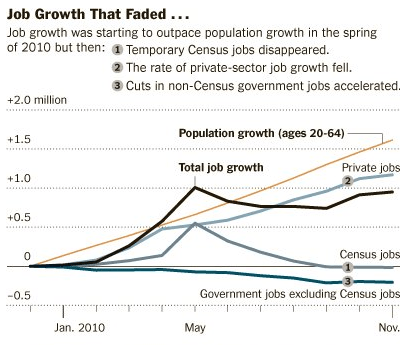
Several of The Big Lies put to, er, lie in one graph.

A) “No jobs have been created in the Obama administration, stimulus or otherwise,” unless, that is, you count all those jobs that have been created. Fewer than necessary to be sure, but indisputably there are jobs being created and tasks done in exchange for money.

B) “Government has exploded in the Obama administration” unless, of course, you exclude temporary census workers or set utterly arbitrary start/end dates to capture peak census-hiring (but not their subsequent and prompt return to zero). In fact, line 3 clearly shows government has indeed gotten smaller (as measured by employment) under Obama. This also holds as a percent of GDP, but that’s another graph.

C) “Government-funded jobs aren’t ‘jobs’ at all,” until you start to think about that line being parallel to the private jobs line, and where that, collectively, would put the overall employment line relative to population growth.
I mean, if you’re going to do crazy things like employ people by funding and then building infrastructure projects until the economy recovers, and then count those people as actually employed, well, then I think we know you’re a dirty fucking hippy who needs to shut the fuck up and worry a lot more about the bond vigilantes who are going to show up any day now to get 10-year bond interest rates up way, way above 2%, you can be sure. So there. Any. Day. Now.

The Wrath of the Bond Vigilantes

At first, the vigour with which Dublin wielded the spending axe won plaudits from bond markets. But the deflationary impact of the cuts has since seen the deficit widen.

Clearly the answer to this is simply deeper cuts. But only to services for the poor and unemployed. Couple that with a massive tax cut for the top 2% and you’ve got yourself a recipe for runaway growth…

The Wrath of the Bond Vigilantes

File under: Things We’re Not Allowed to Discuss.
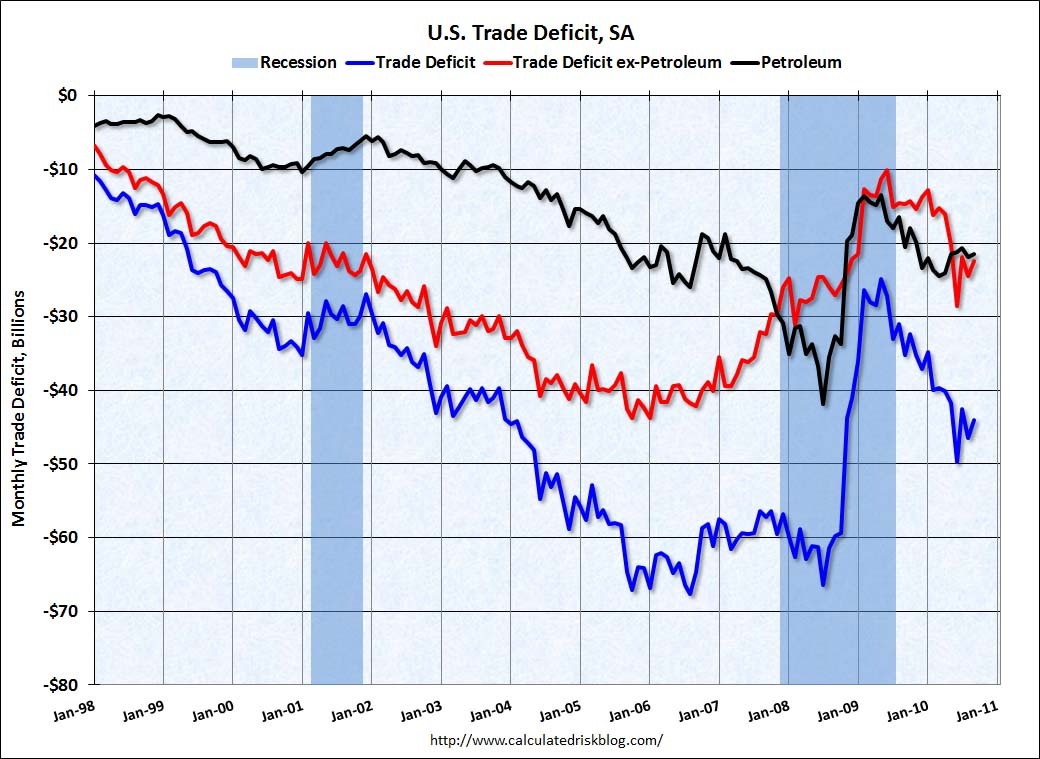
Much easier to talk about big bad China bogeyman than the simple fact that the car-centric, energy hungry American lifestyle of the late 20th century on is the thing driving our trade deficits, driving our foreign policy decisions, driving our economy into the ditch. Is it any wonder? The economic inducements drive most people to live 50 miles from work and, as a result, drive for hours each and every day, and drive everywhere else you may want to go as well. Insanity. And, far from calling out said insanity, our society seems to look down upon and make life unnecessarily difficult for those who are even able to choose to withdraw from this cycle.
That it is a solvable problem if and when met with sustained will to change it gives me no optimism whatsoever. That the process of solving it would greatly assist our own recovery will never be discussed. Cars today! Cars Tomorrow! Cars über alles!

Come On, Myerson, $303 Ain’t Bad

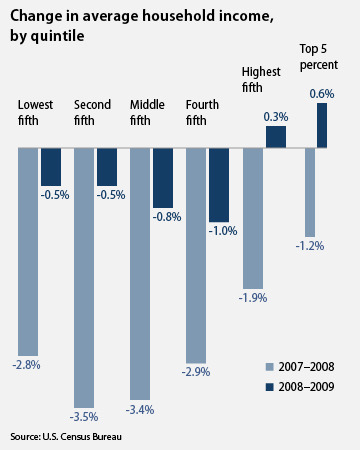
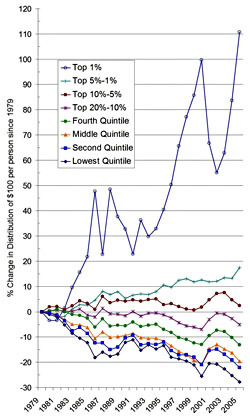
Since 1980, it’s been a very different story. The economy has continued to grow handsomely, but for the bottom 90 percent of Americans, it’s been a time of stagnation and loss. Since 1980, the share of all income in America going to the bottom 90 percent has declined from 65 percent to 52 percent. In actual dollars, the average income of Americans in the bottom 90 percent flat-lined – going from the $30,941 of 1980 to $31,244 in 2008.

In short, the economic life and prospects for Americans since the Reagan Revolution have grown dim, while the lives of the rich – the super-rich in particular – have never been brighter. The share of income accruing to America’s wealthiest 1 percent rose from 9 percent in 1974 to a tidy 23.5 percent in 2007.

Looking at these numbers, it would be reasonable to infer that when the Tea Partyers say that they want to take the country back, they mean back to the period between 1950 and 1980, when the vast majority of Americans encountered more opportunity and security in their economic lives than they had before or since. Reasonable, but wrong. As the right sees it, America’s woes are traceable to the New Deal order that Franklin Roosevelt, working in the shadow of the even more sinister Woodrow Wilson, imposed on an unsuspecting people.

In fact, the New Deal order produced the only three decades in American history – the ‘50s, ’60s and ’70s – when economic security and opportunity were widely shared. It was the only period in the American chronicle when unions were big and powerful enough to ensure that corporate revenue actually trickled down to workers. It marked the only time in American history when, courtesy originally of the GI Bill, the number of Americans going to college surged. It was the only time when taxes on the rich were really significantly higher than taxes on the rest of us. It was the only time that the minimum wage kept pace (almost) with the cost of living. And it was the only time when most Americans felt confident enough about their economic prospects, and those of their nation, to support the taxes that built the postwar American infrastructure.

Come On, Myerson, $303 Ain’t Bad

Looking at You, Nevada

jonathan-cunningham:

Raise the minimum wage to a living wage.

I think this, more than anything else, is what truly explains the electoral map:

They are almost the same (though inverted) image, with the exceptions of the Nevada/Utah/Texas WTF are they thinking™ lunacy corridor (and the fact that CO is lately a genuinely purple state, seemingly awakening from a long and careless slumber). And, honestly, Nevada’s current and indefensible Tea Klan tendencies are indeed a reflection of this: we’ve got Reid and still can’t get economic reforms going in this state.

It is not and may never be clear to me why all the Democratic “strategists” in the employ of the national party apparatus are so seemingly oblivious to the fact that we live in a polarized nation, but not polarized along any of the lines they parrot…polarized along the “I can afford to live where I do” and “I have to work three jobs just to buy my dollar’s worth of potted meat product and still keep myself and my family off the streets” lines. This is the real and only issue. It drives everything, most definitely including the Tea Klan.
Yet strategists and their candidates almost never pay more than lip service to the idea of it; more often than not, it’s dismissed entirely in service of better enabling the lives and fortunes of plutocrats.

That the term “working poor” now basically defines the middle class in this country is the real, existential issue. And still nobody but nobody ever wants to talk about it, much less do anything.

Banksters Own US, We Just Live Here

The investment banks didn’t mind buying up loans they knew were bad, because they considered themselves to be in the moving business rather than the storage business. They weren’t going to hold on to the loans: they were just going to package them up and sell them on to some buy-side sucker.

In fact, the banks had an incentive to buy loans they knew were bad. Because when the loans proved to be bad, the banks could go back to the originator and get a discount on the amount of money they were paying for the pool. And the less money they paid for the pool, the more profit they could make when they turned it into mortgage bonds and sold it off to investors.

Oh, and they withheld this information from the people and organizations they sold these products to.

I guess we’d better get together a blue ribbon commission. What, you think anyone will face trial over this? You think anyone will go to jail over this? You think any bank that sold these products will even have to pony up their own money to cover losses they created?

If you answered “yes” to any of those questions, you need to reassess just what country it is you live in and just who is in charge. Because it isn’t who you think.

Banksters Own US, We Just Live Here