Gee, mail?

Ezra Klein:

I’m starting to worry a bit about Gmail, which is at the core of pretty much my entire life. I know, I know — Gmail is safe. The data it feeds into the Google mainframe is extremely valuable to the search giant. They won’t let anything happen to it.

You should be worried and they will, inevitably, let “anything” happen to it. While Reader had far fewer aggregate users than GMail has, think of what the underlying dataset was. Hundreds of thousands, if not millions of savvy users collecting the the feeds they were interested in and then ladle on top what they actually read out of that list. Back in the old days, it was also what they starred and shared with friends. But that’s not allowed anymore, hasn’t been for a long time now…so, uh, there went that little nugget of highly actionable advertising information right down the toilet.
Many of the biggest sites around still garner huge fractions of their incoming hits from Reader feeds, and this is a product that has (at best) been ignored and (at worst) progressively disabled by a parent company ever sure that Reader’s just not “social” enough and therefore not anything people would ever be interested in. This, of course, after they killed the social functions in Reader. Nothing at all worth seeing in there for a massive advertising company, what with all the hits and all. Outgoing hits, don’t you know. One should expect to stay at Google. Kinda like AOL. You know, the early 90’s and the high excitement of “portal” sites. Which were pretty great, I think we’ll all agree. “You’ve got GMail!” is really something they should look into with the doodle. Get somebody’s 10% time assigned to that, Grace.

But the fact is, Google saw nothing worthwhile in that Reader data, or they wouldn’t be killing Reader. Yes, I understand that they think all that hot, linking action will automagically move into Google+, where no one is, and that the same massive group of nobodies will laboriously (and mostly manually) create the equivalent feed(s), one entry at a time, and just go back to enjoying all that great Google+ product when they’re not doing so. But, you know, manually. And in front their pals who also aren’t using the service.

So it should be pretty plain that the moment some corporate bozo decides that GMail is the problem with Google+ (or whatever the idiotic corporate bozo windmill Google is tilting at come the day), GMail will end. And no amount of “but I paid for more space!” will save your email, Ezra. This too shall pass.

So enjoy the grand convenience of being advertised to based on your emails while it lasts. Quite frankly: I love it too. Were it legal, I might marry it. Again, for the first time. And but also buy the biggest hard drive you can afford every couple of years and back up all your Google data to it. Because all of it will go away. Maybe not today, maybe not tomorrow, but soon. And for a long time.
41% of Americans were not aware of the [Supreme Court’s ACA] decision and/or its major finding. That includes 18% of the public who asserted that the decision had not yet been made.

Kaiser Family Foundation polling data (PDF link).
On the bright side, 56% of Americans that, uh, actually knew something had transpired in this area prefer that lawmakers “move on to other national issues” rather than “continue to block the law from being implemented.“ So there’s that…

Romney won’t have 60 votes in the Senate. But if he has 51, he can use the budget reconciliation process, which is filibuster-proof, to get rid of the law’s spending.

Ezra Klein reflects on President Romney’s potential chances and methods should he try repealing the ACA.
I’m not sure when, if ever, the DC Commentariat will get this through their heads: the next time the GOP holds the Presidency and a non-supermajority in the Senate, the filibuster will be eliminated approximately 30 seconds into the new Congress. Period, the end, carve it in stone.
Reconciliation won’t even be an issue with ACA repeal. It will be a simple majority vote, no filibusters allowed because there aren’t any allowed for any reason. Same with the functional elimination of Medicare, Social Security, and all the other Glibertarian wonders that await us under the Ryan budget plan when and if Romney wins. There’s simply no other way to get their preferred policies through, and the next time they have control of these levers of power they will get their policies through, no matter what it takes. Eliminating the filibuster will be among the more minor procedural changes and will be lost in the shuffle that heralds the end of the New Deal and basically all of the legislative 20th century.
Those are the stakes. Just when, exactly, will anyone in DC realize it? Sometime six to eight years after it all transpires, apparently. I’m assuming David Brooks already has an editorial in the can praising the end of filibusters. For Democrats, anyway.

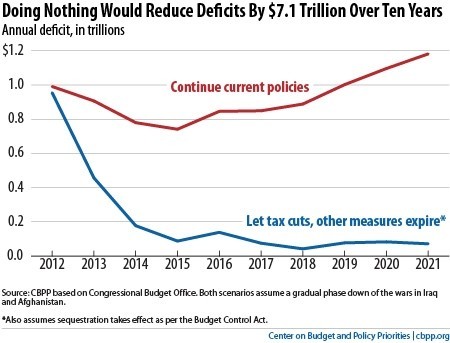
Do nothing, Congress. Ezra Klein and EJ Dionne both write today about the benefits of simply letting various existing policies expire…doing so would net $7.1 TRILLION in deficit savings over the same decade that the “Super-committee” can’t find a way to reliably extract $1T. This path requires no votes, it requires no legislation, it requires no GOP assistance of any kind. Gridlock is all that’s required to make it happen.
So why is it no Serious Person (to whom deficits are, always have been, and always will be the preeminent policy question come-what-may) ever talks about the biggest deficit reduction plan currently out there, a plan that outstrips all other extant deficit plans by several orders of magnitude? Because they don’t actually care about deficits. None of them do. Because deficit reduction is not the goal. The GOP and their media enablers do not care about deficits. They care about eliminating social spending in this country to lower taxes on the richest 1%. Period. Everything and anything else that happens is collateral damage to that desired policy outcome.

Gridlock works. Gridlock will help America. Relying on gridlock is the best possible negotiating tool for Democrats. Period. Be prepared to end the Bush tax cuts. All of them. Be prepared to end the “doc fix.” All of it. Be prepared to end it all. Then you begin to drive policy decisions and have actual governing authority to get jobs bills and other things done.

Instead, they will, of course, continue to negotiate with themselves and parrot right-wing talking points. This is why they fail.
Just sit there quietly and let it all expire. Whenever the GOP talks about deficits, you bring up the $7T you are cutting deficits by over the next decade.
When the GOP gets tired of that, realizes you are serious about this, and is ready to talk, they’ll come to you. Then you set the terms. Then you begin to govern. This is how politics works. The Democrat seems to have largely forgotten this. Again: this is why they fail.

S&GOP

Ezra Klein:

My hunch is that S&P was making a political argument and felt the need to cast it as deficit arithmetic. Then, when their arithmetic proved wrong, they were left looking foolish. As it stands, you actually can’t coherently merge the first and second versions of S&P’s explanation of the downgrade. That should tell you something about how rigorous their framework is, even if doesn’t obviate the still-legitimate points they made about our political system.

I think Ezra is fundamentally right here. The problem is this: if S&P set out to make a political point, they did so in such a fumbling manner that the political message, the most important part, was utterly lost. The MSM has a fundamental inability to report on something negative relative to a single party. Obama offered at least four debt ceiling deals, including several that had previously been GOP deals. How was this reported? “Both parties unwilling to compromise; President unwilling to lead and/or deal”
S&P issues a report castigating GOP intransigence on revenues. Reported: “political system unable to deal with current crisis.”

If S&P truly intended to make a political point, the report itself needed to be called “The GOP’s Willful Destruction of The American Century” or “Political Nihilism and Today’s GOP: A Downgrade Story” and furthermore needed to be told through colorful pictures and in fewer than 50 words. There’s no way in hell a company like S&P is going to do this; they are fundamentally incapable of really making the political point that they seem to have set out to make, as such moves soon prove to be bad for business. (And don’t think for a moment the GOP will forget this slight. There will be GOP initiated investigations, damaging ones, into S&P at the first available opportunity). Therefore: you don’t do it at all unless you can back it up with hard numbers such that the conclusions are inescapable. Which they also couldn’t do. But that national embarrassment is a whole other post.
Assuming for the moment that they went there and made the political point utterly and inescapably explicit, even then, it would be hard to get the MSM to report it as such. They’d dodge with a “it’s all very complicated” or “let’s leave it there” or simply book only conservative guests and allow them to talk as long as they want to without challenge or correction. Above all else, they’d avoid any mention of what was actually written in the report. You know: pretty much what’s happened in the last several days.

Naturally, this all has to transpire alongside the slow-motion European financial collapse and its effect on global markets. Typically “USA über alles” reporting over-stresses the influence, if any, of the downgrade on global events. “Post hoc, ergo procter hoc motherfucker” may as well go on the Times masthead. People are stampeding for Treasuries!!! It must be the downgrade of that instrument’s backing that is causing them to do this!!! (Had the downgrade not occurred, at least FOXnews and maybe the broader media would have blamed the collapse in value on the Presidential birthday BBQ’s failure to durably impact jobs creation). The MSM response? Get some folks on to scream “I blame the Democrat and the dirty fucking hippies for this historic downgrade of the United States and the similarly timed collapse of the global markets. The only response is to slash the social safety net, cut taxes, and increase defense spending. Or a mandatory National Week of Constant Prayer. Whichever.” What other rational approach is even possible?“

This is why we fail.

In short, the Boehner plan would force policymakers to choose among cutting the incomes and health benefits of ordinary retirees, repealing the guts of health reform and leaving an estimated 34 million more Americans uninsured, and savaging the safety net for the poor. It would do so even as it shielded all tax breaks, including the many lucrative tax breaks for the wealthiest and most powerful individuals and corporations.

Robert Greenstein, writing about the “Boehner plan” at the nonpartisan CBPP.
Said it approximately one billion times: this isn’t some side affect. It’s the intended consequence. The debt ceiling is simply a useful construct for ramming the same old policy of “zero social safety net, all wealth and benefits to top 2%” GOP dream government setup. All it is, was, or ever will be. If they fix the debt ceiling this morning, they will be using the next federal budget (which will need to be done to have a government post-September) to push the exact same line by this afternoon.
The GOP does not care about deficits. If they did, they’d have taken any of the four increasingly huge deficit cutting plans offered them. They want low to nonexistent tax rates on the top 2%. Simple arithmetic will show anyone that this means eliminating the social safety net; as Ezra Klein has noted: the federal government is better thought of as an insurance conglomerate with a large standing army. To cut taxes to “GOP preferred” levels, services have to go. And to get rid of those hugely popular and helpful services, a large number of people using them have to be convinced said services (and government in general) aren’t working or even in their interest at all. This is the core GOP governing strategy in fifty words or less. Everything they have done and said in the past several decades of tight, lockstep messaging with the aid of the most popular “news” network on television has been aimed at and in service of making those 48 words reality.
Everyone not already up the ladder will kindly go die in the streets. Today they’re using the debt ceiling, tomorrow it will be the FY2012 budget, the next day it will be veterans benefits or whatever else comes to hand. And until they are forced to pay a steep political price for steadfastly using gridlock and economic hostage situations as a negotiating strategy, they will continue to use them. That Congressional and Executive Democrats seemingly haven’t figured this out yet is why they fail.

Obama’s Other Card

Even as the political battle mounts over federal spending, the end result for federal policy is already visible — and clearly favors Republican goals of deep spending cuts and drastically fewer government services.

President Obama entered the fray last week to insist that federal deficits can’t be reduced through spending reductions alone. Federal tax revenue also must rise as part of whatever deficit reduction package Congress approves this summer, he said. Obama has been pushing to end a series of what he calls tax loopholes and tax breaks for the rich.

But even if Obama were to gain all the tax-law changes he wants, new revenue would make up only about 15 cents of each dollar in deficit reduction in the package. An agreement by the Republicans to accept new revenue would be a political victory for Obama because “no new taxes” has been such an article of faith for the GOP.

I think this analysis leaves out a critical piece of the calculation: the December 2012 expiration of the Bush tax cuts. Recall that Obama, above all else, is the “outcomes” President. He’s more than willing to take a temporary political setback or even a seeming political loss in the short term if that in turn leads to the long-term policy outcomes he prefers.

So: to get a deal on the debt ceiling he gives the GOP a fatter ratio of cuts to revenues for now. Keep in mind, these “cuts” are really a framework that then plays out over most of a decade and will ultimately be changed and tuned by several Presidents and Congresses (and that’s assuming they stick to the framework at all).
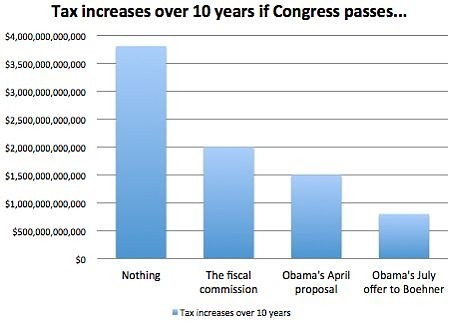
Next year though, assuming Obama’s reelected, everything changes on the revenue front. If the Congress simply fails to act, the full set of cuts expires. If they act, but the GOP includes extension of the cuts for those making more than ~$200k/yr, Obama vetoes it. And, really, if we assume that the GOP will fail in its efforts to destroy the economy in the next few weeks, Obama likely prefers one of those two outcomes. Why? Again, it’s because they are the best long-term outcomes for the country. That both reflect poorly on the GOP is a bonus side benefit going into the 2014 midterms. To be sure, a tax rise represents real short term pain for the less well off, but that pain yields long term stability and, let’s face it, sanity in the revenue structures of the United States.

Expiration of the Bush tax cuts is a key pillar in the “do nothing” solution for our current deficit/revenue issues. The assumption that all or most of them are going to expire if Obama is reelected needs to be included in any meaningful political calculus regarding the ratio of cuts to revenue increases in the current negotiation. Assuming expiration, you ultimately end up with a number of difficult but doable fixes that can be handled one at a time. If those “fixes” are, you know, paid for, the country will once again be on firm financial footing, complete with a reasonably robust social safety net for as far as the eye can see. This is precisely the outcome Obama is playing for.

Obama’s Other Card

So when the GOP’s economic policy team sat down to make the strongest case they could for growth-inducing deficit reduction, they recommended a mix an 85:15 mix, not a 100:0 mix. And then, when the Obama administration agreed to an 83:17 mix, the Republican leadership walked out of the room and demanded that taxes be excluded from the deal altogether. How do you negotiate with that?

Ezra Klein asks the right questions.