Gee, mail?

Ezra Klein:

I’m starting to worry a bit about Gmail, which is at the core of pretty much my entire life. I know, I know — Gmail is safe. The data it feeds into the Google mainframe is extremely valuable to the search giant. They won’t let anything happen to it.

You should be worried and they will, inevitably, let “anything” happen to it. While Reader had far fewer aggregate users than GMail has, think of what the underlying dataset was. Hundreds of thousands, if not millions of savvy users collecting the the feeds they were interested in and then ladle on top what they actually read out of that list. Back in the old days, it was also what they starred and shared with friends. But that’s not allowed anymore, hasn’t been for a long time now…so, uh, there went that little nugget of highly actionable advertising information right down the toilet.
Many of the biggest sites around still garner huge fractions of their incoming hits from Reader feeds, and this is a product that has (at best) been ignored and (at worst) progressively disabled by a parent company ever sure that Reader’s just not “social” enough and therefore not anything people would ever be interested in. This, of course, after they killed the social functions in Reader. Nothing at all worth seeing in there for a massive advertising company, what with all the hits and all. Outgoing hits, don’t you know. One should expect to stay at Google. Kinda like AOL. You know, the early 90’s and the high excitement of “portal” sites. Which were pretty great, I think we’ll all agree. “You’ve got GMail!” is really something they should look into with the doodle. Get somebody’s 10% time assigned to that, Grace.

But the fact is, Google saw nothing worthwhile in that Reader data, or they wouldn’t be killing Reader. Yes, I understand that they think all that hot, linking action will automagically move into Google+, where no one is, and that the same massive group of nobodies will laboriously (and mostly manually) create the equivalent feed(s), one entry at a time, and just go back to enjoying all that great Google+ product when they’re not doing so. But, you know, manually. And in front their pals who also aren’t using the service.

So it should be pretty plain that the moment some corporate bozo decides that GMail is the problem with Google+ (or whatever the idiotic corporate bozo windmill Google is tilting at come the day), GMail will end. And no amount of “but I paid for more space!” will save your email, Ezra. This too shall pass.

So enjoy the grand convenience of being advertised to based on your emails while it lasts. Quite frankly: I love it too. Were it legal, I might marry it. Again, for the first time. And but also buy the biggest hard drive you can afford every couple of years and back up all your Google data to it. Because all of it will go away. Maybe not today, maybe not tomorrow, but soon. And for a long time.
Faceplant

Sergey Brin: [Smartphones are] emasculating. You’re standing around and just rubbing this featureless piece of glass.
John Gruber: I can see the argument that dicking around with our phones in public is not cool, that we should pay more attention to our companions and surroundings, and less to our computer displays. Strapping a computer display to your face is not the answer.
Lemkin: Yep. File Google Glass away with “Because everything is waterproof, the housewife of the future will clean the living room with a hose.”

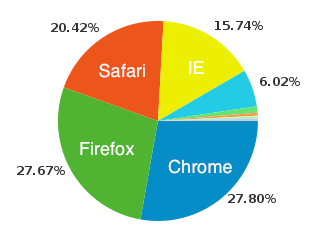
In which TechCrunch tells us about their browser stats. It’s sort of moderately amazing that Chrome is (already) edging out Firefox, but what I find most astounding, the thing that 2003 me would not have believed at all, is that Safari is third. Even more amazing: the article notes that 10% of Safari’s score is coming from the Mobile Safari variant, meaning iOS devices like iPhone and iPad.

tl;dr: Mobile Safari is now within striking distance of IE, and Safari as a whole is cleaning its clock, at least within the obviously gadget-obsessed demographic that reads the source. Let’s all pause to reflect on that for a few moments, because it’s fairly incredible, especially when you count the number of sites (and tech-support scripts) out there still “optimized” for IE6.

iThink therefore iAm

Kottke talks about the iPhone (as a device-class, mind you, not specifically the device) impacting many, many more markets than just smart-phones or PDAs. It’s also a compact camera killer, to name only one segment touched on in his fine essay. And I think he’s basically right. But I want to talk about a point he makes in the second footnote (without going all DFW on you):

You’ve got to wonder when Apple is going to change the name of the iPhone. The phone part of the device increasingly seems like an afterthought, not the main attraction. The main benefit of the device is that it does everything. How do you choose a name for the device that has everything? Hell if I know. But as far as the timing goes, I’d guess that the name change will happen with next year’s introduction of the new model. The current progression of names – iPhone, iPhone 3G, iPhone 3GS – has nowhere else to go (iPhone 3GS Plus isn’t Apple’s style).

Gruber picks up on this point too, basically answering him directly with:

If this platform is here for the long run, the general purpose name that best works for a general purpose device is already here: iPod. In fact, iPod, semantically, is a better name for the iPod Touch than it ever was for the original focused-on-music models. As I see it, the phone in iPhone isn’t about telephony, but about the necessary contract with a mobile carrier.

Agreed. Lemkin was all over this subject back in 2007 (!), talking about Steve Jobs’ almost certain desire to skip 3G (and any other carrier-tied technology) entirely in favor of some form of ever-present WiFi that could come from any company, municipal co-op, or whatever. This, of course, is the ultimate existential threat to AT&T: if they become (as a company) nothing more than a provider of the dumb pipe, then you can substitute any old dumb pipe for them without noticing any change at all. This is why they’re fighting Google tooth and nail over Google Voice, though hiding behind Apple to do it (presumably, the relevant lawyers (correctly) predicted a prompt FCC smackdown should AT&T intervene directly). But they will lose this fight over the long term. Google has already seen to it via the bidding process on the wireless spectrum. How well did AT&T like that?

“Google is demanding the government stack the deck in its favor, limit competing bids, and effectively force wireless carriers to alter their business models to Google’s liking.”

By “alter their business models” he meant to say: “stop relentlessly fucking over the end-user through long, inflexible contracts on POS phones of AT&T’s choosing.” Oh, GenericNetCo has really cheap wireless internet this month. I’ll switch. So it’s fundamental to AT&T that they seemlessly transition you from the locked, carrier specific technology (basically today’s situation) to the quietly generic wireless technology (aka Dumb Pipes) they’re hoping you don’t even notice you can actually get from anyone and everyone that cares to provide said service.

What will be their value-add in this situation? Unclear. Presumably they intend it to be nationwide reach, reliability, convenience, and some kind of competitive pricing for same. That said, and somewhat obviously, if AT&T were dependent on consumer goodwill and raw network reach, reliability, and convenience as of today, they’d be out of business inside of a fortnight. They seem busier blaming their iPhone users for their network’s various problems than, you know, improving the service that they are contractually obligated to provide in some fashion or other. And that’s within a market and on a network whose design they’ve had decades to cultivate, tune, and understand (though with an outcome that clearly implies that they still don’t “understand” what it is these iPhone users expect from their device, and how that’s different from, say, the user of a more generically crippled feature-phone). So can they build out a nationwide, everpresent, high-speed, and five-9s reliable WiFi service that’s compelling enough to keep people around once access to the underlying technology no longer requires multi-year contracts? Without recourse to tethering them to a number or some other lock-in? I seriously doubt it.

But, yeah. It will be called the iPod. Within a handful of years, the core iPod platform will be entirely Touch-based, and thus simply morph back into iPod (with Nanos or Shuffles being the variant, but today’s Touch being The iPod). And you’ll use said device to make calls.

All your recruitment positions are belong to us

Yet another “I interviewed with teh Googul” story. This one recounts the eight (count ‘em) 8 interviews that were required to sift said applicant (or supplicant?) into the OUT pile. Not ready for mission critical jobs said they. Google probably has 3000 people working on said mission critical project, but–hey, if even one of them is only 110% ready on day one, all of Google will resolve to: fail. There’s a whole post in the notion of mission critical here, but what really gets me is the initial pitch.

Said supplicant wrote some ki11er k0de that caught mighty Google’s unblinking eye. So they wrote him thusly:

I recruit top notch Software Engineering talent at Google. I recently came across your name as a possible world class Engineer and am intrigued to know more about you. I promise to exchange some detailed info about us as well.

Uh, okay. Said Supplicant apparently still believed this note actually came from Google, and managed to attend some interviews to prove it. We can only assume the letter went on to say:

I are having some 92 million dollars UNITED STATES to park in you’re accounts. Do you have sum numbers’ so I can begin to moving the UNITED STATES dollars to your accounteds?

Clearly, recruiting “world class Engineers” isn’t in and of itself a mission critical operation.