
Ezra Klein muses on 2010: The Year We Make Contact; the whole post can be summed up graphically with this:
and this:


Ezra Klein muses on 2010: The Year We Make Contact; the whole post can be summed up graphically with this:
and this:
Healthcare reform is wrong for the country unless it gets ‘somewhere between 75 and 80 votes.’
Health care reform is wrong for the country unless it gets ‘at least 70 votes’
–Orrin Hatch, ® Fucktardia.
Who will be the first to propose the magical 100 vote margin?
Ezra Klein puts this simple concept as well as I’ve yet seen:
Liberals don’t think that Congress will pass a bill outlawing private insurance. They don’t think the Supreme Court will render a decision naming WellPoint “cruel and unusual.” Rather, they think the market will, well, work: The public option will provide better service at better prices and people will choose it. Or, conversely, that the competition will better the private insurance industry and that people won’t need to choose it.
But that confidence rests on a very simple premise: The public sector does a better job providing health-care coverage than the private sector. If that proves untrue – and I would imagine most every conservative would confidently assume that that’s untrue – the plan will fail. The public option will not provide better coverage at better prices, and so it will not be chosen, and it will languish. Indeed, if it languishes, it will lack customers and thus lack bargaining power and economies of scale, and get worse even as the private insurers get better. In that scenario, the public option not only fails, but it discredits single-payer entirely.
The liberals are willing to bet that they’re right. It’s not a sneaky strategy: It’s an up-front wager. The conservatives are not, however, willing to bet that they’re wrong. They’re willing to say the public option will fail, but not give consumers the chance to decide that for themselves.
If we had a working government, maybe we’d get to try things, work for good policy, and ultimately get to the best outcome for the American people, whatever that might be. Why are the conservatives in this argument so afraid of The Market? What don’t they want us to find out?
[The public option is a] major step toward universal health care coverage.”
With 40 grandchildren of his own, he said, he does not want the country to go in that direction.
Obama directs FCC to adopt “Net Neutrality” (and write any new or revised regulations accordingly). This policy is a 180 from the Bush administration position that can be boiled down to “whatever the big companies want, the big companies get,” and these changes would, without a doubt, foster the sorts of innovations and game-changing uses that people tend to use the word “internet time” as a synonym for (e.g. rapid advance over short time periods and the ubiquitous availability of seemingly all human knowledge to relatively simple front-end tools on computers, and nowadays, mobile devices of all shapes and forms).
Naturally, today’s GOP, ever a friend to the Established Interests is categorically agin it. Kay Bailey Hutchison says:
I am deeply concerned by the direction the FCC appears to be heading.
Indeed, just take a look at these troubling developments:
new network neutrality rules that would require carriers to deliver broadband in a nondiscriminatory manner and to disclose their network management policies. Genachowski also said the FCC would explore the question of whether to extend network neutrality rules to mobile carriers.
[…]
“This means they cannot block or degrade lawful traffic over their networks, or pick winners by favoring some content or applications over others in the connection to subscribers’ homes,” [FCC chairman Julius] Genachowski said in an address before the Brookings Institute Sept. 21. “Nor can they disfavor an Internet service just because it competes with a similar service offered by that broadband provider. The Internet must continue to allow users to decide what content and applications succeed.”
How can innovation possibly succeed in an environment that encourages open competition and a level playing field? It’s unpossible. The only way forward: Hutchison feels the monopolistic providers of net access as of today “should be unencumbered by consumer protections and basic Internet freedoms.” Indeed they should.Who could possibly want any of those things. According to the GOP, freedom is overrated anyway.
Net neutrality: clearly another example of Obama’s rampant Socialist, command-and-control agenda. By forcing the internet to remain open and free, unchained by secret access rules or “preferred” website providers and tiered service, he’s pursuing the Socialist takeover of said internet by lots of small, innovative, ideas-based companies that leverage terrifying Socialistic Free-Market principles at the expense of the moneyed interests and the various, ossified, copper-wire owning players of today. Why, that’s categorically un-American! Jon Ensign, in a remarkable bit of double-speak, clearly agrees:
In this struggling economy, any industry that is able to thrive should be allowed to do so without meddlesome government interference that could stifle innovation,“ Ensign said in a statement. "We must avoid burdensome government regulations that micromanage private businesses or that limit the ability of companies to provide what their customers want. The Internet has flourished in large part because of a lack of government interference; I see no need to change that now.
Truly, truly remarkable. No other word for it. By writing regulation that permanently opens the internet to competition from all comers, and any size company, by guaranteeing this access for both consumers and businesses we are, in fact "micromanag[ing] private business” and “limit[ing] the ability of companies to provide what their customers want.” Because we know what customers want, now and forever. So long as customers want tiered internet access, and a Comcast-approved network, that is. And, since that’s all they’re offered in most markets through built-in, city-wide monopolies, that must be what they want. Right? Right?
An excellent Boston Globe op-ed describes the current, historically bad state of the Grand Old Party, held hostage as it is by the most extreme elements of its fringe membership. I’ve even put it in graph form:

Pretty easy to gather that, compared to everybody else, Democrat and “Independent” alike, self-described Republicans hold very different views on the issues of the day. And it’s not as though, were these folks asked about immigration or abortion, they’d suddenly step back into some region of the non-lunatic spectrum. GOP identifiers largely believe (to the tune of 58%) that the President of the United States is a secret Muslim born in Kenya, after all. And that he’s furthermore planning to usher in a Socialist Empire of some sort. People are certainly entitled to their insane views; the problem is, as the article notes:
In America, we don’t really have splinter parties. When one of our parties goes crazy, it doesn’t slide to the margins.
Yep. It’s not as though this is some tiny, ad-hoc group’s take on some arcane local zoning issue we’re talking about here. This is a national party competing for the Presidency. We either need more choices, or need the GOP to sort itself out, and fast.
But, far from dusting itself off and letting some cooler heads prevail, the modern GOP just pushes the crazy meter even further along. Here’s the man that delivered the response to Obama’s joint-session address on the subject of the President’s citizenship:
STARK: What do you personally believe, I mean – do you think there’s a question [surrounding Obama’s citizenship] here?
BOUSTANY: I think there are questions, we’ll have to see.
Alright, they must have chosen Boustany because of some sort of unique ability or achievement in the healthcare and its administration in LA. Or not:
…ranked Louisiana dead last in 2008 among the 50 states for the overall health of its people, hugely because of its high percentages of people without health insurance, preventable hospitalization, infant mortality, cancer deaths, cardiovascular deaths, and overall premature deaths. The Trust for America’s Health had similar findings in its 2008 rankings. The infant mortality rate in Louisiana, according to the United Health Foundation report, is more than triple that of Slovenia and the Czech Republic.
And yet, apparently, this is the best the GOP had sitting on the bench, waiting to make an important speech to an audience who’d just watched Obama make his case.
Worth noting the ending of the afore-linked op-ed:
Maybe Democrats should be happy that Republicans have been reduced to a lunatic fringe. But the lunatics still have their seat at the table, and someday they may be sitting at its head again. What then?
Greg Sargent pulls out some interesting figures from a recent WaPo poll:
* That Dems hold an overwhelming 20-point lead on which party is most trusted on major issues, with Obama preferred over Republicans by 12 points on health care.
* That a majority, 53%, agrees that “government reform of the nation’s health care system is necessary to control costs and expand coverage,” underscoring yet again that the public wants government action.
* That a plurality now believes reform won’t prevent people from keeping their own health care, suggesting the public may be it reform as less and less threatening.
* That a big majority, or 62%, believe Republicans have not made a good faith effort to cooperate with Dems on health care.
That last one seems the most damning. Everyone talks about 2010 being full of doom for the Democratic party. To be sure, historic majorities like the current Democratic position don’t last. By definition, any “historic” majority is going to include seats that, for one reason or another, are more likely to be held by the non-historic-majority party more often than not.
But, and it’s a big but: to go back to the “predictable” seat holder party-wise, you still have to give those “predictable” voters a reason to prefer you. And the GOP isn’t doing it so far. Even worse: people are noticing. Naturally, we need to see some of these toss-up districts broken out to be sure, but I suspect this polling data is more or less on the nose.
The bad news for Democrats in this poll is this:
a big majority wants Dems to craft a bill that will win GOP support
Since we know a priori that no proposal will win GOP support (party leaders have done everything but put that in writing on granite tablets), there would appear to be a rather hazardous, built-in capacity for outrage. That is: voters, never ones to pay a lot of attention, will see that some healthcare reforms passed, not realize that nothing rolls out until 2012 or later (circa 2010: “I ain’t seen nuthim from it ‘tall!”), see (and be told repeatedly) that not one member of the GOP voted for it in the House and that (at most) one or two GOPers voted for it in the Senate, and will assume that all the “problems” with the bill are well and truly the fault of the Democrats. And, here’s the rub: they’ll assume it’s all because they wouldn’t work with the GOP, not because the GOP refused to work in good faith with the Democrats. The ever feckless Reid et al. will try to point out that no GOP proposal or counter-offer (beyond Go Die in the Streets) ever appeared. But the media cares not for nuance, and you need to be setting up the short, two or three word rhyming drumbeat right now, every day, every hour, and every minute about GOP intransigence such that, when the time comes (and it will come), you can merely call back to your groundwork, which will seem familiar, and will almost automatically become the basis for the discussion. No Democrat should even be approaching a microphone without uttering something like “The GOP needs to Play, or Pay.”
Of course, that will not happen. And, we all know that, even if the Democrats managed to gain seats in 2010, it will be portrayed as “good for Republicans.” Everything always is.
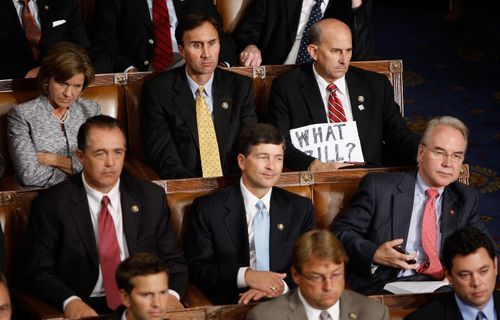
Every face tells a story…
Total spending on health care, per person, 2007:
United States: $7290
United Kingdom: $2992
Italy: $2686
Spain: $2671
We must be getting the best outcomes, right? Think of all our technology!?! Think again:
As of the 2006 data (the most recent I can find), we ranked 27th in infant mortality, just behind the Slovak Republic, with Mexico nipping at our heels. Life expectancy at 65 for females (compared among the relatively wealthy nations) ranks 14th, males 18th. We perform similarly poorly in almost all metrics you look at, perennially trailing countries that spend 4 or 5 times less per person than we do; hell, we trail countries that people would otherwise routinely mock as sadly “backward” or “economically stunted.” Dread France beats us on costs and outcomes. Repeatedly. (This data and much more available here. Use it. Please.) So, just to summarize in the simplest, clearest terms possible:
we pay 2.4 times more per person on healthcare than our next nearest competitor and get substantially worse outcomes than countries spending even less than that.
But, by all means, GOP: don’t mess with such a powerhouse of efficiency. Well, beyond your proposed “solutions” of blowing up the existing employer-based system and putting everybody out on the streets to fend for themselves.
Today’s GOP can effectively be summed up by the phrase “Go Die in the Streets.” Seriously, it applies to every position they have. Clearly, they’re working backwards from it to form whatever passes for policy in their lairs.
Just to review, I give you the 2010 GOP Platform:
Social Security: Go Die in the (Wall) Streets
Welfare: Go Die in the Streets
Immigration: Go Die in the Streets (preferably of your home country, but we’re not picky)
Healthcare: Go Die in the Streets
Military Spending: Go into the Streets so you can Die
Firearms/Gun Control: Go Die in the Streets
Abortion: Go Die in the (back) Streets
Prove me wrong, children. Prove me wrong.

