Cause and Effect

unsolicitedanalysis:

So, of course you lead your rebuttal with two incidents that do not substantiate your argument.

Hey pal, you’re the one that disputed the very existence of a focused and systematic deconstruction of the regulatory apparatus on the part of successive GOP administrations dating back to Reagan and “government is the problem.” Just providing you with a few of the more brazenly obvious examples of said “unheard of” activities that go beyond fostering a merely “cozy” relationship between regulators and industry. The regulations themselves have been weakened through a focused and Bush-administration-mandated lack of enforcement coupled with Congressional oversight turning a blind-eye to what amounts to ignoring a Constitutional mandate that the Executive branch see to the enforcement of the law as it exists, not the law they wish they had. See: Statements, Signing.

On oil:

Proximate Cause: Cheney directly contributed to, and arguably caused this accident by determining that acoustic switches and more robust blowout preventers would be an “undue burden” on the industry

Cause: Blowout valve that was placed was insufficient to seal the bore in event of catastrophic accident

Effect: Essentially unstoppable flow of oil into gulf until some other solution is found

Yes, Dick Cheney was evil!  Except no one knows why the blowout prevention system failed

The old “no one could have expected!” dodge. Uh, sorry to be the bearer of bad news, but we know exactly why it failed: Among other, more minor failings, even had everything worked perfectly the cutoff device was insufficiently robust to actually cut through the casing and seal the bore with the drilling and lining apparatus still in place.

The Deepwater Horizon’s blowout preventer had:

  • A dead battery;
  • Leaks in the hydraulic system that would activate the pistons in the [“unforeseeable”] event of an accident;
  • By design, 260 different failures that could require the BOP’s removal and replacement;
  • A useless test component installed, and;
  • Cutting tools that were not strong enough to shear through 10% of the joints in the piping.

You might note that each of these is a case directly addressable by a robust regulator assigned to oversee this activity. Any of these cases is found to exist: the work on drilling stops until they are rectified. The permit to drill can be suspended or revoked. Fines can be levied. None of these listed failures represents some condition that was unknowable or some totally unexpected chain of individually minor failures that led to the disaster. The primary cutoff system was insufficient to cut the bore. It should never have been placed. The regulatory apparatus as directly conceived and constructed by Bush/Cheney was asleep at the switch, a switch which they had furthermore allowed the oil industry to design and install (seeing as the regulatory reports were being filled out in pencil by the industry and “inked” by the regulators. Wonderful; indeed a searing indictment of the very concept that regulation can work. I guess we should just throw up our hands and forget about regulating industry.

But lets get back to your argument:

How do you stop “cronyism?”

How’s about by stopping cronyism? Simply deny the administration authority to undertake widespread replacement of the traditionally non-political, “career” civil service jobs (yes, I know you are shocked, shocked to hear that such a thing took place under Bush). And yes, Congress (lately in the fetid claws of The Democrat) desperately needs to flex its oversight power here; as a rule no administration should be allowed to sweep out what have been historically apolitical, career jobs in favor of putting unqualified hacks in place (that were, in this case, specifically placed to create the auto-affirming appearance of a government of by and for political hacks that is incapable of the simplest services or regulatory oversight). Undermining confidence in the government is/was the stated aim of these moves. And guess what: it’s working.

How do regulatory agencies take responsibility for decision-making that they don’t have absolute power over?  Do you believe in providing them with absolute power?

Give them absolute power. That’s the point of any well thought out regulation, to remove the potentially devastating outcome of precisely this kind of case-by-case, politically charged decision making (recall that BP received a personalized waiver on this project, one which was renewed on an apparently pro forma basis by the Obama administration) and in place of that patronage- and crony-based situation you build an impartial apparatus outside of the two/four/six year political cycle that impartially declares “we will allow BP to drill here, and these criteria will be met; these are the various levels of penalty for the different gradations of wrongdoing, be it accidental or willful. Here is how we will empirically determine compliance, stated in advance, such that BP can plan and act accordingly. In the event of accident, these are the guidelines…” Congress simply needs to find its institutional will to act, reengage its oversight function in a robust way (they are at least holding hearings again…), and ultimately force a broad reform that begins to cure a systemic ill.

Is that really so hard to understand?
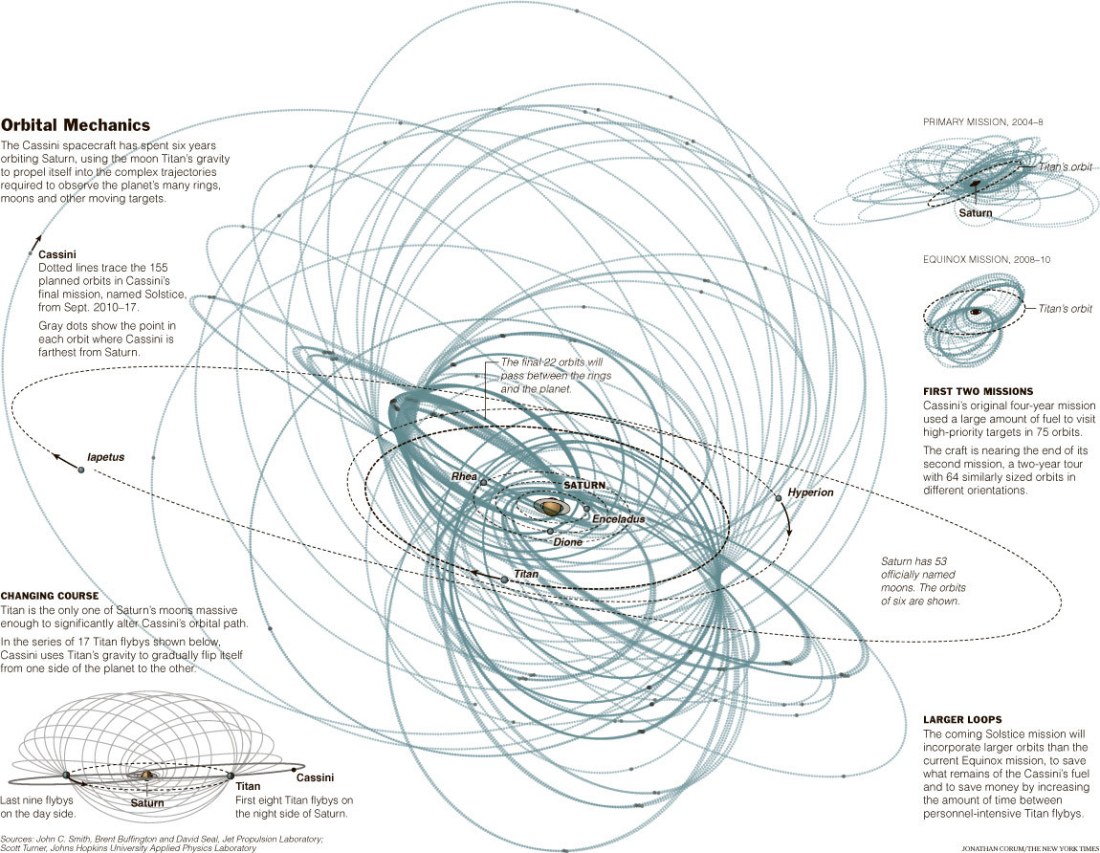
The government blows it again; Cassini mission extension lasts seven years (that’s seven years beyond the already extended six years of service, itself two years longer than anyone anticipated. In orbit around Saturn.)
The final “reference trajectory” calculates all the course corrections and various gravity-assisted adjustments, tracking through those seven years, all the while correlating scientific goals with manpower and funding availability. Out seven years. This path “includes 56 passes over Titan, 155 orbits of Saturn in different inclinations, 12 flybys of Enceladus, 5 flybys of other large moons.” Then the probe will fly into Saturn and be destroyed.

Is there nothing this government can do right?

Tea Klan in Brief(s)

Witness the Shirks, perhaps the most ironically named Tea Klanners in existence:

For the Shirks, it was a day for their children to seek inspiration from Palin and the other speakers, who questioned Obama’s patriotism and at least one of whom referred to him repeatedly as Barack Hussein.

The couple, who rely on Medicaid for their health care, were also upset about the nation’s new health reforms.

When asked why her family used state-subsidized health care when she criticized people who take handouts, Valerie Shirk said she did not want to stop having children, and that her husband’s income was not enough to cover the family with private insurance.

“I know there’s a dichotomy because of what we get from the state,’’ she said. “But I just look at each of my children as a blessing.’’

Truly paragons of the Individual Responsibility arm (far-right lunatic division) of the GOP. I mean, seriously. No doubt they arrived in a Cadillac.
Lest you think this is some isolated case, here’s another just like it (served up with a twist):

Tea Party supporters said they did not want to cut Medicare or Social Security – the biggest domestic programs, suggesting instead a focus on “waste.”

Some defended being on Social Security while fighting big government by saying that since they had paid into the system, they deserved the benefits.

Others could not explain the contradiction.

“That’s a conundrum, isn’t it?” asked Jodine White, 62, of Rocklin, Calif. “I don’t know what to say. Maybe I don’t want smaller government. I guess I want smaller government and my Social Security.” She added, “I didn’t look at it from the perspective of losing things I need. I think I’ve changed my mind.”

Progress, I guess. When faced with a serious logical disconnect, a Tea Klanner didn’t just impugn the veracity of Social Security being a government program or somesuch, they reassessed their position. More like this, please.

And maybe there would be more like that if we bothered to teach any kind of formal reasoning or critical thinking in schools. Unfortunately, we all know that shit went out along with any other R not relating to Religion. Years ago.

The other angle here, of course, is the failure of the Democrat. Bridge falls, E. coli outbreak, mine explosion, train crash, whatever: each a powerful object lesson in what functional government can do that a non-functional, regulatory captured government cannot. But that sort of talk is, apparently, too shrill.

The basic picture of the federal government you should have in mind is that it’s essentially a huge insurance company with an army; Social Security, Medicare, Medicaid — all of which spend the great bulk of their funds on making payments, not on administration — plus defense are the big items.

Paul Krugman, demonstrating the sort of simple yet incisive and instructive logic that won him the Nobel Prize.

From this day forward, all of the cynics, all the naysayers, they’re going to have to confront the reality of what this reform is – and what it isn’t. They’ll have to finally acknowledge, this isn’t a government takeover of the health care system.

Barack Obama. I hope he’s right, but doubt he is. The Democrat is functionally incapable of this sort of messaging.

Tax Outrage Sydrome

Tax expert Roberton Williams, interviewed by Derek Thompson at the Atlantic has some notes on the political landscape for reform (as currently proposed via Wyden Gregg, which itself only has life so long as the President disavows any and all knowledge of it):

From a political perspective, you say, “We’ve got to do it because you can’t trust big government.” That’s it. That’s all you can say. That’s the only argument I can see [against radically simplifying the filing process for ~80% of Americans by having the IRS essentially pre-fill your form].

Uh, no. The GOP will allow meaningful reforms over their dead bodies. You can pry said bill from their cold, dead hands. Why? Because they are utterly dependent on the government being perceived as a faceless automaton meant to screw you out of your money with no perceptible civic gain in return. Period.

Making healthcare delivery work, making tax codes simpler, efficient government-run response to disaster, making the trains run on time, or whatever other example of government actually working you want to use: none of them comply with the current GOP vision for government. They are fundamentally opposed to all of it. And will fight any attempt to fix it. To. The. Death.

Witness the various tax pickles that Obama’s nominees found themselves in. This wasn’t because they’re all crooks. It’s because our tax codes are vastly overcomplicated. Did the Democrat fight to make that point? Of course not. The nominees largely just withdrew. Instead of a teachable moment, the administration got a fundamental reduction in the available pool of nominees: those with very, very simple tax histories who also decide each and every interpretive question that may arise in favor of the IRS. I think you’ll find vanishingly few CPAs or tax-preparers out there who decide that way. In fact, this problem is sufficiently prevalent that it comes up in the interview (emphasis original):

a study I think in Alabama where they went to a number of preparers with a fake tax case that legally couldn’t qualify for the earned income tax credit. But this particular tax preparer’s thing was to tell people, “We’ll get you the EITC.” And guess what? In only one case did the tax preparers say, “You don’t qualify for this credit.” You pay people a couple hundred bucks for a tax return, you want a real return. You want a credit. If you don’t get it, there goes the business model.

Precisely. Combine this tendency with a complex, multi-national employment record and you’re simply not likely to survive the confirmation process. And, writ large, the GOP likes it this way. They want government to look as ineffectual, impotent, and its processes as internecine as possible. That is the foundational principle of Grover Norquist’s “Starve the Beast” and really all of Reaganism as practiced today. It’s why Medicare Part D (and many other Bush era spending programs) was passed without funding it: the GOP wants financial meltdown such that the government is forced to eliminate said spending programs.

The GOP as currently constituted is and always will be against good policy until such time as they are forced to change tactics. Period. The existence of good policy (and its outcomes) fundamentally weaken their entire volitional paradigm. Period. Democrats need to message accordingly and queue legislation initiatives (like this tax reforms package) that highlight that. Period.

They never will.

Always Bad for the Democrat

Jamison Foser takes a look back to the most recent legitimately questionable use of the reconciliation process, the Bush tax cuts, to gauge what must have been a veritable torrent of “end of democracy” style editorials and hard-hitting analytical articles and investigations. Right?

The Senate reconciliation vote occurred on May 23, 2003. In the month of May, only one New York Times article so much as mentioned the use of reconciliation for the tax cuts — a May 13, 2003, article that devoted a few paragraphs to wrangling over whether Senate Republicans could assign the bill number they wanted (S.2) to a bill approved via reconciliation. The Times also used the word “reconciliation” in a May 9, 2003, editorial, but gave no indication whatsoever of what it meant.

And that’s more attention than most news outlets gave to the use of reconciliation that month. The Washington Post didn’t run a single article, column, editorial, or letter to the editor that used the words “reconciliation” and “senate.” Not one. USA Today, the Los Angeles Times, and the Associated Press were similarly silent.

Cable news didn’t care, either. CNN ran a quote by Republican Sen. Chuck Grassley about the substance of the tax cuts in which he used the word “reconciliation” in passing — but that was it. Fox News aired two interviews in which Republican members of Congress referred to the reconciliation process in order to explain why the tax cuts would be temporary, but neither they nor the reporters interviewing them treated reconciliation as a controversial tactic.

And ABC, CBS, NBC? Nothing, nothing, nothing.

Yep. This time around? Well, that’s totally different, of course:

the media are referring to reconciliation as the “nuclear option” and portraying it as an obscure procedural gimmick being considered in an attempt to circumvent Senate rules and “ram” health care legislation through Congress. The conservative media are going so far as to claim that use of reconciliation would be “unprecedented.”

The Democrat has got to work on its messaging. It’s all that matters. The GOP has sewn the earth with salt re: governance and, really, any sense of shared civic concern whatsoever for over two decades. Any chance to poison the perceived relationship between citizen and government has been used to reassure the populace that government never, ever can provide anything to the governed that couldn’t be better provided by the private citizen.
An equally ferocious, equally long-term effort will be required to reacquaint people with the everyday things that evil big government is doing for them. Most of which are directly enabling enraged GOP voters to live the solitary, exurban lifestyles that make up so much of the current GOP base. That the western “Red” states are livable at all: entirely the result of government spending and ostentatiously generous water policy. Period. That no one living in those states seems to realize this: the fault of the Democrat, and dangerous for the country. This (and messaging on a thousand issues just like it), more than anything, needs to be rectified. And soon.

Noises Off

Kevin Drum reacts to the 1.5-hour systematic refutation of GOP talking points by one Barack Obama today during the GOP caucus meeting (which you can see and read for yourself; Obama is particularly ferocious on healthcare and the preposterous rhetoric surrounding same. Also economic proposals. Worth your time.):

Right now Republicans have a built-in advantage when it comes to attack politics and they’d be fools to give it up. A format like this, which puts the president front and center, allows him to directly call out distortions and lies, and rewards conversation rather than machine-gun style talking points, is something Republicans should justifiably be very afraid of. Unless they’re suicidal — or somehow figure out a way to take better advantage of the format — they’ll never allow this to happen again. Without the noise machine, they’re lost.

I think this overlooks the fact that Obama can simply host the meeting anyway. TV cameras will be there. If the GOP refuses to show up, or won’t let him in the door, it makes for a powerful object lesson. Either they’re a) afraid to face him -or- b) have no valid response and know it. If they let him in but close it to cameras, that’s equally powerful in its own way. Any of these outcomes can then become the message for the next several days. You could even have count-up calendars: 64 days since the GOP last agreed to meet with the President. Will they turn up on Thursday? It’s the sort of simple, powerful concept that the American people will instantly and viscerally understand. And it will piss them off.

The Democrats need to focus all efforts at messaging. Most of the country is utterly unaware of just how pervasive GOP obstruction is, and will never find out on FOXnews. So you have to make it sufficiently unavoidable. Everyone must see it first hand, or hear about it at the water cooler, or see the particularly defenestrating YouTube clip, or what-have-you. Every day. Every week. Now until the mid-terms.