Things To Come

 I think a lot of people have no idea what enforcement of abortion laws is going to look like between modern surveillance technology and the War on Drugs mindset. It’s the ideal American form of reactionary governance from time immemorial: a state that is incredibly intrusive in day-to-day life while providing few benefits.

Scott Lemieux, writing for Lawyers, Guns, and Money

This is a key point that seems to be largely unspoken in the wider media complex. Take a state like Texas and then remove Roe. Laws are already in place to ban all abortions. But I think everyone stops here and talks about how bad that would be for people with no resources to, say, fly to Massachusetts for an abortion.

The folks in charge of Texas, of course, have already thought of this. Their vigilante-based law already provides rewards for turning in your neighbor or co-worker who sneaks off to get an abortion. But why stop there? Medical abortion is safe and available. So Texas (and the other red states) will need to monitor the mail, internet searches, connections to specific websites where one might do a consult online; all of it. Same goes for crossing the border and getting the pills in Mexico; it’s all but guaranteed they’re going to clamp down harder on mifepristone than meth. I’d expect that, before too long, women traveling for any reason will begin to face enhanced questioning and scrutiny if they’re going someplace suspicious. Did you get a permission for travel form signed by your husband, Ma’am? Could we see some proof of your meeting registration in Boston? Why are you trying to drive out of Texas? We’re going to need to draw a little blood…

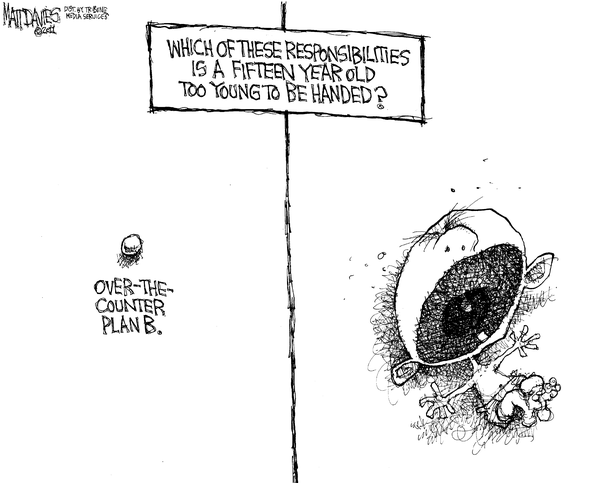
As if that’s not enough, then we get to the “just like an abortion” issue. That’s how these folks now in charge of our legal system define many contraceptives. Turns out that IUDs, Plan B, the regular old pill, and many other common forms of contraception are, in fact, considered abortifacients by the far right who now control the Supreme Court and govern red states across the land. If we’re lucky, married couples will still be able to access condoms in the red states of the near future, though probably not for long the way we’re currently going.

Lastly, can we file the “lets get together and maintain some “popularist” level of regulated access to abortion legislatively” nonsense in the “Tip and Ronnie working into the evenings to hammer out sensible compromises” Drawer of Centrist Fantasies? You could pass such a bill by a collective 535-0 tomorrow and within about six hours it would be struck down by a Trump judge and promptly 5-4’d by the Supreme Court; they might not even bother to hear it. There will be no plausible way (short of amending the Constitution, and I don’t consider that approach plausible) to pass any legislation guaranteeing a right to abortion in this country that will survive judicial “review.” These people don’t give a fuck and will contort their legislative “reasoning” into whatever non-Euclidean shape that is required to back-solve for “strike this down.” Anyone who thinks otherwise hasn’t been paying attention and should not be paid attention to.

It’s the Leaks

Perhaps we can get ahead of the “forget the impact of overturning Roe, it’s the leaking of the draft decision that matters” nonsense like this:

The release of the 98-page document is unprecedented in the court’s modern history: Early drafts of opinions have virtually never leaked before the final decision is announced, and never in such a consequential case. And early drafts of opinions often change by the time the decision from the court is announced.

Michael D. Shear and Adam Liptak writing in the Times of New York

if we actually bother to point out that this characterization is categorically false. Thirty seconds of Googling would net you this highly relevant bit of information that the Post somehow managed to find and print:

…it is not true that rulings have never been given to journalists before the announcement of the decision by the court. In fact, the result in Roe v. Wade itself was leaked by a Supreme Court clerk to a Time magazine reporter in January 1973. The issue of Time, with an article titled “The Sexes: Abortion on Demand,” appeared on newsstands hours before the decision was announced by Justice Harry Blackmun.

James B. Robenalt, Washington Post

We knew this decision was coming and we know that birth control is next. Codifying into law national bans on both would be planks in the GOP platform if they bothered with such documents anymore. This almost makes one think there’s a reason they don’t put out platforms anymore.

As it stands, the GOP is out there every day messaging against Griswold as being of a piece with Roe in the “wrongly decided” department of GOP jurisprudence i.e. “privacy for me but not for thee.” With a functioning Democrat party you might be able to message against that because, last time I checked, access to birth control both in and out of marriage is a pretty popular thing. Access to “safe, legal, and rare” style of regulated abortion is also a 70/30 “for” proposition. But our Establishment Democrat is still not sure they should do anything about being characterized daily as part of an organized pedophilia cult that likely drinks baby blood. This is why they fail.

Never understood the fixation on primary colors and so forth in and around children’s hospitals. We’re putting you in this giant, intermittently noisy machine with a cage enclosing your head; please focus on these colors, which adults apparently interpret as whimsical, and not your impending existential doom. As always, thanks for being scanned by Pepsi™ presents CAT scans [menacing clown laugh].

41% of Americans were not aware of the [Supreme Court’s ACA] decision and/or its major finding. That includes 18% of the public who asserted that the decision had not yet been made.

Kaiser Family Foundation polling data (PDF link).
On the bright side, 56% of Americans that, uh, actually knew something had transpired in this area prefer that lawmakers “move on to other national issues” rather than “continue to block the law from being implemented.“ So there’s that…

Romney won’t have 60 votes in the Senate. But if he has 51, he can use the budget reconciliation process, which is filibuster-proof, to get rid of the law’s spending.

Ezra Klein reflects on President Romney’s potential chances and methods should he try repealing the ACA.
I’m not sure when, if ever, the DC Commentariat will get this through their heads: the next time the GOP holds the Presidency and a non-supermajority in the Senate, the filibuster will be eliminated approximately 30 seconds into the new Congress. Period, the end, carve it in stone.
Reconciliation won’t even be an issue with ACA repeal. It will be a simple majority vote, no filibusters allowed because there aren’t any allowed for any reason. Same with the functional elimination of Medicare, Social Security, and all the other Glibertarian wonders that await us under the Ryan budget plan when and if Romney wins. There’s simply no other way to get their preferred policies through, and the next time they have control of these levers of power they will get their policies through, no matter what it takes. Eliminating the filibuster will be among the more minor procedural changes and will be lost in the shuffle that heralds the end of the New Deal and basically all of the legislative 20th century.
Those are the stakes. Just when, exactly, will anyone in DC realize it? Sometime six to eight years after it all transpires, apparently. I’m assuming David Brooks already has an editorial in the can praising the end of filibusters. For Democrats, anyway.

Roberts Prevents Single Payer

Matt Yglesias makes a strong case re: the likely philosophical underpinnings of Roberts’ joining the more liberal members of the court to uphold the mandate. Namely that, in the absence of mandate, the Democrats would begin campaigning for Medicare for All. And they’d get it. Maybe not today, maybe not tomorrow, but almost certainly within a millennium or two, and then for a long time.

But! I don’t think nearly that long of a game is needed, though. Presuming Roberts was never going to gut the whole bill, knocking out just the mandate within the political system as currently figured does nothing so well as guarantee the end of the private insurance system we all know and love within 5 or 10 years. This is because, without a mandate, healthy individuals would have powerful incentive not to buy insurance until they are sick. Since the ACA already prevents insurers from refusing coverage for any reason, you’d simply buy insurance on the day you started needing it. That is, to say the least, an unsustainable business model. Some even called for a “poison pill” in the original law designed to create this situation such that even a GOP government would be forced into extending Medicare to all the moment even their constituents could no longer afford insurance premiums.

Roberts knew all of this. He knew he likely couldn’t simply gut the law without adversely affecting the public’s opinion of the Supreme Court in general and the Roberts court in particular, knew he furthermore couldn’t simply kill the mandate without also killing private insurance (gridlock essentially ensured this outcome), and decided the least of these was simply keeping the mandate and letting Congress sort it out. Which, as it happens, was exactly the right decision by any reading of the Constitution and precedent that my not-a-lawyer eyes can detect. Huzzah for democracy.

Roberts Prevents Single Payer

Again with the Middle Class

It’s almost as if our media aristocracy of inbred Serious People have a vested interest in seeing to it that the middle class, and only the middle class, gets soaked in any economic “compromise.” Amidst reacting to a particularly poor NYT Magazine piece, Dean Baker nails it:

…the piece too quickly dismisses the possibility of getting substantial additional tax revenue from the wealthy. It presents the income share for those earning more than $1 million as $700 billion, saying that if we increase the tax rate on this group by 10 percentage points (from roughly 30 percent to 40 percent), then this yields just $70 billion a year.

However, if we lower our bar slightly and look to the top 1 percent of households, with adjusted gross incomes of more than $400,000, and update the data to 2012 (from 2009), then we get adjusted gross income for this group of more than $1.4 trillion. Increasing the tax take on this group by 10 percentage points nets us $140 billion a year. If the income of the top 1 percent keeps pace with the projected growth of the economy over the decade, this scenario would get us more than $1.7 trillion over the course of the decade, before counting interest savings. Of course there would be some supply response, so we would collect less revenue than these straight line calculations imply, but it is possible to get a very long way towards whatever budget target we have by increasing taxes on the wealthy.

Shocking. And but also, Baker smartly includes the most important issue in any truly serious discussion of American economics and the proper balance of same: the cost of health care:

We pay twice as much per person as people do in other wealthy countries. Since more than half of the tab for our health care is paid by the government, our broken health care system becomes a budget problem. If we paid the same amount per person for our health care as people in other wealthy countries, we would be looking at long-term budget surpluses rather than deficits. The reason that we pay so much more is not that we get better outcomes – we don’t generally. Rather it is that we pay too much to drug companies, hospitals, medical specialists, and others in the health care industry.

Baker’s being generous. We spend as much as five times more per capita than the best performing countries do, all of which achieve uniformly better outcomes than we do. Obviously, the only possible answer here is just get Big Guvmint out of the way so the poor can kindly go die in the streets. It’s the only serious answer to the problem. Well, that and lowering taxes on the wealthiest 1% of the country.

Read the whole thing.

Again with the Middle Class

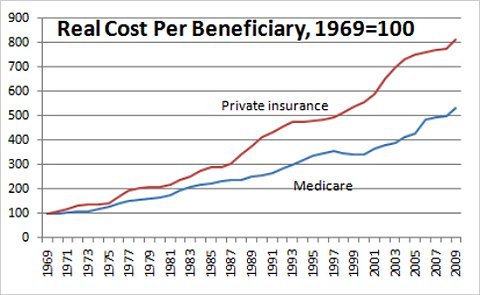
How to square the circle: Assuming Medicare for all tomorrow and that you can find a way to return the dollars in-between the red and blue lines to the people paying it: the American worker with employee provided health insurance. Right now, that’s all invisible income, spirited away into the employer-shared costs of providing coverage. It’s the underlying reason that real wages have been stagnant for most of my lifetime. Turn that into real wages and the broader economy would explode. There would suddenly spring into existence a middle class with (gasp) actual purchasing power. Who knew?!?

Naturally, the plutocrats would, at least initially, turn that space into more profits for themselves. Sooner or later, though, it seems likely that constraints on quality workers would gradually bring the money over into regular salary as companies competed to find highly trained folks. You’d still have to solve the manufacturing issue and/or something to do with all that idle but essentially untrained labor force out there…but it would be a start.
At any rate, a few more than the 17 Americans vaguely cognizant of this cost gap need to be made painfully and continually aware of it. Every day, every hour, every time a microphone is switched on with a Democrat behind it. Complete with this graph. That Medicare, far from being “expensive,” saves money in dramatic fashion. And that, since they, the average hardworking healthcare consumer, cannot buy into that massive bargaining pool or something very much like it, they are being robbed. Every. Single. Day. With malice aforethought. And that they have precisely one party, the GOP, and Joe Lieberman to thank for it.

But that would be shrill. And Weiner lied to his fellow Democrat. That’s what’s important here.