PO Boxed

azspot:

“If, as reported, the Democrats have dropped the public option, they have abandoned any attempt to improve the health care in the United States in favor of increasing health-care insurance profits. This is good for the economy, as ever more jobs will be created in medical claims processing. Also, delivering 40 million new (taxpayer subsidized) premium-payers to the insurance companies to pretend to cover the currently uninsured will certainly drive up health insurance stocks. But nothing in the bill will actually improve heath care nor lower the cost of what passes for healthcare in the US. The war is over, the people lost.”

I must say that I strongly disagree with this sentiment. First and foremost, it presupposes that adding 40 MILLION PEOPLE to the world of the insured is somehow barely worth doing. All these folks can go see a doctor, and not just whoever is on duty at the emergency room. And, presumably, won’t be financially ruined for doing so. And, presumably, will go sooner, when the treatment course will be both cheaper and more effective. Look no further than breast cancer diagnostic stage and outcome in african american women stratified by socioeconomic standing for a hint at what this could really mean. Answer: a lot. A shit-ton. Just this is (potentially) a giant cost container if you can convince people to use it and find sufficient primary care doctors to handle them.

Then, you’ve got the public/private government plans: extending tightly regulated but still for-profit plans like those offered to government employees. This is your mid-level cost container. These are big pools of folks…public option light with a prettier name. Garden-variety people will see the cost benefits that a large pool can bring. Also for the good.

Forgetting all that, though, you still have the (supposed) Medicare buy-in for individuals over 55; this is the biggest deal by far, and, if actually enacted, marks genuine progressive progress in this country. For the first time, you’ll have actual consumers comparing prices of the dread government care and that provided through private insurers. Worth noting that these same 55-and-ups vote. A lot. This is potentially a game changer. It’s a lot simpler to revisit the law and roll the eligible age for buy-in to 45, then 35, then everybody that might want it than it is to announce that on Jan 1, 2010, we’ll be having a single-payer plan in these United States, as much as many on the left would like to believe otherwise. This plan, much more that what remained of the late but not terribly lamented public option, has the potential to completely rewrite how we deal with healthcare in this country. Seriously. Because people will finally know what the costs are and what it means to be part of a negotiated, nationwide cost structure. And this information will begin to trickle down. Think of it as healthcare Reaganomics…

Best of all, though: This version appears to have the votes for passage. You could (potentially) convince Pelosi to ping-pong this thing straight to Obama’s desk before Jan. 1. Not saying that’s going to happen, but it could. But, by all means, go on like this outcome is a giant failure, not worth doing in the first place, and a deep disappointment to boot. Nothing gets us to President Palin more quickly.
As things stand, 65-year-olds get enrolled in Medicare. Buy-in is something of a different beast: Folks between 55 and 64 with access to the exchange could choose to buy Medicare. That sets up an apples-to-apples comparison. And that apples-to-apples comparison is not going to come out well for private insurers, as Medicare has a large and acknowledged price advantage over them. They might be fine with that, because no one wants to insure 60-year-olds anyway. But I doubt they’re going to be fine with a world in which people see the full difference between the prices private insurers offer and the prices a robust public insurer can offer. That, after all, is why they fought the strong public plan so ferociously.

Smell the Joementum!

TPM is reporting that Lieberman is at least open to the notion of the Medicare buy-in as a replacement for the public option:

Lieberman said he’s open to both the Medicare buy-in idea, and a separate proposal to extend the private system that insures federal employees to individuals and small businesses.

On the Medicare buy-in–which has significant appeal among liberals–Lieberman was open, but non-committal. “I’ll take a look at it,” Lieberman said. “I think the good news is, however, that the current bill will, for the first time, provide people 55 and over who are not yet eligible for Medicare with subsidies to go on to the exchanges and buy, so they can buy for a lot less than it costs them in the marketplace now.”

“I’m open to looking at it,” Lieberman told reporters. “But I want to make sure that we’re not…adding a big additional burden to the Medicare program.”

Seeing as Snow has already dumped on this idea as pure crazy-talk, this statement by Lieberman counts as real progress. He’ll go back on it by tomorrow morning, but at least we’ve got tonight.

Opting Out

Paul Starr argues that, because of the potential for real public backlash, the individual mandate should contain an opt-out provision. In a nutshell, you could choose to opt out of coverage…on the condition that you couldn’t easily opt back in for a five year period afterwords.

I agree with Starr that the mandate is the thing that will really burn people up come, oh, 2075 when the last provisions of this damned bill actually go into effect. And that, if the compromises continue, what you’ll have is a mandate to buy today’s overpriced, under-provisioned insurance…now: with a guarantee of coverage! And but so I tend to think a different kind of solution is necessary when talking about the mandate.

Instead of a fine, you automatically enroll mandated but uninsured individuals into Medicare at whatever the premium cost is for a person of their age (and, yes, I’m therefore proposing here that Medicare-based coverage would/should then be open to anybody of any age that fails to procure private insurance; this doesn’t change the fact that it’s a terrible idea that the smelly hippies will hate, hate, hate). That’s the fine: that you have paid for coverage the hard way…through your tax return; but you’ve ultimately just paid for coverage. The end. No further fines, certainly no jail time, just coverage. Whether you like it or not. If you choose not to decide: you still have made a choice.

Ultimately the opt-out only allows for that most dangerous of impulses: the free rider. I won’t pay until I’m really sick or hit by that bus. It just can’t be allowed if we’re to have any chance at all of containing costs. In many ways, it’s precisely this sort of non-covered coverage that is already driving costs today.

The reductions in Medicare Republicans are now decrying are more equitable, better targeted, and not even half as large as the ones many of those same Republicans endorsed in the ‘90s.

Jonathan Cohn,
writing for The New Republic, and creating a little koan for us all to recite. Also, keep in mind that John McCain himself pushed cuts in the neighborhood of $1.3 trillion just ~8 months ago during the campaign. And is now all worked up over revisions that total $487 billion (mostly from dumping the idiotic and wasteful Medicare Advantage program by which the government pays insurance companies to provide Medicare benefits…at higher cost than, uh, Medicare). Unconscionable. And they will be allowed to do it. And then go back on it. Again and again.

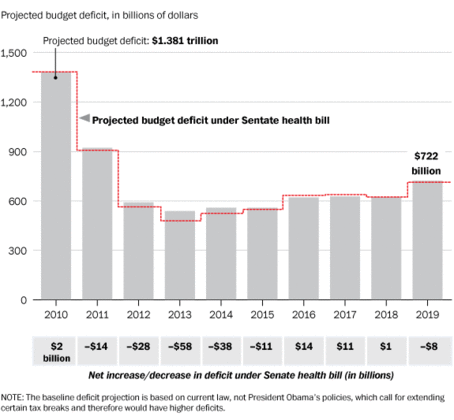
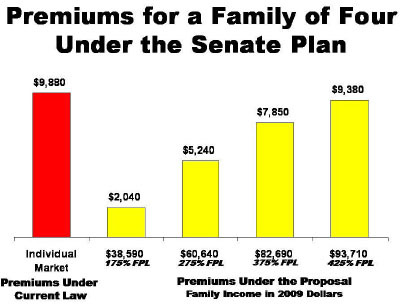
    Memo to Joementum and all his friends: Doing nothing will do harm. It will add to the deficit, and, according to this latest bit from the CBO analysis, it will cost families and individuals money, no matter what bracket they are inhabiting. Oh, and doing nothing leaves ~30 MILLION PEOPLE uncovered that would, in fact, get health coverage under the Senate plan. Those people need to shape up and go die in the streets like good American Citizens.

    But, by all means, let’s play pretend that doing nothing is not only a viable option, but the only sane option. And media: let’s continue to let people say shit like this without challenge of any sort. To ask if they have any sane reasoning behind their obstructionism just wouldn’t be polite.

    Price of Failure

    Lots of people seem to think that if we don’t get all the way to single payer (or some other abstract, personal measure of “success” in health insurance reforms) that the reform is not worth doing. I think Ezra Klein destroys that meme rather completely while noting that failure doesn’t breed more expansive second-tries; instead, it only breeds more caution on the subsequent go-round:

    Truman sought single payer. His failure led to Kennedy and Johnson, who confined their ambitions to poor families and the elderly. Then came Nixon, whose reform plan was entirely based around private insurers and government regulation. He was followed by Carter, who favored an incremental, and private, approach, and Clinton, who again sought to reform the system by putting private insurers into a market that would be structured and regulated by the government. His failure birthed Obama’s much less ambitious proposal, which attempts to reform not the health-care system, but the small group and nongroup portions of the health-care system by putting a small minority of private insurance plans into a market that’s structured and regulated by the government, and closed off to most Americans.

    Never get tired of talking about Nixon re: healthcare reform. Anywho, Ezra goes on:

    Medicare and Medicaid began as fairly limited programs. Medicaid was pretty much limited to extremely poor children and their caregivers. Medicare didn’t cover prescription drugs, or individuals with disabilities, or home health services.

    But once the programs were passed into law, they were slowly and continually improved. They became more expansive, with Medicaid growing to cover not only poor families but also poor adults, and the federal government giving states the option, and matching dollars, to include more people under the program’s umbrella. Medicare was charged with covering people with long-term disabilities, and it was eventually strengthened with a drug benefit, more preventive coverage, the option of supplementary plans and much more.

    Pass something. The worst version of the Baucus bill would indisputably improve the lot of millions, millions of Americans. The main thing to focus on is keeping the outcome one that quantifiably improves the experience for many, if not most, consumers. The voters out there can accept an imperfect solution, so long as they sense they are no longer being utterly screwed by their insurance company. This will (presumably) happen the first time they make a claim, or change jobs, or (hopefully) see their premiums drop and their pay rise accordingly post-reform.

    Every vote over the minimum necessary to secure passage represents compromises that the Democrats as a group would prefer not to make. It’s not that Nancy Pelosi was lucky to pass the bill, it’s that the Democrats wrote the strongest bill they could that would get enough votes to pass. That’s good strategy.

    Rafe Colburn, who I currently agree with 100%.

    Simple enough for Joementum

    Let’s begin:

    LIEBERMAN: A public option plan is unnecessary. It has been put forward, I’m convinced, by people who really want the government to take over all of health insurance. They’ve got a right to do that; I think that would be wrong.

    But worse than that, we have a problem even greater than the health insurance problems, and that is a debt – $12 trillion today, projected to be $21 trillion in 10 years.

    WALLACE: So at this point, I take it, you’re a “no” vote in the Senate?

    LIEBERMAN: If the public option plan is in there, as a matter of conscience, I will not allow this bill to come to a final vote because I believe debt can break America and send us into a recession that’s worse than the one we’re fighting our way out of today. I don’t want to do that to our children and grandchildren.

    That was Lieberman on FOXnews (where else?) this Sunday past. Doubtless just posturing, but let’s take him at his word: the deficit (and, by extension, the debt) is and should be held in absolute primacy to any and all other spending or policy decisions (which, of course, also have direct spending implications). Fair enough. We take that as a first principle.

    The current GOP “plan” (in that it’s not even a plan so much as a policy statement) has been scored over the 10-year window as potentially resulting in a reduction of budget deficits by $68 billion while helping 3 million folks get coverage they wouldn’t otherwise have.

    The plan passed by the House, on the other hand, extends coverage to 36 million currently uninsured Americans while cutting the deficit by $104 billion over the same 10-year window.

    Which of those plans is more deficit neutral, Joe?

    Of course, third option is do nothing. Joe himself has pushed this idea. Here’s what that looks like:

    By all means, MSM, continue treating Joe Lieberman as a sober, deficits minded fellow only out for what’s best for the country. Let’s not once pause to ask him: Joe, just how does the public option contribute to the deficit?