
Anyone notice that the pres signed a $680 BILLION defense approp bill [that doesn’t include Iraq or Afghanistan] in the midst of our debates about $90b a yr for hc?
Tag: Healthcare
(Not) Frakked Up
This curve (Austin Frakt via Kevin Drum) gave me the heebeegeebees yesterday:

Depending on our positions on that curve, reforms could actually increase costs…and it’s unclear just where we are. Turns out, those fears were (likely) misplaced. Results from Our Beloved Commonwealth (we’ve had the Death Panels up and running for a while now…) seem to imply that, hey presto, this healthcare reform thing can actually drive down costs:
the most authoritative objective voice in this debate suggests that reform will significantly reduce, not increase, nongroup premiums.
This conclusion is consistent with evidence from Massachusetts. In their December 2007 report, AHIP reported that the average single premium at the end of 2006 for a nongroup product in the United States was $2,613. In a report issued just this week, AHIP found that the average single premium in mid-2009 was $2,985, or a 14 percent increase. That same report presents results for the nongroup markets in a set of states. One of those states is Massachusetts, which passed health-care reform similar to the one contemplated at the federal level in mid-2006. The major aspects of this reform took place in 2007, notably the introduction of large subsidies for low-income populations, a merged nongroup and small group insurance market, and a mandate on individuals to purchase health insurance. And the results have been an enormous reduction in the cost of nongroup insurance in the state: The average individual premium in the state fell from $8,537 at the end of 2006 to $5,143 in mid-2009, a 40 percent reduction, while the rest of the nation was seeing a 14 percent increase.
Imagine that. Increasing the pool size, having a mandate, and guaranteeing coverage reduces rates by spreading risk. Will wonders ever cease?
Lieberman to US: Drop Dead
Lieberman has officially and categorically joined the “Go Die in the Streets” brigade:
SCHIEFFER: But is what you’re also saying is that nothing is better than a government health insurance, or a health insurance reform that includes a public option? Nothing is better than that?
LIEBERMAN: Well, the truth is that nothing is better than that because I think we ought to follow, if I may, the doctor’s oath in Congress as we deal with health care reform, do no harm.
You’ll note that Lieberman also opposed the original, public option free version of the Baucus bill. He seriously just wants the CATO-inspired answer: yes, if you are poor and cannot afford care, you should just go die in the streets. Any other course of action would simply be unfair.
[People] are fed up – frustrated and fed up and angry about the way in which our government does not work, about the way in which we come down here and get into a lot of political games and seem to – partisan tugs of war and forget why we’re here, which is to serve the American people. And I think the filibuster has become not only in reality an obstacle to accomplishment here, but it also a symbol of a lot that ails Washington today.“
"But I do want to say that the Republicans were not the only perpetrators of filibuster gridlock, there were occasions when Democrats did it as well. And the long and the short of it is that the abuse of the filibuster was bipartisan and so its demise should be bipartisan as well.”
“The whole process of individual senators being able to hold up legislation, which in a sense is an extension of the filibuster because the hold has been understood in one way to be a threat to filibuster – it’s just unfair.
[Lieberman] still wants to be a part of the Democratic Party although he is a registered independent,“ Harkin said. "He wants to caucus with us and, of course, he enjoys his chairmanship of the [Homeland Security] committee because of the indulgence of the Democratic Caucus. So, I’m sure all of those things will cross his mind before the final vote.
Sen. Tom Harkin (D-Iowa), noting that Joementum has a nice place here, and he’d sure hate to see anything happen to it.
Lieberman won’t join a futile filibuster, but if he has the chance to stick in the knife and kill health care reform, I think he’d probably jump at the chance.
Jonathan Chait, on Joe Lieberman’s inexcusable yet totally predictable blathering re: health insurance reform.
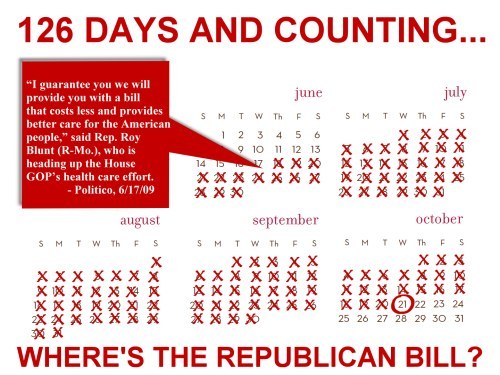
They put out the bill a long time ago: Go Die in the Streets. Wasn’t that enough of a plan?
[…] you know, I’m busy and Nancy [Pelosi is] busy with our mop cleaning up somebody else’s mess — we don’t want somebody sitting back saying, you’re not holding the mop the right way. (Applause.) Why don’t you grab a mop, why don’t you help clean up. (Applause.) You’re not mopping fast enough. (Laughter.) That’s a socialist mop. (Laughter and applause.) Grab a mop – let’s get to work.
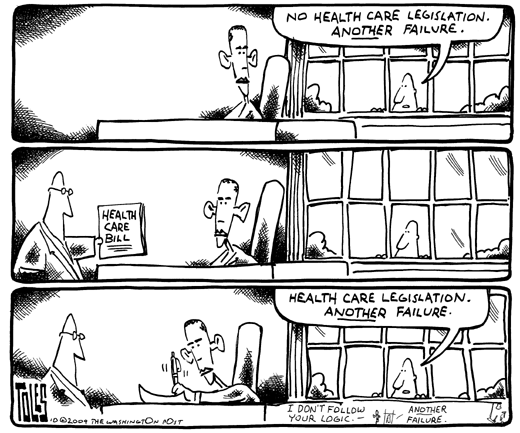
Wish in One Hand…
Activists on the left have long insisted that insurance companies aren’t to be trusted. But up until now, it’s been hard to make the charge stick, since the insurance lobby–a.k.a., America’s Health Insurance Plans–has been cooperating with the White House and its allies.
AHIP’s new paper, though, may have changed things. In the last day, the specious claim that reform would raise premiums has provoked a fast and furious response, uniting everybody from the White House to AARP against a common foe. And that unity could have policy implications.
Let’s face it, the insurance companies own reform. They will, in large part, write the final bill in which they will create an individual mandate (and most definitely not an employer mandate) to buy whatever they deign to sell you, the ‘Merican consumer. And, no, there will be zero competition if they have their druthers. Only subsidies such as may be allowed by some made up number in Olympia Snow’s head will affect the final price to the most imperiled future consumers of this insurance, folks earning at ~300% of poverty.
To the extent that rampant dishonesty (like this AHIP report) helps create some wedge-room to make the previous paragraph less expensive to the end-user, it’s for the good. But I think we all need to start adjusting ourselves for the major screwing over that will only be, uh, rectified once the policies are in place and people are pissed off and demanding some major readjustments or, at the very least, some spittle. But this:
“Ironically with AHIP’s report today may make it more likely that such a windfall profits tax would be included in the final legislation.“
is totally nonsensical. The insurance companies (which stand to make, at a minimum, billions on this or any health reforms package that passes) will pay not one dime of new tax. They may well end up with a tax exemption. Mark my words, children. It will be so.
Funniest of all:
“In a strange way, and look, obviously they didn’t mean this, the health insurance lobby today fired the most important salvo in weeks for the public option,” Rep. Anthony Weiner wrote today on his website, as Daily Kos noted. “Left to their own devices, according to their own number crunchers, they’re going to raise rates 111%.”
Yes they are. And no, there won’t be a robust public option. Best we can hope for is a states-opt-in option that, over time, might actually begin to work. But: there will be significant and extended consumer pain. Get ready. Mostly, I wonder what color the sky is in Anthony Weiner’s world…
 Lemkin