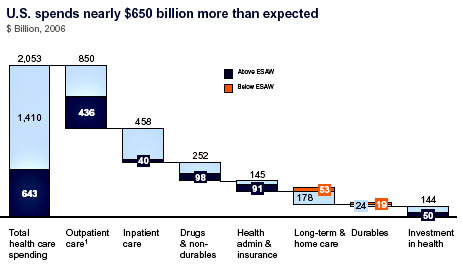
Kevin Drum provides a link to this excellent chart (dark blue where we spend more than expected, orange where we spend less than expected, lighter-blue what we should expect to spend adjusted relative to our economy/population/and other systems). He also helpfully cites the specific line-items that ultimately cause us to spend more on (and yet still get less from) healthcare in this country:

  • We pay our doctors about 50% more than most comparable countries.
  • We pay more than twice as much for prescription drugs, despite the fact that we use less of them than most other countries.
  • Administration costs are about 7x what most countries pay.
  • We perform about 50% more diagnostic procedures than other countries and we pay as much as 5x more per procedure.

Let me offer a modest proposal: If Congress fails to pass comprehensive health reform this year, its members should surrender health insurance in proportion with the American population that is uninsured.

Nicholas D. Kristof, New York Times columnist, and (clearly) Lemkin fan.

The Lunatic is: IN

In amongst Michelle Cottle’s epic takedown (don’t get too excited, it’s 15 years too late by my count) of Betsy McCaughey, we have this tidbit:

Her standard m.o. (as “Daily Show” host Jon Stewart recently experienced) is to greet each bit of contradictory evidence by insisting that her questioner is poorly informed and should take a closer look at paragraph X or footnote Z. When those sections don’t support her interpretation, she continues to throw out page numbers and footnotes until the mountain of data is so high as to obscure the fact that none of the numbers add up to what she has claimed.

The natural linkup to this observation is in the activities of Sarah Palin, and Cottle goes there too:

…[Palin’s] scorching self-regard and ostentatious disdain for politics-as-usual infuse even her most self-serving fabulisms. Palin, of course, hawks homespun wisdom, faith, and common sense, in contrast to McCaughey’s figures and footnotes. But both women have an uncanny ability to shovel their toxic nonsense with nary a blink, tremor, or break in those dazzling smiles. People of goodwill and honest counsel don’t stand a chance.

The issue is really that these sorts of people feel safe in the assumption that they cannot be effectively countered given the constraints of the modern news cycle. They know that, no matter how prepared the host/anchor may be, they have to move on within 90 or 180 seconds and can thus be easily filibustered into oblivion. Muddy water: sprayed. It’s out there now; mission accomplished.

The solution, of course, is almost as pathetically obvious as it is unimplemented. CNN (and the rest; to keep it simple I’ll refer broadly to all the respectable, 24/7 news networks as “CNN” from here on out) essentially run on floating schedules. If they need to report for 6 hours on a car chase, they fucking do it. Wolf (or whoever) will just sit there and repeat that we’re waiting for, uh, something to happen. And then cut to some guy also waiting for something to transpire.

Sooner or later, then, they need to spend as much time as it takes to reduce McCaughey (or somebody like her) to tears on national television. Simply pull out every one of her page attributions. Turn off her microphone while you find it so she can’t further confuse issues. Dispatch that point. Move to the next. As long as it takes. She runs out of material or simply runs off the set. Either way: victory. Pyrrhic to be sure, but a step.

Sure, this will be gruesome live television, but excellent YouTube material. Somebody will edit it down to 90 seconds of pure joy. Which then, of course, fits back into CNN’s attention span. All it takes is the will to do the initial, extremely long-form interview. Jon Stewart could even do it, were he willing to call her back “on” and then expend a day wearing her down. Jim Cramer was easily cowed; he had a job to protect. McCaughey and her ilk are more like kamikazes. Occasionally they survive their attack run, but that outcome is purely incidental to them. They need to be made to see the fundamental hopelessness of such tactics such that they choose not to employ them in the first place. Realizing that they will simply be called to account on national television for as long as it takes will dissuade all but the craziest. That last subset will simply no longer receive bookings after being seen as fundamentally unhinged.

Such a trip to the woodshed would only need to be done once or twice. The worst of these offensive people would then dutifully scuttle back under whatever rock they live when not being offered a national audience.

Two Little Caveats

NYT readers seem to understand the problems with American healthcare in ways that NYT writers never seem to:

The Swiss system for universal coverage is certainly intriguing, but there are two little caveats that will make it unappealing to our legislature: the insurance companies are to some extent nonprofit, and the drug prices are regulated. The Swiss system directly attacks what is wrong with the American health care system: profit.

Go Die in the Streets is catching on, though under the Die Quickly! rubric. I still take, nay DEMAND credit, though.

When pressed by the GOP for an apology, Grayson gave them one:

“I apologize to the dead and their families that we haven’t voted sooner to end this holocaust in America.”

More like this, please.

All About the Benefits

TNR reports on the firing of Hyatt’s Boston-area housekeepers, noting:

The housekeepers, some of whom had worked for Hyatt for over twenty years, were making between $14 and $16 an hour plus health, dental, and 401(k) benefits. Their replacements were to make $8 an hour with no health benefits.

It’s unclear to me why, within the context of the current debate about healthcare, the benefits angle to this story has received zero attention. Instead, everyone rushes to the $16/hr to $8/hr change in gross-pay. Sure, Hyatt is now paying half as much and these replacements are, apparently, pretty much all there on guest-worker visas (and so are, by definition, short-term, damned near cash basis day workers).

The key fact, though, is all that stuff that comes after the mention of base pay. These folks that have been fired were getting health, dental, and 401k benefits. That’s a vaguely astounding contract they had; seemingly unprecedented, actually. I’d wager Hyatt cut their expenses on employing these workers by four to five fold just by dropping benefits. Tacking on the pay cut was just gravy; something they did because they could. Based on some back-of-envelope calculations using these figures to get ballpark estimates for provisioning the insurance coverage, to provide the health benefits (forgetting dental and 401k for now) Hyatt was paying these workers the equivalent of $23/hr. Add in the rest and you’re up to $30/hr easily. Probably well beyond it.

So, we have workers’ jobs cut specifically to save on the (presumably) outrageous expense of providing them with healthcare; these firings have subsequently gone national for a variety of completely unrelated reasons. During the biggest healthcare debate of my lifetime. What does the media focus on with absolute uniformity? An $8/hr pay differential. As if nothing else is going on here. Do we mention that these uninsured guest workers still create a cost on healthcare in this country? Do we mention that Hyatt has effectively shifted some of its healthcare expenses from Hyatt to you, the US Taxpayer? Do we mention that this is yet another clear-cut case of spiraling health coverage costs measurably and indisputably claiming jobs, all the while adding to the rolls of the unemployed (and uncovered) in this country? Of course not. Keep walking. That sort of thing just isn’t said.

Reconcile This

Ezra Klein muses on reconciliation:

“…a reconciliation bill should not look like the current health-care reform bill. It should be an expansion of public programs: Bring Medicaid up to 150 or 200 percent of the poverty line and allow people from 45 to 65 to buy into Medicare and give some of them tax credits to do so. I don’t know if there are votes for that strategy. But it wouldn’t run afoul of the Senate parliamentarian.”

Absolutely. Sounds good to me. And I think the surest way to bring your more recalcitrant conservative Democrats aboard (and maybe even a Republican or two) is to offer these as your legislative choices on the (much harder to deal with) Senate side:

1) Some modified Baucus bill type package with a Rockefeller-style robust public option (or per-state’s option to activate said plans) that goes through “normal” channels, gets 60 votes for cloture, and then 51 for final passage. Goes to Conference to line it up with the House’s existing version.

-or-

2) We put it through reconciliation as Medicare for all. You want to buy in, buy in. You can’t afford it, we’ll subsidize you. You like your current plan: keep it. 51 votes to pass, House has to pass something new to match.

I think there’d be a waiting line on option (1) about 45 seconds after the wheels were set in motion. And reconciling a Medicare-for-all with the House? I don’t see that as a big problem; they’d have something passed about 45 minutes later…after all, it’s essentially what a number of them tried to push through on the first go-round anyway. It’s my understanding that they failed because of a (perceived) lack of support for such a move on the Senate side (e.g. such a move would be DOA; better to pass something akin to what the Senate might be moving to pass).