
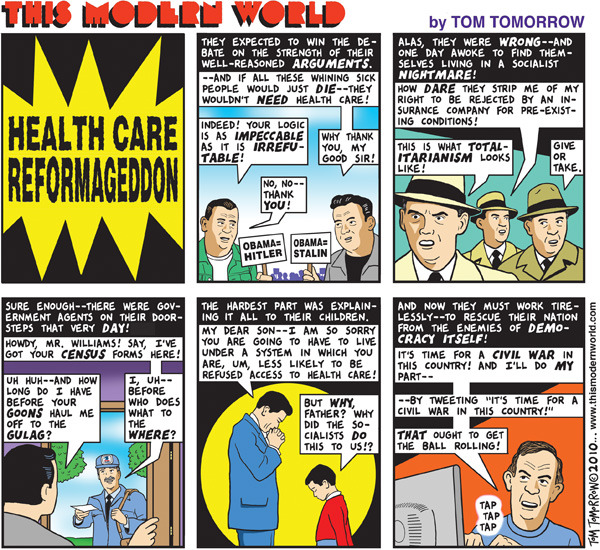
Tag: Healthcare
From this day forward, all of the cynics, all the naysayers, they’re going to have to confront the reality of what this reform is – and what it isn’t. They’ll have to finally acknowledge, this isn’t a government takeover of the health care system.
Barack Obama. I hope he’s right, but doubt he is. The Democrat is functionally incapable of this sort of messaging.
The Doc Fix Myth
By far the best analysis I’ve seen on this total non-issue.
For the tl;dr sect: right-wingers have built a closed information loop based on false premises re: true cost of healthcare reform with regard to a key pre-existing condition that’s not addressed by the reform package at all (this being the annual “doc fix” legislation). A permanent doc fix, when and if it comes, will either be paid for or not; it won’t alter the cost or savings of the reforms as passed one way or the other.

This graph clearly requires some lightly paraphrased Diamond Joe Quimby:
You people don’t know what you want! I am flip-flopping!

For the CSPAN caller last night claiming we were embarking on a $10T (as in trillion) spending spree. Not so, and never was. They have lied to you. Repeatedly. Systematically. You might want to make them pay a price for that come November.
Hopey Changey
James Fallows positively nails it:
the significance of the vote is moving the United States FROM a system in which people can assume they will have health coverage IF they are old enough (Medicare), poor enough (Medicaid), fortunate enough (working for an employer that offers coverage, or able themselves to bear expenses), or in some other way specially positioned (veterans; elected officials)… TOWARD a system in which people can assume they will have health-care coverage. Period.
-and-
this [set of reforms and all the attendant process arguments] will not seem anywhere near as poisonous seven months from now as it does today. Jobs jobs jobs is what will matter most then.
So very true. If unemployment is at or near 10% in 2012, Obama will not be reelected. Period. If the economy continues to pick up this year, Democratic losses come November will be not-so-bad…not that they’ll be presented that way, of course. Anything short of a 100 Democrat Senate will be treated as an Historic Upset of the “normal order,” which, of course, currently has many Democrats representing historically red districts. But, back to Fallows:
There are countless areas in which America does it one way and everyone else does it another, and I say: I prefer the American way. Our practice on medical coverage is not one of these.
Nancy Pelosi touched on this point last night in her floor speech: that losing the fear of living insurance-free will let a thousand startups bloom. Folks locked into their current jobs simply to maintain a safety net for their kids can now think solely on the basis of how good they think their idea is. It won’t happen overnight, but it will happen. This is where the much longed-after “new economy” will ultimately come from.

Memo to David Brooks: hey, what do you know, the House actually voted on the “Senate” bill, passed it, then actually voted on the House reconciliation package that goes to the Senate to be actually voted on using the increasingly aptly named reconciliation rule. Remarkable.
When Pigs Fly
2007: WellPoint pledged that its charitable foundation would give $30 million in grants to help the uninsured
2010: “It was just not something that the company really wanted to do,” said one former executive, who, like others interviewed for this story, asked not to be identified out of concern that discussing WellPoint could have adverse career consequences. “So it went by the wayside.”
Gravity (and other theories)
Yglesias wants to know:
If Mitch McConnell & co were really so sure that passing health reform would be a political loser for Democrats and that organizing around repeal will be a big winner, then wouldn’t they be making it easier to pass the damn bill?
It’s not that if McConnell believed what he said he’d be voting for the bill. But if your opponents are determined to inflict a wound on themselves, why not just let them, in a procedural sense? Why not stop the bitching and moaning about reconciliation? Why not stop talking about gambits to stick the reconciliation process up?
Because the GOP true-believers know that if anything is potentially more destructive to The Democrat (as party in charge) than either passing or failing to pass something, it’s the spectacle of a slowly unfolding legislative FAIL itself (regardless of outcome; the long process is, in and of itself, a failure).
People hate the process of our government more than anything. The outcome, whether good, bad, or indifferent really is beside the point. The longer ‘Merica is forced to watch Washington in the act of gridlocking itself, the better the GOP thinks it looks. And the GOP is completely an unalterably right about this one thing. As Clinton once said, “It’s better to be strong and wrong, than right and weak”; these slow-rolling legislative fits are, to the polity at large, completely indistinguishable from weakness, both in terms of legislative will and of ideas. And, of course, the beauty is that the GOP is entirely responsible for the slow-roll and will never, ever be made to pay a price. Period. As in: Not in this lifetime. Just how it is. Like gravity.
The Democrat, utterly unaware of any of this for reasons that are beyond unclear, acts as a both implicit and explicit enabler of this sort of behavior. Again and again. And wonders why it gets the same results.
In an op-ed in Tuesday’s Post, Sen. Orrin Hatch (R-Utah) offered an excellent example of this hypocrisy. Right off, the piece was wrong on a core fact. Hatch accused the Democrats of trying to, yes, “ram through the Senate a multitrillion-dollar health-care bill.”
No. The health-care bill passed the Senate in December with 60 votes under the normal process. The only thing that would pass under a simple majority vote would be a series of amendments that fit comfortably under the “reconciliation” rules established to deal with money issues. Near the end of his column, Hatch conceded that reconciliation would be used for “only parts” of the bill. But why didn’t he say that in the first place?
Hatch grandly cited “America’s Founders” as wanting the Senate to be about “deliberation.” But the Founders said nothing in the Constitution about the filibuster, let alone “reconciliation.” Judging from what they put in the actual document, the Founders would be appalled at the idea that every major bill should need the votes of three-fifths of the Senate to pass.
[…]
Hatch said that reconciliation should not be used for “substantive legislation” unless the legislation has “significant bipartisan support.” But surely the 2001 and 2003 Bush tax cuts, which were passed under reconciliation and increased the deficit by $1.7 trillion during his presidency, were “substantive legislation.” The 2003 dividends tax cut could muster only 50 votes. Vice President Dick Cheney had to break the tie. Talk about “ramming through.”
 Lemkin