Requirement

(D) MEMBERS OF CONGRESS IN THE EXCHANGE—

(i) REQUIREMENT—Notwithstanding any other provision of law, after the effective date of this subtitle, the only health plans that the Federal Government may make available to Members of Congress and congressional staff with respect to their service as a Member of Congress or congressional staff shall be health plans that are—

(I) created under this Act (or an amendment made by this Act); or

II) offered through an Exchange established under this Act (or an amendment made by this Act).

(ii) DEFINITIONS—In this section:

(I) MEMBER OF CONGRESS—The term ‘‘Member of Congress’’ means any member of the House of Representatives or the Senate.

(II) CONGRESSIONAL STAFF—The term ‘‘congressional staff’’ means all full-time and part-time employees employed by the official office of a Member of Congress, whether in Washington, DC or outside of Washington, DC.

Music to Lemkin’s ears. By forcing Congress and their staffs onto the exchange, you can be quite sure that there will be a broad array of choices there and that the price will be, er, right. I’ve long said that most of the problem with getting healthcare reform done is that members of Congress simply have no clue what it’s like on the outside: they and their families have nearly-free, 24/7 access to what’s essentially a private physician, fantastically complete coverage with a wide menu of choices for care, and low to no co-pays when something really hits the fan. Plus they cant’ be dropped. Why wouldn’t they persist in calling such a setup “the best healthcare in the world”? It pretty much is. The trouble is that almost nobody outside Congress has access to even a part of a plan like that.

What reform is about is allowing the rest of us access to some of that. And doing it in a way that, even projecting out 20 years, will only be costing the taxpayer 1% relative to doing nothing. Thirty million people will have access to care on the basis of that 1%. And, of course, those same projections show a half trillion dollar savings to the overall budget. Frankly, that’s amazing given the compromised nature and inherently “around-the-edges” approach of this plan so frequently (and nonsensically) derided as “government takeover.” Any plan with a total monetary outlay on the part of the government amounting to ~90 billion dollars a year isn’t a takeover of anything. The Pentagon budgeted

“$52.1 billion [for ancillary items] such as ammunition, portable generators, cooling equipment, field medical supplies, hospital equipment, and night vision goggles”

in 2009. Nothing inherently wrong with any of those things, but that’s a military outlay of $50B a year and doesn’t even get around to, oh, I don’t know, guns.
We’re wasting well north of $40B a year on the plainly idiotic War on Drugs. Don’t even get me started on how many times over our little foray into Iraq could pay for healthcare in this country. But such context never matters to the savvy reporter. Who won today’s political horse race? Who played their press releases better?
Never: who lied? Whose facts were more accurate? What is the broader context of this decision?

Even more importantly, though: people won’t be making career decisions based solely on maintaining their and their families’ access to healthcare. Even if it fails in every other way, signing these reforms into law will let a million startups bloom.
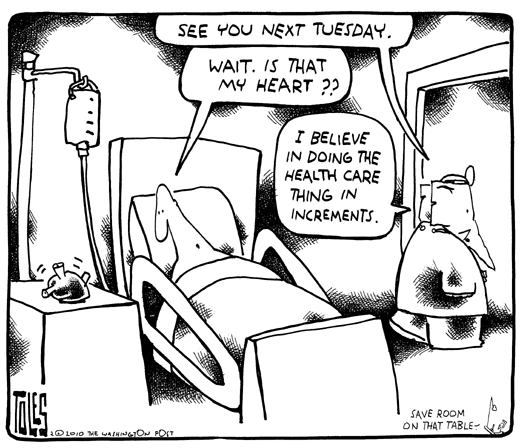
Comprehensive health care reform will not work through reconciliation. But if the House passes the Senate bill, and wants certain things improved on, like affordability, the Medicaid provisions, how much of Medicaid expenses are paid for by the Federal government, that is something that could be done through reconciliation.
A sidecar would be a good candidate for reconciliation depending on what’s in it,
The only thing that works here is the House has to pass the Senate bill, then the House can initiate a reconciliation measure that would deal with a limited number of issues that score for budget purposes.

Kent Conrad (~D, ND) and (clearly) a friend to Lemkin

MicroReconciliation

Memo to the media: healthcare reform has already passed. Both houses of Congress. It is done.

However, the two houses passed marginally different versions of the legislation. Thus, the House will likely pass a modified version of the Senate bill. The Senate, then, will reconcile their already passed bill with that “final” output. The order of the action may flip, but that’s really just window dressing. The point is that reconciliation will only be in use for the points of disagreement between House and Senate, which are few.

There is not and will not be any attempt to “pass the healthcare reforms package” via reconciliation. What there may be is an attempt to reconcile House and Senate versions of the bill through the rather aptly named reconciliation process instead of through a joint House/Senate conference committee and normal order.

Once more: if and when healthcare reform reaches Obama’s desk for signature, it will have passed through normal order. Period. Minor differences will have been ironed out through a kind of “sidecar” bill using reconciliation; it will functionally amend previously passed legislation. But the bulk of the reform: already passed through normal order.

Perhaps a six-hour televised summit on this is necessary to pound it through Our Media Overlords’ heads. I know they find it bore-ing, but that’s life in the big city.

Most of the credit [for the Health Summit discussions, such as they were] goes to President Obama. The man really knows how to lead a discussion. He stuck to specifics and tried to rein in people who were flying off into generalities. He picked out the core point in any comment. He tried to keep things going in a coherent direction.

David Brooks.
Remarkable that the teleprompter was both completely concealed and updated with detailed information in a screamingly fast, near real-time way. Must be an NSA project.

We don’t have a philosophic disagreement. If you agree that you can’t be dropped [by your health insurance provider], that there has to be dependent coverage, that there’s no annual or lifetime cap, then, in fact, you’ve acknowledged that is the government’s role. The question is how far to go.

Vice President Joe Biden, emphasis mine, repeating at yesterday’s summit (and nearly verbatim) my side of a “conversation” I once had with someone whose main response was that my brain must be made of shit. Wonderful, thoughtful people those “conservatives.” If we could get down to arguing over “how far to go” you’d have what we like to call a “functional government.”

The “Philosophical” Difference

Louise Slaughter (D, NY): I even have one constituent — you will not believe this, and I know you won’t, but it’s true — her sister died. This poor woman had no denture. She wore her dead sister’s teeth, which of course were uncomfortable and did not fit. Do you ever believe that in America that that’s where we would be?
Rush Limbaugh: I mean for example, well what’s wrong with using a dead person’s teeth? Aren’t the Democrats big into recycling? Save the planet? And so what? So if you don’t have any teeth, so what? What’s applesauce for? Isn’t that why they make applesauce?

Procedural Difference

Ezra Klein toots:

There’s a difference between “we have the best health-care system in the world” and “I can buy the best health care in the world.”

Absolutely goddamned right there is. The sentence that usually comes out of the mouth of someone positing the “best healthcare” trope is one about some Sultan or Prime Minister coming here for a procedure. Nobody says that our capability to perform procedures isn’t among the best or the very best in the world. What we don’t do well, if at all, is fix somebody’s high blood pressure. Or monitor their diabetes. Or screen them for colon cancer while it’s fixable. You simply cannot do those things through the Emergency Room (where the “best healthcare” folks always point out you can receive free care).

It’s precisely these little things that markedly reduce life expectancy in this country, and concomitantly increase cost as the folks who haven’t been dealt with turn up and need incredibly costly end-of-life care. This is why we pay at least twice as much as the next nearest “Western” nation while getting remarkably worse outcomes across the board.

Thus by my admittedly simple classification scheme, this would suggest that 14 of the 19 times reconciliation was used between FY1981 – FY2005, it was used to advance Republican interests. Or, to put this more precisely, it was used to advance bills that were signed by Republican presidents or vetoed by Democratic presidents.

Memo to Code Brown 2: Judgement Day

Scott Brown, local imbecile, said through a spokesman yesterday that:

If the Democrats try to ram their health-care bill through Congress using reconciliation, they are sending a dangerous signal to the American people that they will stop at nothing to raise our taxes, increase premiums and slash Medicare. Using the nuclear option damages the concept of representative leadership and represents more of the politics-as-usual that voters have repeatedly rejected.

The problem is that using reconciliation is neither “the nuclear option” (that’d be this, a technique both invented and brandished by one Grand Old Party) nor is the use of said reconciliation in any way unprecedented, either in terms of budgetary measures (precisely the reason the damned thing was created in the first place) or healthcare reforms (which often are entirely or nearly entirely budgetary issues). NPR provides us with a partial listing of the many uses of reconciliation in recent years:

  1. 1982 — TEFRA: The Tax Equity and Fiscal Responsibility Act first opened Medicare to HMOs

  2. 1986 — COBRA: The Consolidated Omnibus Budget Reconciliation Act allowed people who were laid off to keep their health coverage, and stopped hospitals from dumping ER patients unable to pay for their care

  3. 1987 — OBRA ‘87: Added nursing home protection rules to Medicare and Medicaid, created no-fault vaccine injury compensation program

  4. 1989 — OBRA ’89: Overhauled doctor payment system for Medicare, created new federal agency on research and quality of care

  5. 1990 — OBRA ’90: Added cancer screenings to Medicare, required providers to notify patients about advance directives and living wills, expanded Medicaid to all kids living below poverty level, required drug companies to provide discounts to Medicaid

  6. 1993 — OBRA ’93: created federal vaccine funding for all children

  7. 1996 — Welfare Reform: Separated Medicaid from welfare

  8. 1997 — BBA: The Balanced Budget Act created the state-federal childrens’ health program called CHIP

  9. 2005 — DRA: The Deficit Reduction Act reduced Medicaid spending, allowed parents of disabled children to buy into Medicaid

Conveniently left off that list are several that are specifically damaging to the GOP’s case for grievance here. Like both of the Bush tax cuts. Reconciliation. Additional oil drilling courtesy of W. Reconciliation. Medicare Part D (aka W Bush’s unfunded cost explosion). Reconciliation. Various W trade authorities. Reconciliation. And, of course, there’s this hypocrisy that’s never mentioned by the MSM:

the very senators who speak reverentially of the filibuster now, voted for reconciliation then. Judd Gregg, in fact, voted for reconciliation every time it was used in the Bush era.