Starve the Beast

Paul Krugman notes that the GOP has collectively been working for around three decades to bring on the catastrophic nexus, “preparing the ground” for the moment at which they can cut wildly popular programs like Medicare and Social Security in the name of “fiscal responsibility.” Unfortunately, with that day all but at hand, the GOP finds itself unwilling to pull the trigger and say these long-held beliefs publicly:

At this point, then, Republicans insist that the deficit must be eliminated, but they’re not willing either to raise taxes or to support cuts in any major government programs. And they’re not willing to participate in serious bipartisan discussions, either, because that might force them to explain their plan — and there isn’t any plan, except to regain power.

Absolutely right. And but Krugman goes on to note in today’s column that the state of the California health insurance system generally and the recent Anthem move to raise rates by ~30% specifically put to lie everything the GOP is saying about national health insurance reforms:

some claim that health costs would fall dramatically if only insurance companies were allowed to sell policies across state lines. But California is already a huge market, with much more insurance competition than in other states; unfortunately, insurers compete mainly by trying to excel in the art of denying coverage to those who need it most. And competition hasn’t averted a death spiral. So why would creating a national market make things better?

More broadly, conservatives would have you believe that health insurance suffers from too much government interference. In fact, the real point of the push to allow interstate sales is that it would set off a race to the bottom, effectively eliminating state regulation. But California’s individual insurance market is already notable for its lack of regulation, certainly as compared with states like New York — yet the market is collapsing anyway.

Finally, there have been calls for minimalist health reform that would ban discrimination on the basis of pre-existing conditions and stop there. It’s a popular idea, but as every health economist knows, it’s also nonsense. For a ban on medical discrimination would lead to higher premiums for the healthy, and would, therefore, cause more and bigger death spirals.

So California’s woes show that conservative prescriptions for health reform just won’t work.

To which we say: yep, even though Krugman starts with a straw-man in there. Some? How about “GOP leaders in the House and Senate say” or any other construction there? Some? That’s Bush league usage.

But, I think the synthesis of these two articles is what actually provides the way forward. We’ve said it before: Democrats can’t bring themselves to move good policy and the GOP categorically can’t resist bad policy, so combine the two. Spend a few years “preparing the ground” just as the GOP did on forcing government into the present fiscal situation in hopes of eviscerating the New Deal once and for all. Make it such that, when the inevitable happens, the end result will require the desired policy solution.
This means that you just pass into law the super-popular and death-spiral inducing community rating and tack on whatever meaningless and ineffective tort and state-lines “reform” the GOP wants to make that poison pill pass. Both sides celebrate. Then wait five years. Even conservatives agree that:

the country will face a choice: allow the numbers of uninsured to continue shooting up, or enroll more and more people directly in taxpayer-funded government insurance plans.

At the collapse of health insurance in this country, the GOP will be forced to roll out Medicare for all; after all, there will be no functional private insurance industry left to protect. Even the very rich will be priced out. Nothing gets the GOP’s attention more quickly than a situation like that.
Just think of the day that Single Payer is finally signed into law by President Palin. Likewise, the new Democratic majority will return to a Senate free from the filibuster as, everyone knows, that will be the first thing to go once the GOP is back in charge over there.

Somewhere, off in the distance, a dog barked.
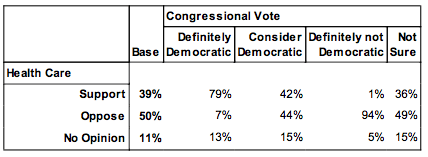
Stunning! Those that overwhelmingly oppose healthcare are also overwhelmingly unlikely to vote for a Democrat, any Democrat in the upcoming 2010 Congressional mid-terms. (PDF of polling data here)

Does that mean that the Democrat will now go ahead and push through health insurance reforms, secure in the idea that those opposed would never vote for them anyway, and those “unsure” are, at least, somewhat malleable and willing to be convinced on the matter? Of course they won’t. Are you fucking retarded?

Mirandizing terrorists inhibits intelligence collection? Wrong. Charging a terrorist in criminal court is a danger? Hundreds have been convicted that way. Non-torturous methods of interrogation fail? They work better. Call the Obama team pussies and they’ll back down? They’ll smack the tartar off your teeth. The public will rally around Republicans if they just ignorantly yell OMG TERRORISM loud enough? They’ll go to the other guy.

There’s just nothing left. […] [T]he GOP, for the first time in decades, is completely discredited on national security, without any credible spokespeople.

Spencer Ackerman, who’s right about everything except for his implicit assertion that the public understands this in any kind of durable way. Without continual, drumbeat messaging they will soon forget and fall back on the MSM trope that only the GOP can be trusted with Our National Security. It’s just too pervasive a frame, and one that has been repeated so relentlessly, explicitly and implicitly, for decades to the point that, like gravity, it’s just there, and not even noticed when invoked. You can’t and won’t undo that overnight. See: health insurance reform and government takeover of, subhead Death Panels. Democrats just don’t do this idea of “messaging” very well, if at all. I’m seriously not yet convinced they are aware of it as a concept.

1776

We fought the British over a 3 percent tea tax. We might as well bring the British back

William Temple of Brunswick, Ga., perhaps marginally better known as the fellow appearing at tea-party events dressed in his trademark three-cornered hat.

Indeed, William, why don’t we? The Brits are at least having a truth-commission of sorts that aims to get to the bottom of (but not prosecute those involved in) their complicity in the lie-laden run-up to the Iraq folly. Likewise, the Brits enjoy (and broadly support) their National Health Service, which, I might add, routinely outperforms American healthcare in any outcome metric you might reasonably choose to look at and costs half as much (as a share of GDP) to operate. Conservatives in Britain strongly support NHS. Wouldn’t think of privatizing it. Furthermore and finally, the Brits actually have a functional parliamentary system, as opposed to our functionally parliamentary system in which nothing can get done. In scary, scary Britain, when your party wins an election, you get to set the policy and set about governing. Imagine that. If the public broadly disapproves of your outcomes and prefers the platform of the shadow cabinet, then, hey what do you know, those folks get elected and start governing. Lather, rinse, repeat. It’s what we in the Big City call “representative democracy.”

So count me with the Tea Partiers. Let’s ask Big Daddy Britain if we can just come back and all is forgiven.

All during that health care debate, whenever things got impossible you could always say: “What I think they should do is pass the Wyden-Bennett Reform Plan,” and everybody would shut up and slink home to look it up on Google.

It’s a more elegant version of the Bipartisan Study Commission. Which, by the way, the Republicans recently filibustered.

Actually, I think we just need one simple change that will get us back to the good old days when Congress was capable of passing standard legislation and could occasionally summon the will to make large, imperfect fixes of urgent national problems.

Get rid of the Senate filibuster. It wouldn’t make things tidy. It wouldn’t be utopia. The Democrats will miss it next time they’re in the minority. But when people elected a government, it would get to govern again. And probably, it could keep the lights on.

Gail Collins, apparently summoning this material
from some long forgotten font of agreement between us.

Decoder rings

Various folks are trying to sort out just what Obama means with this statement:

That’s why I think it’s very important for us to have a methodical, open process over the next several weeks and then let’s go ahead and make a decision. And it may be that if Congress decides, if Congress decides we’re not going to do it, even after all the facts are laid out, all the options are clear, then the American people can make a judgment as to whether this Congress has done the right thing for them or not. And that’s how democracy works, and there will be elections coming up and they will be able to make a determination and register their concerns one way or another during election time.

I think it’s pretty damned clear, actually. After all, he had just said this:

What I’d like to do is have a meeting whereby I’m sitting with the Republicans, sitting with the Democrats, sitting with health care experts, and let’s just go through these bills – their ideas, our ideas – let’s walk through them in a methodical way so that the American people can see and compare what makes the most sense.

So then, following “President’s Questions” and the GOP’s performance at same, Obama feels he (and, by extension, his party) is/are the ones with the real solutions (as opposed to mere slogans), no matter how flawed those solutions may be, to the truly existential problems facing our government. The GOP, on the other hand, is suggesting we can simply cover everyone, lower taxes, and still have budget surpluses to use on all the wars we can start as far as the eye can see.
In fact, the only member of the GOP caucus putting real ideas out there that could do anything about the situation at hand is Paul Ryan ® of Wisconsin, who comes right out and admits that:

Just look at the numbers. [That the healthcare problem is the deficit problem is] not a theory. It’s a fact.

-and that-

if Ron Wyden and I were in a room, we could hammer out a deal [merging our healthcare proposals] by tomorrow.

And but Ryan basically wants to cap Medicare benefits, privatize at least parts of Social Security, and a do whole host of other stuff that I’d disagree with. That’s not important, though. The point is: these would be extremely unpopular positions to put into law, but at least they are positions. They are not sound-good, rhyming boilerplate nonsense; they are actionable “solutions” that could be turned into actual legislation that might do something about the problem (again, this is whether you agree with the particular mode of the solution or not). This is radically different from what the rest of his caucus proposes, which can be efficiently boiled down to “USA! USA! USA!”

So then, what Obama is saying is this:

Let’s get the key, decision-making personnel and folks with real ideas in a room, Democrats and Republicans. We’ll have all the plans and ideas, the GOP will have nothing to offer other than elimination of extremely popular programs, assuming they even offer that. Even if a deal doesn’t get done, there are clear positions taken, clear stances made public in a way that can’t be taken back, and is ultimately very similar to what the “Questions” televent did. It will be live, and it will be compelling. As such, any deal that actually comes out of it basically has to pass, otherwise the GOP look like the two-faced negotiators that they have proven to be (but have yet to be called out on). Failure to make a deal most likely also redounds on the GOP, since they would ideally be seen as having no ideas to offer anyway (assuming they just show up and scream platitudes while the Democrats actually have functional legislation and CBO scoring to offer). Thus, you show America in microcosm (and, not coincidentally, in TV drama form) the real reason “nothing gets done” in D.C. and, simultaneously, make the GOP look very small indeed. Or you get a healthcare deal.

The key to this plan, though, is the CBO (or whoever could reasonably play Ref in this debate). You can’t just run the numbers in 48 seconds and, on the spot, call out somebody’s plan as totally unworkable horseshit. So the more likely outcome of such an event would be a draw; two weeks later, nobody bothers to check that the GOP “plan” consisting of rhyming maxims and hoary chestnuts about using the ER as your PCP scores poorly (if at all), while the Democratic plan of actionable legislation scores as a deficit reducer and, oh by the way, covers 30 million presently un-covered Americans out of the gate. And such an outcome redounds to the generally negative perception of the Democrat as a feckless, do-nothing, non-governing, circular firing squad failure machine. So, I guess this is pretty much what’s going to happen. Whatever it is, it’s always good for the Republicans.

You heard it here first.

If we don’t pass [healthcare reform] I don’t know what differentiates us from the other guys. It’s nice to believe good things, but no one keeps their home, or pays for their doctor visit, because Democrats believe good things. If anyone is searching for an answer to the lessons of Massachusetts, I promise you, it’s not to do nothing.

Barack Obama, President of these United States.
Absolutely goddamned right, as usual.

Sen. Ben Nelson (D-Neb.) said Monday that he would oppose any health care reform bill with a national insurance exchange, which he described as a dealbreaker.

“The national exchange is unnecessary and I wouldn’t support something that would start us down the road of federal regulation of insurance and a single-payer plan,” Nelson told reporters Monday.

If Senate Democrats still had 60 votes, this would matter a lot.

Carrie Budoff Brown
Just for the record, it didn’t matter then, either. Just a lot of people convincing themselves it mattered. 59=clarity.