There may be no more iconic image for the sorry state of America in the waning days of Our Glorious Conservative “revolution.” A crumbling bridge partially shut down dead center in what’s supposedly the glittering capitol of the most wealthy, most powerful nation in the world today. If only we’d faced historically low employment and historically low interest rates for the past decade or so such that we might actually invest in our country. Come get a big cup of Your Freedoms, everyone.

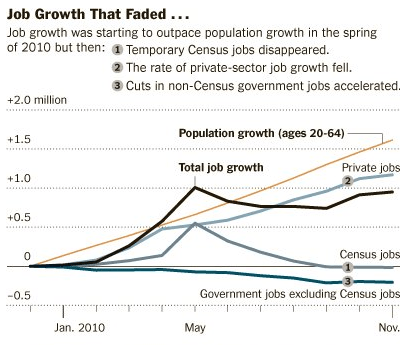
Several of The Big Lies put to, er, lie in one graph.

A) “No jobs have been created in the Obama administration, stimulus or otherwise,” unless, that is, you count all those jobs that have been created. Fewer than necessary to be sure, but indisputably there are jobs being created and tasks done in exchange for money.

B) “Government has exploded in the Obama administration” unless, of course, you exclude temporary census workers or set utterly arbitrary start/end dates to capture peak census-hiring (but not their subsequent and prompt return to zero). In fact, line 3 clearly shows government has indeed gotten smaller (as measured by employment) under Obama. This also holds as a percent of GDP, but that’s another graph.

C) “Government-funded jobs aren’t ‘jobs’ at all,” until you start to think about that line being parallel to the private jobs line, and where that, collectively, would put the overall employment line relative to population growth.
I mean, if you’re going to do crazy things like employ people by funding and then building infrastructure projects until the economy recovers, and then count those people as actually employed, well, then I think we know you’re a dirty fucking hippy who needs to shut the fuck up and worry a lot more about the bond vigilantes who are going to show up any day now to get 10-year bond interest rates up way, way above 2%, you can be sure. So there. Any. Day. Now.

Twilight of the Bombs

How much did the Cold War cost everyone from 1948 to 1991, and how much of that was for nuclear weapons? The total cost has been estimated at $18.5 trillion, with $7.8 trillion for nuclear. At the peak the Soviet Union had 95,000 weapons and the US had 20 to 40,000. America’s current seriously degraded infrastructure would cost about $2.2 trillion to fix—all the gas lines and water lines and schools and bridges. We spent that money on bombs we never intended to use—all of the Cold War players, major and minor […]. Much of the nuclear expansion was for domestic consumption: one must appear “ahead,” even though numbers past a couple dozen warheads were functionally meaningless.

Twilight of the Bombs

Obama’s Watergate

This paragraph from Yglesias got me thinking:

This is the oddity of American politics in 2010. To simply appropriate funds to give to poor foreigners (”foreign aid”) is hideously unpopular and politically unthinkable. To appropriate funds to give to state governments to keep the public sector operating is also politically untenable. But to appropriate the funds to build facilities for Americans but located in Afghanistan is easy.

In a nutshell: while we’re turning out the streetlights in Colorado and chopping up paved roads that states can no longer manage to pay up-keep on (and etc…), the Congress can always find plenty of money for our overseas adventures.

So: whoever Obama’s edition of Oliver North is, that person should build up some kind of sufficiently large yet sufficiently innocuous project that just needs doing over to Afghanistan. Money in hand, said North should then redirect that money to secret infrastructure improvements in this country. We can call it the Tuttle Initiative. Tuttlegate inevitably follows.

That this seems not only doable but probably the only way such a project gets done says a lot about our collapsing empire. Tap tap tap.

Whither Transit

muppetpants:

Looks like the streetcars have effectively been killed off after already spending millions.  Good news is unallocated funds will go to building playgrounds in Georgetown!

Uh, no. The economic impact of transit construction is well known:

  • According to US DOT director Norman Mineta, every $1 billion invested in the nations’ transportation infrastructure supports approximately 47,500 jobs.
  • Transit capital investment is a significant source of job creation. In the year following the investment 314 jobs are created for each $10 million invested in transit capital funding.
  • Transit operations spending provides a direct infusion to the local economy. Over 570 jobs are created for each $10 million invested in the short run.
  • Tri-Rail of South Florida expects its five-year public transportation development plan to spawn 6,300 ongoing system-related jobs.
  • New York’s East Side Access project is expected to generate 375,000 jobs and $26 billion in wages.
  • In 2000, the average downtown vacancy rate for cities without rail was 12.8%, but 8% for all cities with rail transit.

Playgrounds: not so much. Terrible, terrible decision with far-reaching, all-bad repercussions for the DC economy.

Whither Transit

Peak Water

This is, perhaps, the most charged sentence ever written on the innernets:

Eventually, [the Ogallala and Central Valley Aquifers in the US, along with a number in China and India, which are being drained at a rate that far exceeds their recharge] will tail off to [reach usage rates] something in the neighborhood of their recharge rate.

Sensible! Except the recharge rate for the Ogallala, which, like all of these aquifers, charged over geologic time frames, is ~0.024 inches per year (in the Texas portion, anyway; Kansas manages a rate approaching 6 inches).
Good luck with achieving a usage rate below that with a population of ~0.5 million folks (per 2000 census) and a large, water intensive agricultural economy (in fact, ~30% of the groundwater destined for agricultural use in the entire US comes from this very same place).
And it’s not just Texas that’s sort of attached to drinking the stuff. The Ogallala services a bunch of population centers right up the red core of these United States. As in: they get their water from it exclusively. Because no other source exists. 82% of those folks in its boundary, which is all of Nebraska, large chunks of Kansas and Oklahoma, and the panhandle of Texas.

Anywho: peak water. Everybody west of the Mississippi better start thinking, hard, about where their water is going to be coming from long term. I, for one, am all for letting the market decide what the price of an acre foot of water ought to be in, say, Nevada. After all, we’ve been underwriting their water-drenched lifestyle via Reclamation and Corps of Engineers projects for decades. We’re told the days of “Big Government” are at an end. Fine. We’ll start with repricing the desert West’s water supply to a acre foot pricing schema that might actually pay for a few of these projects this century and properly move use to the family farmer the damned things were meant to benefit in the first place. Then we’ll see just who wants dread guvmint all up in their grill.

Optimistically assuming that demand for [helium] continues to grow only a few percent each year, and that the entirety of the globe’s remaining natural gas reserves will be processed for their helium, the NRC report estimates there will only be enough to last another 40 years.

Lee Billings, writing for Seed.
Articles like this make me think we are going to be back to living in caves and trading hides along the riverfront inside of a century. It sounds like apocalyptic science fiction, but perhaps there is a narrow window of opportunity for any global civilization to either figure out how to efficiently get off its particular rock (and access vastly greater industrial resources that (hopefully) reside nearby) or be stuck there, forever.
Seems like we’re deep down in the slowness more every day.

Can’t be done

This quote is probably worth noting:

Japan Steel Works is spending 80 billion yen ($864 million) at its Muroran plant in the country’s northern island of Hokkaido by March 2012 to increase capacity to make parts for 12 nuclear reactors a year, compared with 5.5 units now, the president said.

The investment will increase annual sales from Japan Steel Works’ cast and forged steel for electric and nuclear power to 70 billion yen from the year starting April 2012, up from 45.5 billion yen expected for the current year, Sato said.

This is important, you see, because we can’t make this part in America. Despite all the hype recently given over to the idea that we’ll be steadily building new nuclear power plants (and wind turbines and solar cells and lots of other, non-carbon based energy production mechanisms) in this country as a partial offset to our ever greater carbon emissions, it’s completely clear that we can’t and won’t be building very many nuclear reactors, if any at all. Simply put, we cannot because we cannot. We cannot cast the key component here. Meaning in this country, which, as we are constantly reminded, is supposedly superior in all respects. But rather it’s over in Japan, where Japan Steel Works is currently the only place that can cast these large, integral, and functionally irreplaceable single pieces. And, oh by the way, China has an interest in cornering some or all of their current and theoretical output:

The country has 9,100 megawatts of nuclear capacity and has approved the construction of additional reactors able to generate 25,400 megawatts, Sun Qin, then-deputy head of the National Energy Administration, said last month. China will issue a plan by the end of the year to push development of clean energy sources such as nuclear, wind, solar and hydro power.

The average time it took to build China’s first 10 nuclear reactors was 6.3 years, according to a report commissioned by the German environment ministry.

Gross domestic product in China expanded 7.9 percent in the second quarter as the economy rebounded from the weakest growth in almost a decade, boosted by stimulus spending.

“Similar to road and railway construction, nuclear energy is also part of China’s plans for a recovery after the economy slowed,” Sato said.

In fact, the entire future run of this component for five to ten years (or more) is already spoken for. Recovery X all over again. We need a new economy. We need to make things, preferably things that are in demand. You want a real National Security issue of the Call to Greatness kind? This is it.

A real country with functional leadership (and, uh, leaders) would be talking about this right now. Acting, right now. It will take decades to do even begin to do anything about it. Instead, we’ll spend those decades not doing anything while China (and the rest of the world) acts. As it stands right now, China looks to have the money, the power (both political and but more importantly: electrical) to be unassailably in ascendancy over the next 50 years. The US: not so much. We’ll be lucky to still be a reasonable tourist destination come 2050.

You might just take a look at what quantity of excess electrical power-generation the United States had on hand in 1940. What are a few of the more important war and/or peace projects that we carried off with that seemingly excess power capacity? Compare that situation with today’s. Then look at China. Who is better prepared for the future? To grow and locate a new market in an X-shaped recovery, in which the “old” jobs and the “old” economy simply never return? Just saying.
Then pause to consider this: which country is currently leading the world in wind turbine production? In solar cell production? GeoThermal? Hydroelectric? I’ll give you a hint: the United States isn’t even reliably in the Top 5 of those categories. Even from a purely capitalistic position: which countries are then better positioned to profit on the grand conspiracy that is climate change and carbon emissions reduction? Is it to be thought of as an a priori harmful concept to generate power from sources other than fossil fuels? Or to make and sell equipment to others who may wish to do likewise? Judging from our national posture, one could only assume it must be.

The Chinese and others have chosen their priorities and are working towards them. We have an inwardly focused, rotting core of a political system that is doing less than nothing about even setting national priorities, much less acting on them. Wonder who’s going to come out on top in that equation? Sure as hell won’t be America, home of Free Enterprise, with special emphasis on would, as in “theoretically could”:

Czech forges have said that they would be able to retool to build large reactor vessels within about two years.

This economy can’t get back on track because the track we were on for years – featuring flat or declining median wages, mounting consumer debt, and widening insecurity, not to mention increasing carbon in the atmosphere – simply cannot be sustained.

The X marks a brand new track – a new economy. What will it look like? Nobody knows. All we know is the current economy can’t “recover” because it can’t go back to where it was before the crash. So instead of asking when the recovery will start, we should be asking when and how the new economy will begin.

Robert Reich. X is the new L. This elusive new economy is precisely why we should be investing, and heavily, in infrastructure and overall technological development. Nothing else matters. At all.

Just about everyone

America: satisfied to be number two. Or ten; or even just outside the top-25 somewheres, but who can keep count?

While China (and others) use the current downturn to invest heavily in their infrastructure, we in the United States use it to line up for group photos and pat ourselves on the back for the political savvy it took to stop any kind of productive jobs bill from getting through and but still allowing some “jobs” bill to get through such that we don’t look like obstructionist asshats (it’s our “play of the week”, Bill!). Oh, wait, did I say “we”? I meant the GOP.

Anywho, worth repeating:

a Chinese official [reportedly told] him “over the past decade you’ve spent $1 trillion on Iraq and Afghanistan, we’ve spent $1 trillion building the future of China”

You’d think a politician somewhere would grab this concept that seemingly combines 52 different concerns into a simple, understandable concept that can be stated in one sentence, and then use that sentence to craft a new politics of American progress, building infrastructure and other actually useful projects that both provide jobs today and also create the greased skids of tomorrow’s economic growth. But, no. Can’t do that here. Just like most other things China is, you know, actually doing.

It’s going to be a long, slow slog back up. America:Britain::1900:2015. Welcome to functional irrelevancy.