They’re Doing it Wrong

Jozsef Szajer, a Hungarian politician and member of the European Parliament, wrote an enthusiastic blog post last week detailing how he’s using Apple’s tablet device to flesh out Hungary’s new constitution, the country’s first since 1949. Not only is Szajer using the iPad to churn out new constitutional drafts, but he’s also using it to review new draft proposals. Apparently all aspects of the new Hungarian constitution are being vetted via the iPad in one form or another.

Don’t these people know that iPads are for consumption only? There is no creation on an iPad. Silly Hungarians.

They’re Doing it Wrong

Here we have the man who invented the personal computer, then the laptop. He’s now destroying them. That is an amazing life.

Rupert Murdoch on Steve Jobs. I’d quibble with the “invented” being more of a “popularized,” but otherwise spot on.
Equally amazing (to me, anyway) is that the transition from “let’s sell everyone personal computers” to “let’s sell everyone wireless things that people don’t really even realize are computers” took place within the span of one CEO’s lifetime, though not one continuous tenure with Apple (since we’re talking Jobs here).
Color me unimpressed with The Daily, though. Just the sort of crap magazine I avoid in print, much less on the iPad. Reeder is the really disruptive technology if you’re asking me. And I know you are.

What can we do with the idea of a “book” if we eliminate the limitations of ink and paper, rather than mimic them?

John Gruber, asking a question that seems utterly obvious and yet is seldom if ever confronted. This Push Pop Press he’s talking about sounds like just the thing for a real magazine or deep-content newspaper experience on an iPad or similar device.
Well, except for the “content as app” design. I don’t want an app for each and every book/magazine/paper, and I don’t think anyone else does either. One app to rule them all, please.

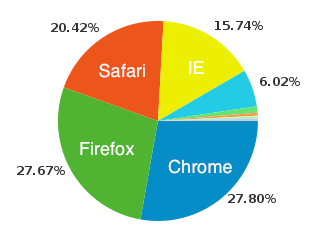
In which TechCrunch tells us about their browser stats. It’s sort of moderately amazing that Chrome is (already) edging out Firefox, but what I find most astounding, the thing that 2003 me would not have believed at all, is that Safari is third. Even more amazing: the article notes that 10% of Safari’s score is coming from the Mobile Safari variant, meaning iOS devices like iPhone and iPad.

tl;dr: Mobile Safari is now within striking distance of IE, and Safari as a whole is cleaning its clock, at least within the obviously gadget-obsessed demographic that reads the source. Let’s all pause to reflect on that for a few moments, because it’s fairly incredible, especially when you count the number of sites (and tech-support scripts) out there still “optimized” for IE6.

Just last week, we crossed five billion downloads [from the App Store]. This next thing is my favorite thing is my favorite stat of the whole show. As you know, 70% of revenue goes to the developer. How much have we paid you to date? Just a few days ago we crossed a billion dollars.

Steve Jobs, today at the Apple Worldwide Developers Conference. That’s a staggering number for something that didn’t even exist on this day in 2008.

Steve is showing a completely interactive ad here, almost like a sub-app inside the application. Embedded video, toys to play with. Really impressive as far as mobile advertising goes. If that kind of thing excites you.

Joshua Topolsky, liveblogging the iPhone OS 4 event.
He hits on the key point: advertising, no matter how great, only excites the advertiser, generally not the advertisee (though in narrow circumstances: of course, you’re glad to hear about something that interests you. 99.9% of all web-based advertising I’ve ever seen would interest no one). Nothing poses more of a hazard to the platform than opening this sort of floodgate for intrusive, platform-wide ads than does iAd.
Which Apple itself introduced today.
The examples shown seem tame enough, but then it always seems tame to start. Advertisers simply will not content themselves with opt-in advertising tucked away inside an app, and the new suspend/resume function means there’s no escape, the interrupting ad will still be waiting for you when you return; these are the people to whom you’ve just given the keys to the kingdom, and it has the capacity to make the crown jewels (the information-driven apps) totally unusable.
Pundits keep thinking Apple is going to “closed” itself out of the mobile market just like they all have convinced themselves that Apple did in the PC market. They won’t. But if it’s not careful, Apple will ultimately advertise itself out of the market.

iPaddery

I think “the web” doesn’t mean what John Battelle thinks it does:

There’s a very easy way for the iPad to [have a HyperCard like development environment for casual users to make apps with], and it doesn’t involve creating another HyperCard. It just involves the iPad becoming a world class Internet client. So far, from all I’ve heard, it sounds like it won’t be, and if you want to make anything that works great on the iPad, you have to make it in Apple’s proprietary authoring environment – just as you did for the iPhone. I think that’s a classic Apple mistake.

Er, methinks that, to John, Flash==“the web.” Sadly, no. Apple is, in fact, ensuring that iPad, iPhone, iTouch have a world class internet client. That’s called WebKit. The proper response on the part of web developers (and casual users, for that matter) is to move away from proprietary (e.g. Flash) to the open, or at least more open alternatives present in HTML5. You can make, today, a standalone application built entirely on that basis. Like Glyphboard or Pie Guy show, you can have a fully functional, offline capable, completely web-standards-based application on an iPhone without ever touching any of Apple’s “proprietary authoring environment” or relying on the Apple-run iTunes store for distribution.

Remaking HyperCard isn’t necessary. Apple already has a world class, non-proprietary authoring environment on their mobile OS. It’s called “the web.”

Islands in the stream

The Pew Research Center’s Project for Excellence in Journalism has put out an analysis of MSM’s business model and its prospects. A few grim highlights:

We estimate that the newspaper industry has lost $1.6 billion in annual reporting and editing capacity since 2000, or roughly 30 percent, which leaves an extra $4.4 billion remaining. Even if the economy improves, we predict more cuts in 2010.

$141 million of nonprofit money has flowed into new media efforts over the last four years (not including public broadcasting). That is less than one-tenth of the losses in newspaper resources alone.

[~79% of internet users never click on an ad, so:] Advertising during the year declined for the first time since 2002, according to data from eMarketer. Updated August projections put the declines at 4.6 percent, to $22.4 billion in total revenues.

Under the heading “Thrilling news for the New York Times’ upcoming paywall model,” you have:

Only about one third of Americans (35 percent) have a news destination they would call a favorite and even among these users, only 19 percent said they would continue to visit if the site put up a paywall.

But it seems the peeps do like opinion television, day night or otherwise:

At night, when cable is dominated by ideological talk shows, Fox grew by nearly a quarter to an average of 2.13 million viewers at any given moment. MSNBC rose 3 percent to 786,000, while CNN fell 15 percent to 891,000 viewers….

In daytime, CNN was up 9 percent over 2008 to an average of 621,000 viewers. But Fox daytime viewership grew again by almost a quarter, to roughly twice CNN’s audience (1.2 million viewers). MSNBC, relying on NBC news people more than talk show hosts, fell 8 percent to 325,000 viewers.

So, MSM, I guess this is it. You’re going to die. Before anyone start dancing on their grave, though, consider a future in which the Glenn Becks and Bill O’Reillys of the world (and their left of center counterparts) are all that’s left on cable news stations…and in which 80% of the content the blogosphere, notably including (in a roundabout way) this very post, is:

ongoing analysis of more than a million blogs and social media sites finds that 80 percent of the links are to U.S. legacy media.

So, in five years or so, we’ll all just be reblogging some crap O’Reilly said last night. And calling that news.

Jiminy. In the finest tradition of the blogosphere: I proclaim that I don’t know what it is, but something’s got to be did. Doubtless there will be an app for that…

Equivalency of Everything

Ashlee Vance is mystified by HP’s poor performance in the mobile phone market:

Hewlett-Packard is one of the world’s most successful makers of desktop computers, laptops, servers and printers. It owns a powerful consumer brand, and it is a growing provider of services for businesses. In the first quarter, the company’s sales rose 8 percent.

But in smartphones, H.P. has been on a steady slide into irrelevance.

[…]

Sales of HP’s hand-held products, including its iPaq smartphone, dropped to $25 million in the quarter, down from $57 million in the same period last year. Apple, by contrast, had sales of $5.6 billion for iPhones and related products during its most recent quarter.

HP’s anemic performance in the smartphone market has left analysts perplexed.

Indeed, most analysts tend to use this construction:

  1. Apple is a large computer company
  2. HP is a very large computer company
  3. Apple is making billions selling a mobile phone that doesn’t even have FM radio built in
  4. Q.E.D.: HP should be making even-more-billions selling a mobile phone with FM radio built right in; any other outcome is either an aberration or a mirage, but is clearly not the result of consumer opinion re: HP’s product offerings

The experience of the phones in question just doesn’t enter into it. Ever. That no customer has yet successfully activated that all-important FM radio without being directed step-by-step just isn’t even worth considering. Those are just user errors. Customers want a robust feature check-list at the expense of all other considerations, don’t they? Overall customer satisfaction isn’t something worth wondering after.
HP sells a bunch of commodity hardware running Windows, so they automatically should sell a bunch of commodity hardware running Windows Mobile. That that OS is a well documented train wreck of an operating system, again, just isn’t worth wondering after. It’s got “Windows” in the name, thus people will buy it just as they do the various desktop OSes with “Windows” in the name. Any other outcome is attributed to Apple’s marketing expertise. What else could be responsible? It must be those damned catchy ads. How else do you explain the largest purveyor of Windows Mobile phones, HTC, seeing that segment collapse as Android phone sales on their platforms grow? Again, just Apple and their catchy ads misleading the consumer. After all, it’s called Windows,

Remember, these are professional analysts we’re talking about here.

The article closes with this priceless quote from Phil McKinney, the chief technology officer in H.P.’s personal systems group:

“There is clearly a gap that has opened up for a device that has north of a 3.5-inch screen and less than a 9-inch screen.”

And, unfortunately for HP, that gap’s name is vastly more likely to be iPad than it is to be HP Commodity Doodad, now! with Windows Mobile Classic and a built in FM radio. You know: for kids!