Manna

Sweet, sweet research proves what I’ve been shouting about for a while now; this study took a look at what people react to (and email), essentially hoping to quantify why some articles go viral while others just sit there:

People preferred e-mailing articles with positive rather than negative themes, and they liked to send long articles on intellectually challenging topics.

Perhaps most of all, readers wanted to share articles that inspired awe, an emotion that the researchers investigated after noticing how many science articles made the list. In general, they found, 20 percent of articles that appeared on the Times home page made the list, but the rate rose to 30 percent for science articles, including ones with headlines like “The Promise and Power of RNA.” […]

“Science kept doing better than we expected,” […] “We anticipated that people would share articles with practical information about health or gadgets, and they did, but they also sent articles about paleontology and cosmology. You’d see articles shooting up the list that were about the optics of deer vision.”

Wait, wait, wait. I thought the answer to today’s problems in media were to shorten the article, dumb it down, and pack as much advertising (preferably blinking or animated) into the entirely theoretical “above the fold” space while also requiring innumerable “next page” clicks such that any still-sufficiently-interested reader would be so challenged to identify actual content that he or she would drop into a rage-seizure of some kind. Huh. Consider me gobsmacked. They continue:

To make sense of these trends in “virality,” the Penn researchers tracked more than 7,500 articles published from August 2008 to February 2009. They assessed each article’s popularity after controlling for factors like the time of day it was published online, the section in which it appeared and how much promotion it received on the Web home page.

A random sample of 3,000 of these articles was rated by independent readers for qualities like providing practical value or being surprising. The researchers also used computer algorithms to track the ratio of emotional words in an article and to assess the relative positivity or negativity.

[…]

More emotional stories were more likely to be e-mailed, the researchers found, and positive articles were shared more than negative ones. Longer articles generally did better than shorter articles, although Dr. Berger said that might just be because the longer articles were about more engaging topics. (The best way to test that, he said, would be for The Times to run shorter and longer versions of the same article that would be seen by different readers.)

Emphasis added by me to highlight the thing I want most: variably dimensioned articles. Got 15 seconds on the subway and just want the USAToday bullet? Here it is. Need an explainer that goes long on the various competing pieces of the legislation. Here it is. Want 10,000 words on the complete history of this movement in the United States. Here it is. Want a slideshow about the effects of doing/not doing this? Here it is. Want a video depicting those most affected? Here it is.

This sort of thing is not necessarily easy, and it’s certainly not free. But they’re doing a chunk of it already; they just don’t tie it together very well because they universally see themselves as, first and foremost, being in the dead-tree distribution business. The first newsroom with a national imprimatur that successfully enacts this can charge whatever they want. Eventually. The first hit is always, and must always be free. Wonder why the NYT paywall is going to work that way. Fascinating.
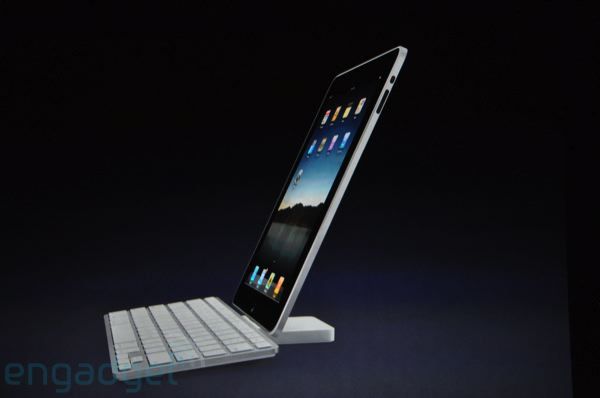
There’s a scene early on in [Avatar] where one of the scientists walks across the lab carrying the “mobile computer slab of the future.” We’ve seen one of these in almost every sci-fi movie of the last 50 years. It comes free with a jetpack, I suppose. Except this time, one month later, my 12 year old son turns to me and whispers “Look Dad, it’s an iPad.”

Mike Monteiro definitely gets it.

if you use it for just a few minutes, it becomes obvious that the iPad is not a big stretched-out iPhone, but rather that the iPhone is a shrunken stripped-down version of the iPad. The iPad is what they’ve been building toward all along.

John Gruber, agreeing with Lemkin.

iPAM

Alright then, how did we do? We were basically calling for:

It makes much more sense going forward for Apple to abstract away the “I’m ready to sync” part of the current equation; you buy the app, it comes with an iPhone app, they are linked and automatically exchange info. Changes then sync next time you dock the phone or tablet or, presumably, automatically over the air if you so desire.

Some of which we got, I guess. Certainly not the xenomorph part of my theory (yet); instead, you get to buy iWork for your Mac, and then buy it three more times for your iPad. Why the hell didn’t I think of that? But we didn’t get tight, vertical integration of any kind, really, even though Steve did use the product matrix with the hole between iPhone and a laptop. Just have to wait for some future revision (if ever) to really get the full-on, 24/7 back-and-forth arrows going there. Or else they suspect the entire “home computer” side of the equation will gradually extinguish itself over a number of years and obviate the whole issue. And maybe it will. iPad certainly represents a first step in that direction.

That’s what makes its interface choices, and the relative popularity of same very important going forward. As the Macintosh set the standard for computing, well, so far, I strongly suspect the iPhone and its descendants is setting the standards for future consumer computing. At the very least as said computing gets done through Apple.

AT&T stays on as carrier. If Apple was ever going to go with Verizon, this was the product. Not happening. Mark my words, Apple will buy or found its own damn dumb-pipes company before it has product on the Verizon network. Period.
The lack of contracts part of the equation is certainly interesting. I suspect AT&T sees it as a way to lessen the network impact by encouraging people to buy a month of service when they really need it, then let the service lapse for a while. No other explanation for it, really. We can therefore expect iPhone 3G service to get markedly worse in densely populated areas since they think they’ve got the overloading issue prefigured. Wonderful.

My overall iPad-specific thoughts in convenient numerical form:

  1. I think the iPad is really aimed at MacBook Air users; they’re not exactly power users, but they need to be able to open and edit a spreadsheet or a document of some sort on the go. Weight is their critical factor. iPhone, though pocket-sized, can’t provide the file editing and really never will; again: it’s pocket-sized. And but so the same folks clearly aren’t willing to lug a MacBook around, since any MacBook out there is cheaper and vastly more capable than an Air, and yet they went for the Air anyway.
    Obviously, the non-laptopped are also targets here; they may well have an iPhone and wish it did just a bit more, or they want something like an iPhone but don’t want to or couldn’t mess with the contracts and/but also saw iTouch as too limiting for one reason or another.
  2. The sandboxing implicit in the iPhone/iPad OS automatically and fairly drastically limits what you can do with it when compared with a “real” laptop computer. But I suspect we’ll only see more and more of that approach in consumer devices. Notably missing from the demos, though, was “what happens to the files” you are opening/saving/editing with the various iWork apps that were demoed. Pretty clear they aren’t automatically syncing via the cloud, or we’d have been shown it. I suspect you have to plug it into a Mac, where you then bump them back into your traditional filesystem. Presumably iTunes then deals with pushing any Mac-side updates back again and sorting out versions. Or not. Small deal to give you the capability to move this stuff into .me, though. Seems so painfully obvious, one wonders where it was today.
  3. Brushes looks like an absolute killer app on the iPad (as opposed to the iPhone version of the same app being interesting, for sure, but not really a reason to buy an iPhone/iTouch). Seriously, it’s DTP for tablets.
    Likewise, I think comic books, textbooks, and newspapers will prove to be unexpectedly powerful. The interweaving of text, video, charts, chat, depth, and you-name-it really could revitalize the whole news-papering trade. Likewise comics seem to be crying out for a killer platform and easy, impulse purchases that don’t involve Comic Book Guy (worst tablet ever). Just seems like an awful lot of business to be done in the currently-printed realm, especially when iPads are down ~$200. Perhaps already, seeing as KindleDX is  ~$450, of similar dimensions, and an utterly hobbled, so-last-decade device by comparison.
  4. Another dark horse not related to comics: The MLB app looks like something out of the not-too-distant future that I’ve been promised every time anyone does a “what will  the teevee be like in 10 years” piece for OMNI. Wowie. Unlimited possibilities. Pop-Up video goes wide. Really a big deal.
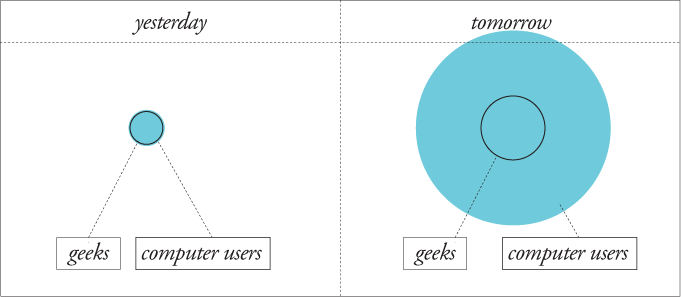
  5. The matrix: I really never thought that, as of this announcement, iPhone would be instantly, clearly, and definitively the iPad mini. But it is. Funny how things work out sometimes.
  6. The name? Boy, Apple is really feeling its oats right now. The least of the problems with the name is its relative proximity to iPod. Generally speaking: not so fresh. In related news: the countdown clock for the end of the iEra is probably set back another five or ten years now. Jesus.

I am thrilled to announce to you that iPad will start at $499

Steve Jobs.
Going to sell a few of those after all, even with a largely non-functional (but also non-contract) AT&T 3G data network.

We’ve been able to achieve 10 hours of battery life. I can take a flight from San Francisco to Tokyo and watch video the whole time.

Steve Jobs.
Methinks that we are “able to achieve” and “I can take a flight … to Tokyo” are utterly unrelated statements here.