if you use it for just a few minutes, it becomes obvious that the iPad is not a big stretched-out iPhone, but rather that the iPhone is a shrunken stripped-down version of the iPad. The iPad is what they’ve been building toward all along.
Tag: iphone
iPAM
Alright then, how did we do? We were basically calling for:
It makes much more sense going forward for Apple to abstract away the “I’m ready to sync” part of the current equation; you buy the app, it comes with an iPhone app, they are linked and automatically exchange info. Changes then sync next time you dock the phone or tablet or, presumably, automatically over the air if you so desire.
Some of which we got, I guess. Certainly not the xenomorph part of my theory (yet); instead, you get to buy iWork for your Mac, and then buy it three more times for your iPad. Why the hell didn’t I think of that? But we didn’t get tight, vertical integration of any kind, really, even though Steve did use the product matrix with the hole between iPhone and a laptop. Just have to wait for some future revision (if ever) to really get the full-on, 24/7 back-and-forth arrows going there. Or else they suspect the entire “home computer” side of the equation will gradually extinguish itself over a number of years and obviate the whole issue. And maybe it will. iPad certainly represents a first step in that direction.
That’s what makes its interface choices, and the relative popularity of same very important going forward. As the Macintosh set the standard for computing, well, so far, I strongly suspect the iPhone and its descendants is setting the standards for future consumer computing. At the very least as said computing gets done through Apple.
AT&T stays on as carrier. If Apple was ever going to go with Verizon, this was the product. Not happening. Mark my words, Apple will buy or found its own damn dumb-pipes company before it has product on the Verizon network. Period.
The lack of contracts part of the equation is certainly interesting. I suspect AT&T sees it as a way to lessen the network impact by encouraging people to buy a month of service when they really need it, then let the service lapse for a while. No other explanation for it, really. We can therefore expect iPhone 3G service to get markedly worse in densely populated areas since they think they’ve got the overloading issue prefigured. Wonderful.
My overall iPad-specific thoughts in convenient numerical form:
- I think the iPad is really aimed at MacBook Air users; they’re not exactly power users, but they need to be able to open and edit a spreadsheet or a document of some sort on the go. Weight is their critical factor. iPhone, though pocket-sized, can’t provide the file editing and really never will; again: it’s pocket-sized. And but so the same folks clearly aren’t willing to lug a MacBook around, since any MacBook out there is cheaper and vastly more capable than an Air, and yet they went for the Air anyway.
Obviously, the non-laptopped are also targets here; they may well have an iPhone and wish it did just a bit more, or they want something like an iPhone but don’t want to or couldn’t mess with the contracts and/but also saw iTouch as too limiting for one reason or another. - The sandboxing implicit in the iPhone/iPad OS automatically and fairly drastically limits what you can do with it when compared with a “real” laptop computer. But I suspect we’ll only see more and more of that approach in consumer devices. Notably missing from the demos, though, was “what happens to the files” you are opening/saving/editing with the various iWork apps that were demoed. Pretty clear they aren’t automatically syncing via the cloud, or we’d have been shown it. I suspect you have to plug it into a Mac, where you then bump them back into your traditional filesystem. Presumably iTunes then deals with pushing any Mac-side updates back again and sorting out versions. Or not. Small deal to give you the capability to move this stuff into .me, though. Seems so painfully obvious, one wonders where it was today.
- Brushes looks like an absolute killer app on the iPad (as opposed to the iPhone version of the same app being interesting, for sure, but not really a reason to buy an iPhone/iTouch). Seriously, it’s DTP for tablets.
Likewise, I think comic books, textbooks, and newspapers will prove to be unexpectedly powerful. The interweaving of text, video, charts, chat, depth, and you-name-it really could revitalize the whole news-papering trade. Likewise comics seem to be crying out for a killer platform and easy, impulse purchases that don’t involve Comic Book Guy (worst tablet ever). Just seems like an awful lot of business to be done in the currently-printed realm, especially when iPads are down ~$200. Perhaps already, seeing as KindleDX is ~$450, of similar dimensions, and an utterly hobbled, so-last-decade device by comparison. - Another dark horse not related to comics: The MLB app looks like something out of the not-too-distant future that I’ve been promised every time anyone does a “what will the teevee be like in 10 years” piece for OMNI. Wowie. Unlimited possibilities. Pop-Up video goes wide. Really a big deal.
- The matrix: I really never thought that, as of this announcement, iPhone would be instantly, clearly, and definitively the iPad mini. But it is. Funny how things work out sometimes.
- The name? Boy, Apple is really feeling its oats right now. The least of the problems with the name is its relative proximity to iPod. Generally speaking: not so fresh. In related news: the countdown clock for the end of the iEra is probably set back another five or ten years now. Jesus.
Metastasis
Simple Finder. It’s been around in one form or another since OS 7 or 8. Here’s what it looks like nowadays:

Remind you of anything? Starting to get some ideas about how the product line could be integrated by the iTablet? How such a device could be made to have just enough Mac in it to be useful while Macs could be made to have just enough iTablet and iPhone in them to be instantly understandable to a hoard of potential new users? How those users would be trained from the get-go to buy apps and other content through Apple/iTunes? How the “what it does” question could be instantly forgotten with a single stroke?
It’s a computing product. It occupies the space between an iPhone and an iBook. And it makes everything else around it fall into place.
It’s what’s coming. It’s what it does.
Command and (Voice) Control
mrgan wants some new iPhone Voice Commands:
- “What time is it?”
- “Rate song three stars.”
- “What’s the weather?”
- “Notifications!” (“You have one unread message and two unread emails.”)
- “Redial.”
- “New voice memo…”
For all its vaunted software design, the iPhone is the victim of a few punishingly odd absences; for the record, I agree with all of these, especially time and song rating.
In other departments, I’d like to see a FrontRow style functionality in the phone/touch. Right now if your phone/touch is docked (and connected to a tv or stereo), you are limited to starting, stopping, and tracking through your music with the remote. Why in the name of all that’s holy is there not a dedicated interface such that you can look at pictures, play a movie, browse your music, look at YouTube (and etc…), and fifty other obvious niceties such an app could provide, all right there on the teevee and from the comfort of your couch. Apple? Seeing as you are the only company that can cross these sandbox lines, why in the hell haven’t you done this yet?
Likewise: Keynote. Why does Apple’s own doodad focus on using the iPhone as a glorified remote? Where is a straightforward way of presenting my slides from the phone/touch? As it stands now, I can bodge it with a custom movie…so long as I don’t mind timed transitions. And, let me tell you: I mind them. There is no reason on this Earth that a laptop need be required to deliver a 50 slide stack at any moment to some unsuspecting audience somewhere. None! That’s the whole point of the device. Isn’t it? Well, that and dropped phone calls.
On the Nexus One, only 190 megabytes of its total 4.5 gigabytes of memory is allowed for storing apps. On the $199 iPhone, nearly all of the 16 gigabytes of memory can be used for apps.
Oh yes.
In which Marco admits to stalking me:
[The entirely theoretical Apple tablet] can be the computer that we buy our parents or grandparents without worrying that we’re signing ourselves up for years of painful tech support calls as they “lose” documents by saving them in the wrong folder, think they can’t save any more files because the desktop is full of icons, delete their browsers’ icons and tell us the internet is gone, keep five different antivirus products half-installed, and fill their RAM with programs they never Quit because they just close every window instead and don’t notice the tiny “running” dot in the Dock or know what it indicates.
He’s right though. Somewhere between the real points Marco makes, along with Siracusa’s take, and what Gruber talks about lies the truth of the Tablet. But I think the biggest thing to come out of the whole tablet introduction will ultimately be the beginning of real convergence between the various compartments of the Apple product line. Right now, Apple has the iPhoneOS and MacOS; presumably, these are about to be joined by TabletOS (which is likely sort of an iPhoneOS+). All of these, of course ride atop some version of OS X. With the introduction of the Tablet, I suspect we’ll begin to see how they all fit together. My prediction extends Gruber’s gist: not only will iPhone apps work as widgets on the Tablet, they’ll work as widgets on MacOS (under its next revision). And not on the Dashboard (though Apple could presumably choose to put them in there too), but on the desktop.
Doing this allows for a whole new class of applications. You’d still have essentially single-purpose iPhone apps: do one small thing and do it very well. Add to that more powerful, tablet and desktop aimed apps: more pixels, more computing power. Bundling this together as a unitary application bundle allows you to implant an iPhone app inside the desktop version; thus you can offer multi-platform sync. Sure, I can’t actually edit X-app documents on the phone, but I can view them easily and do these other, more minor edits on them. Bento offers a paleo-version of this setup today; you can create databases and various data-structures on the phone or the desktop and they sync data and the underlying table designs back and forth…certain features, though, only work on the desktop version.
It makes much more sense going forward for Apple to abstract away the “I’m ready to sync” part of the current equation; you buy the app, it comes with an iPhone app, they are linked and automatically exchange info. Changes then sync next time you dock the phone or tablet or, presumably, automatically over the air if you so desire. All the fiddly bits with saving, file structure, and whatnot are totally abstracted away. THIS is why the tablet will matter. THIS is “what it does” that compels people to buy one.
What this means for the broader Macintosh platform as this more abstracted take on the file system gradually metastasizes up the product chain is left as an exercise for the student.

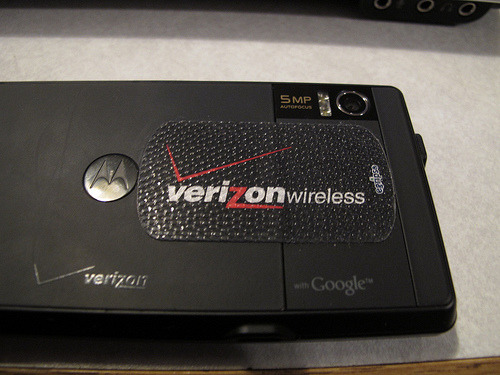
Verizon is the perfect corporate partner for Apple. This is precisely how Steve Jobs himself would deal with a balky battery door. With a branded sticker. Accept no cheap substitutes; only Verizon-brand stickers give you the confidence today’s multitaskers demand.
AmericaLand in bad decline
Re: this and this prior post, Fake Steve Jobs reports on the chat he had with AT&T CEO Randall Stephenson. Here’s some highlights:
Now, the thing about [“Meet the Beatles”] was, on the day [the album] hit the U.S. the whole world changed. Like, before that day, the world was one way, music was one way, culture was one way — and then after that day the world was never the same ever again, and as soon as you heard that album you knew that, and even if you were only nine years old, which I was, you just knew. You knew. Sales were crazy.
[…] there was a lot of demand for that record — so much that the plant that printed the records could not keep up. Now here’s the lesson. Do you think the guys who were running Capitol Records said, Gee whiz, the kids are buying up this record at such a crazy pace that our printing plant can’t keep up — we’d better find a way to slow things down. Maybe we can create an incentive that would discourage people from buying the record. Do you think they said that? No, they did not. What they did was, they went out and found another printing plant. And another one and another one, until they could make as many records as people wanted.
Absolutely goddamned right. AT&T’s metaphorical Meet the Beatles response to the iPhone data-deluge seems to be:
“we need to figure out a way to keep people out of record stores. Prevent them from entering, dissuade them from buying the records if they’re already in there. That is the winning formula.”
Which is precisely the reaction that puts AT&T out of business. Maybe not today, maybe not tomorrow, but soon (and for a long time). Back to (fake) Steve:
Yes, 3% of your users are taking up 40% of your bandwidth. You see this as a bad thing. It’s not. It’s a good thing. It’s a blessing. It’s an indication that people love what we’re doing, which means you now have a reason to go out and double or triple or quadruple your damn network capacity. Jesus! I can’t believe I’m explaining this to you. You’re in the business of selling bandwidth. That pipe is what you sell. Right now what the market is telling you is that you can sell even more! Lots more! Good Lord. The world is changing, and you’re right in the sweet spot.
Indeed they are. Reaction? Let’s piss it away for some modest, short-term gains. The model, you’ll recall, is to sell crippled phones that, since people can’t actually use, don’t tax our network at all. AT&T simply doesn’t understand that the world has turned and left them there, in the past, with a shitty flip phones business while everyone else is up here, in the “future,” waiting on good pipes. Praying someone will take their money for those (still mythical) good pipes. That AT&T doesn’t see it that way is mostly because of the sentence to which I added emphasis: AT&T doesn’t want to believe that they are only selling pipe. They think they are selling something else entirely. I’m quite sure they can’t vocalize exactly what that thing is, but they inevitably deny the notion that they are, in fact, already a dumb-pipes company, though a very bad one. And this is why they fail. They think their subscribers care who is providing them with the dumb pipes instead of how well the dumb pipes work. And it is on this point that (fake) Steve really, really gets going:
Guys like you took over the phone company and all you cared about was milking profit and paying off assholes in Congress to fuck over anyone who came along with a better idea, because even though it might be great for consumers it would mean you and your lazy pals would have to get off your asses and start working again in order to keep up.
[…] everyone focused on just getting what they can in the short run and who cares what kind of piece of shit product we’re putting out […and…] it was all about taking all this great shit that our predecessors had built and “unlocking value” which really meant finding ways to leech out whatever bit of money they could get in the short run and let the future be damned. It was all just one big swindle, and the only kind of engineering that matters anymore is financial engineering.
Empahsis added to point out (fake) Steve likely recapitulating the secret mission statement of AT&T. They sell pipes, for chrissakes. And yet they think it is in their interest to restrict and deny people access to those pipes, which said people feel they have contracted for access to and have every right to access. Worse, AT&T seems to feel this is a winning strategy. And maybe it is. For 2009, and even some of 2010. But 2011? Not so much. I guess Randall and his lot will have vested and retired to Nantucket by then.
That this sort of shit seems to be the organizing concept of American industry for the past half-century or so is, uh, totally unrelated and nothing to worry about, I’m sure. Fake Steve sums it up:
I had this vision of the future — a ruined empire, run by number crunchers, squalid and stupid and puffed up with phony patriotism, settling for a long slow decline.

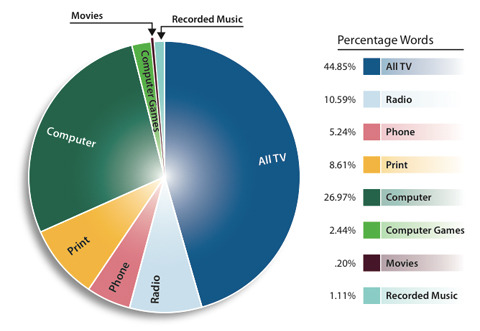
NYT: American households collectively consumed 3.6 zettabytes of information in 2008. That’s 34 Gb per individual. A day. Whoa. Don’t worry, AT&T, this sort of thing doesn’t affect you at all. You’ll be long gone before then.
Also: consider the proportion of that “Recorded Music” slice. Think about all the swirl around the RIAA and etc. Then look at the “TV” slice and contemplate the utter foolishness of those running commercial visual media (and especially: cable companies) in this country. Then, perhaps, buy a nice cave somewheres and go live in it.

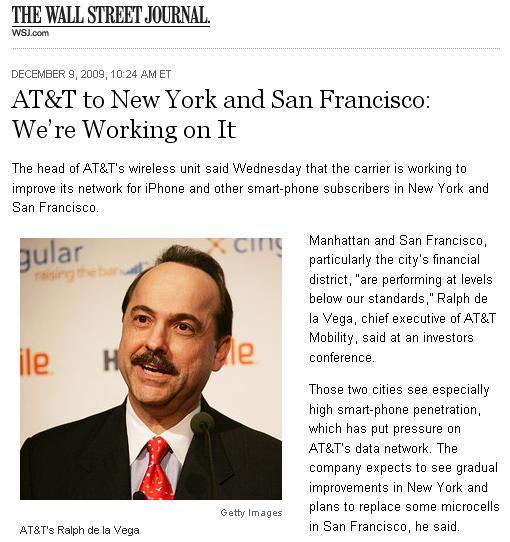
By “working on it” they mean “working on capping bits and then charging overages for data access such that we effectively cripple the iPhone and/but reduce demand for data without, you know, spending any money on our side. Some entirely reasonable amount that’s in the ballpark of what we get for SMS; on the order of $2 a bit. You’ll hardly notice it at all!”