iThink therefore iAm

Kottke talks about the iPhone (as a device-class, mind you, not specifically the device) impacting many, many more markets than just smart-phones or PDAs. It’s also a compact camera killer, to name only one segment touched on in his fine essay. And I think he’s basically right. But I want to talk about a point he makes in the second footnote (without going all DFW on you):

You’ve got to wonder when Apple is going to change the name of the iPhone. The phone part of the device increasingly seems like an afterthought, not the main attraction. The main benefit of the device is that it does everything. How do you choose a name for the device that has everything? Hell if I know. But as far as the timing goes, I’d guess that the name change will happen with next year’s introduction of the new model. The current progression of names – iPhone, iPhone 3G, iPhone 3GS – has nowhere else to go (iPhone 3GS Plus isn’t Apple’s style).

Gruber picks up on this point too, basically answering him directly with:

If this platform is here for the long run, the general purpose name that best works for a general purpose device is already here: iPod. In fact, iPod, semantically, is a better name for the iPod Touch than it ever was for the original focused-on-music models. As I see it, the phone in iPhone isn’t about telephony, but about the necessary contract with a mobile carrier.

Agreed. Lemkin was all over this subject back in 2007 (!), talking about Steve Jobs’ almost certain desire to skip 3G (and any other carrier-tied technology) entirely in favor of some form of ever-present WiFi that could come from any company, municipal co-op, or whatever. This, of course, is the ultimate existential threat to AT&T: if they become (as a company) nothing more than a provider of the dumb pipe, then you can substitute any old dumb pipe for them without noticing any change at all. This is why they’re fighting Google tooth and nail over Google Voice, though hiding behind Apple to do it (presumably, the relevant lawyers (correctly) predicted a prompt FCC smackdown should AT&T intervene directly). But they will lose this fight over the long term. Google has already seen to it via the bidding process on the wireless spectrum. How well did AT&T like that?

“Google is demanding the government stack the deck in its favor, limit competing bids, and effectively force wireless carriers to alter their business models to Google’s liking.”

By “alter their business models” he meant to say: “stop relentlessly fucking over the end-user through long, inflexible contracts on POS phones of AT&T’s choosing.” Oh, GenericNetCo has really cheap wireless internet this month. I’ll switch. So it’s fundamental to AT&T that they seemlessly transition you from the locked, carrier specific technology (basically today’s situation) to the quietly generic wireless technology (aka Dumb Pipes) they’re hoping you don’t even notice you can actually get from anyone and everyone that cares to provide said service.

What will be their value-add in this situation? Unclear. Presumably they intend it to be nationwide reach, reliability, convenience, and some kind of competitive pricing for same. That said, and somewhat obviously, if AT&T were dependent on consumer goodwill and raw network reach, reliability, and convenience as of today, they’d be out of business inside of a fortnight. They seem busier blaming their iPhone users for their network’s various problems than, you know, improving the service that they are contractually obligated to provide in some fashion or other. And that’s within a market and on a network whose design they’ve had decades to cultivate, tune, and understand (though with an outcome that clearly implies that they still don’t “understand” what it is these iPhone users expect from their device, and how that’s different from, say, the user of a more generically crippled feature-phone). So can they build out a nationwide, everpresent, high-speed, and five-9s reliable WiFi service that’s compelling enough to keep people around once access to the underlying technology no longer requires multi-year contracts? Without recourse to tethering them to a number or some other lock-in? I seriously doubt it.

But, yeah. It will be called the iPod. Within a handful of years, the core iPod platform will be entirely Touch-based, and thus simply morph back into iPod (with Nanos or Shuffles being the variant, but today’s Touch being The iPod). And you’ll use said device to make calls.
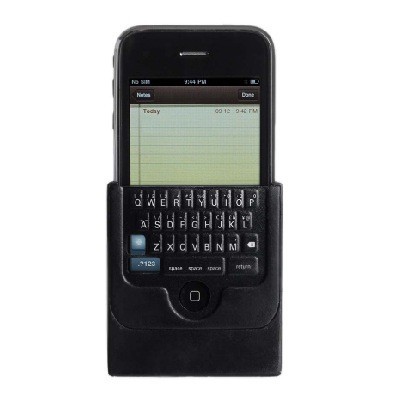
So then, the usage model here is to lug around the iTwinge until the moment you need to use the keypad…at which point you slide the thing on and use it to type (it apparently just presses right through to the screen). Then, when you’ve finished typing…you take this thing off again. That just sounds wonderful. Why, I already can’t imagine using an iPhone without it.

iTwinge users are advised to apply the sleeve as soon as the iPhone is taken out; typos can still occur through incidental contact, improper use of the iTwinge, and many kinds of type-play: even when the iPhone is not fully inserted into the iTwinge.

In defense of the iTwinge, I suppose one could limit oneself to the top two rows for application storage and avoid all apps that employ more than the first half of the screen. Probably some good tip calculators out there that would work just great.

Tablet Rasa Redux

Steve Jobs all but introduces the upcoming Apple Tablet (hopefully the upcoming Macintosh tablet, but time will tell) in these quotes from an interview with David Pogue of the NYT:

There are some things that I’m focusing a lot of attention on right now—to polish

[…]

We have some really good stuff coming up.

Keep in mind, Jobs has previously stated that he considers most tablet-type computers to be, uh, shit. Additionally, we know that a number of pre-iPhones (for lack of a better term) died on the vine because one SPJ deemed them unworthy (he’s occasionally referred to these as their “best product decisions” or some similar construction: better to shitcan something bad than put it out there prematurely and sully the brand. Witness the Newton.

Likewise, he presages that this doodad will be far more than a reader:

I’m sure there will always be dedicated devices [like the Kindle], and they may have a few advantages in doing just one thing,” he said. “But I think the general-purpose devices will win the day. Because I think people just probably aren’t willing to pay for a dedicated device.

Even if the tablet runs the iPhone OS, it will be a far more capable everything than Kindle is a reader. If it runs garden-variety Mac OS X, it will likely outperform many (or most) netbooks in terms of absolute utility. How could it not? People already get pretty good results hacking the Mac OS onto these devices. An optimized version, from Apple, would dominate the space assuming it was priced within, say, $100 of its most direct competitors (honestly, it’s hard to figure out what those are in a field pretty well suffused with crap).

iResolve to iGym

AT&T was happy to sign up as many iPhone customers as they could. Their mentality was probably very similar to gyms who sign up as many people as they can in January when everyone makes their New Year’s Resolution to lose weight. Gym are packed the first few months after January but then there’s a drop-off in attendance, because people tend to slack off

In fact, far from being New Years’ Resolution Gym people, iPhone users are probably using their iPhones to stream music at the gym. All the more data for AT&T to try and avoid handling.

iResolve to iGym

PAMtastic Questions and Answers

Still a few days to go, but I think we already have the answer to this little prediction from Palm investor Roger McNamee:

“You know the beautiful thing: June 29, 2009, is the two- year anniversary of the first shipment of the iPhone. Not one of those people will still be using an iPhone a month later. Think about it – If you bought the first iPhone, you bought it because you wanted the coolest product on the market. Your two-year contract has just expired. Look around. Tell me what they’re going to buy.”

A: (wait for it) iPhones:

Approximately 12% of consumers who visited a retail store this past weekend to make their iPhone 3G S purchase said they were replacing a BlackBerry handset, the latest sign that Apple continues to make headway against rival Research in Motion in the high-stakes smartphone market.
That data point is one of several interesting statistics to come out of a survey by Piper Jaffray of 256 early iPhone 3G S adopters shopping for their new handsets at Apple retail stores in New York and Minnesota this past weekend.

What a remarkable and unpredictable turn of events! Apple convinced another million rubes to buy their products that, as we all know, are only a temporary fashion and not indicative of a new usage model at all. I thought this introduction would mark the end of the iPhone era as hordes of dissatisfied users fled the sinking, née doomed platform for the Elysian fields of Windows Mobile and Blackberry or scrappy up-and-comer Palm Pre. After all, they’ve got tiny keyboards. And some other features that are…probably important! RIM (and the rest) can’t possibly fail. Right? You don’t just walk in and create a “decent phone.” It’s just not possible. Well, I’m sure these poor, misguided users will be off to RIM, Pre, or Android any day now…

Stonecutters

Time for prediction accuracy measurement everyone! Yes, it’s delicious PAM; this time, we review our psychohistorical analysis re: iPhone, Mac OS X 10.6 (aka Snow Leopard), and the magical mystical marble interface. Let’s review. I said:

So, carve it in stone: Snow Leopard will be announced and a full demo given at WWDC, cost $129.00, only run on Intel-based Macs, and probably ship reasonably soon after announcement, say right around 9/1/09.

Alright, Snow Leopard was announced and given demo at WWDC: +1
SL will cost, um, $29.00: -1(00)
SL will indeed run only on Intel-based Macs: +1
SL will indeed ship “in September”: +1

75%. Not too shabby. Take that, eternal asshat Rob Enderle.
On Marble: Clearly, that’ll be the reason the next update reverts to $129 pricing…

iPhone Mini: I “have my doubts” and still do. +1, huzzah! Also a bonus dose of goodwill for noting the notion that existing iPhone tech takes up the “low end” (whether in Mini form or not) while shiny new iPhonery takes the old price-point with feature/memory extension. Fish in a barrel, that one.

The tablet: too soon to score. Certainly the animus directed at AT&T onstage implies a “hey look, it’s that Verizon guy!” attitude amongst the Apple powers that be. We shall see. Score it a zero for now, though.

That gives the staff a 4 out of 5, for a glittering 80%. Everyone feel free to take one extra mint on the way out of the office tonight.

Kindlegarten

This is one of the strangest statements I’ve seen in a long time:

We see that when people buy a Kindle, they actually continue to buy the same number of physical books going forward as they did before they owned a Kindle. And then incrementally, they buy about 1.6 to 1.7 electronic books, Kindle books, for every physical book that they buy.

That’s Amazon honcho Jeff Bezos as quoted in the NYT (reporting on the introduction of the NOW! Bigger! Kindle DX).

Amazon reports rather impressive sales of Kindle-books, especially given that the article states there are probably fewer than 1M Kindles in circulation as of today. And yet, people who buy the Kindle (a device whose chief benefit would appear to be the avoidance of buying dead-tree books that the buyer has to lug around, store, and etc…) keep right on buying dead-tree books they have to lug around at the same rate as before…they simply supplement those with some Kindle-books.

Are these gift books? Do these buyers understand what their Kindle does (and that it does more than calculate tips)? Particular authors that are not available on the Kindle for some reason? What possible explanation can there be (if we assume that Bezos is being completely open about the underlying stats and isn’t simply mistaken on some point). Seriously, this seems to me to be the key moment of the whole presser but it’s reported without too much note.
But this admission does go a long way towards explaining why Amazon decided to put out a Kindle reader app for the iPhone: it’s unlimited upside to them. If they sell a Kindle once you’ve read some of their books on the iPhone (and presumably discovered that you could read on the little screen after all, but decide you would prefer to do so on a Kindle for one reason or another) then it’s even more profit for them. But, if you don’t make the leap to their device, you’re still apparently going to buy just as many dead-tree books as you ever did, plus some number of Kindle-reader books for the iPhone.

Vaguely unbelievable, but apparently true.

Tablet Rasa

Is it just me or is all the speculation about Verizon/Apple/iTablet/iPhone-lite sort of missing the point? Everyone speculating seems to forget how it is the Kindle works and how Apple might improve on that model.

Here’s my prediction: Verizon, if involved at all, will provide transparent but always-on network connectivity but no traditional phone service. This would be just the same as the way Sprint provides WhisperNet to the Kindle; this way there’s no ongoing commitment on the part of the consumer, and assuming this tablet/Verizon thing comes to pass, Apple will contract in a similar fashion with Verizon for the data service and a lifetime connection will be included in the purchase of the device. Maybe Apple throws in a MobileMe subscription for a the first year to make for seemless desktop/mobile doodad integration featuring “instant and anywhere” sync.
Any calls made on an iTablet will be made through Skype (or some other IP-phone service) over normal WiFi connections but never, ever over this mobile data connection Verizon might be providing. That keeps AT&T content for the next couple of years as the butcher gradually sidles up with the pneumatic stunner in the runup to 2010 or so. You can sum it up thusly: Verizon:iTablet::WhisperNet:Kindle.

iPhone Mini: if it exists as a US product (and I still have my doubts, though Gruber makes a nice case), it will be an AT&T device; essentially as he described it on DF: a novel form factor (size- or volume-wise) that is essentially an iPhone 1.0/3G in modified clothing. The top billed iPhone will sport an updated version of the same design we see today, but with suitably gaudy specifications by comparison.