It’s on: Apple cranks up the Beats for $3 billion

By welcoming Beats into his portfolio, Apple CEO Cook is acknowledging a shift away from its pioneering iTunes pay-per-song model and toward streaming audio. He also is side-stepping founder Jobs’ insistence that all Apple hits be crafted in-house.

I guess we’re not counting iTunes (which started life as SoundJam MP until Apple bought, re-skinned, and renamed it) and of course iPod, which was Apple industrial design around the PortalPlayer reference platform and Pixo software. So, yes, excepting those two massive omissions in the most directly comparable field to that which you are writing about, Jobs insisted on only Apple crafted hits.

Additionally worth noting that Jobs apparently outsourced Apple misses. Looking at you, Cube.

It’s on: Apple cranks up the Beats for $3 billion

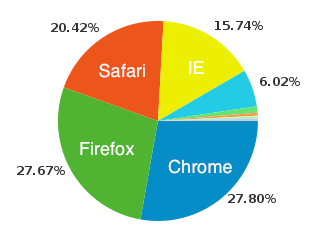
In which TechCrunch tells us about their browser stats. It’s sort of moderately amazing that Chrome is (already) edging out Firefox, but what I find most astounding, the thing that 2003 me would not have believed at all, is that Safari is third. Even more amazing: the article notes that 10% of Safari’s score is coming from the Mobile Safari variant, meaning iOS devices like iPhone and iPad.

tl;dr: Mobile Safari is now within striking distance of IE, and Safari as a whole is cleaning its clock, at least within the obviously gadget-obsessed demographic that reads the source. Let’s all pause to reflect on that for a few moments, because it’s fairly incredible, especially when you count the number of sites (and tech-support scripts) out there still “optimized” for IE6.

Just last week, we crossed five billion downloads [from the App Store]. This next thing is my favorite thing is my favorite stat of the whole show. As you know, 70% of revenue goes to the developer. How much have we paid you to date? Just a few days ago we crossed a billion dollars.

Steve Jobs, today at the Apple Worldwide Developers Conference. That’s a staggering number for something that didn’t even exist on this day in 2008.

The two App Stores

marco make a convincing case about the “two” app stores; but this section really struck me:

The primary screenshots of each game also show a clear difference for people who did select either app for more information:

Skee-Ball is immediately recognizable, well-known, and obvious. But Ramp Champ looks likely to lose out on nearly every impulse purchase from people who don’t want to spend much time looking into it — which is nearly every buyer for App Store A.

It’s really remarkable just how terrible most screenshots are. You’ve got four or five slots to focus attention on what’s best in your application, and that’s assuming a buyer is willing to look at more than one or even two. But even major developers tend to waste them all on views that either aren’t instructive, or repeatedly bash the same point into the ground without really illuminating overall functionality. Bento, to name but one, uses three of five screens to show us that:

  1. different kinds of libraries are possible
  2. –[AND]–

  3. you can use something akin to coverflow to choose between them

And this from a $5 app created by FileMaker, a subsidiary of a company called Apple. Nothing in there to imply that you can sort, sync, and customize databases between your phone and computer. Not that those are important features, apparently. Why not show us a to-do list, a shopping list sorted by need, a library inventory, and tasting notes complete with pictures and a calculation field for scores? Anything, really, would be better than what they do show: Hey! We have some different stationery pads in here.

And it’s not just Apple/FileMaker. Most apps, it seems, suffer from the “does this even do what I think it will?” syndrome with regard to screen-shots. Presumably, the creators hope you’ll just roll the dice on a sub-$X purchase such that the most basic visual information is all that’s required. The fact that most people won’t, at least not the people in the “B” app store, those with exceedingly specific ideas about what this app “needs to do,” figures into Marco’s overall equation mightily. It lands those apps with lousy descriptions or poor screen-shots directly in the “A” store, where I think it’s pretty well established: nobody cares what you’re doing unless it’s cheap and/or very popular for some reason.

Worth noting that Tumblr’s app: excellent selection of screen shots that detail exactly what it is you can do with it in informative little usage scenarios. And it’s a free app.

Shake It Up

Hate to break it to these guys: shaking a developing Polaroid is just like tapping the unopened top on a can of something carbonated. It’s just something to do while you wait around for equilibrium (can) or chemical reactions (Polaroid) to occur; these user-actions aren’t actually doing anything.

But, even if we accept the (wrong) notion that shaking a Polaroid picture does something: Why in the name of Christ would one want to implement said delay in the “development” of a photo on an iPhone? It’s beyond reason. It’s like paying to have the iPod app “warm up” for a few minutes when you launch it, complete with some simulated tubes glowing more and more brightly on the screen. Or making the YouTube app disappear slowly into a central dot when you close it and periodically lose vertical hold while you engage in spectation unless you beat the side of the phone a time or two (this app would also need a distant voice screaming not to hit the TV, you’ll break it! after each required series of phone-taps).

Other than that: great product, boys. Positively bully!

Shake It Up

iThink therefore iAm

Kottke talks about the iPhone (as a device-class, mind you, not specifically the device) impacting many, many more markets than just smart-phones or PDAs. It’s also a compact camera killer, to name only one segment touched on in his fine essay. And I think he’s basically right. But I want to talk about a point he makes in the second footnote (without going all DFW on you):

You’ve got to wonder when Apple is going to change the name of the iPhone. The phone part of the device increasingly seems like an afterthought, not the main attraction. The main benefit of the device is that it does everything. How do you choose a name for the device that has everything? Hell if I know. But as far as the timing goes, I’d guess that the name change will happen with next year’s introduction of the new model. The current progression of names – iPhone, iPhone 3G, iPhone 3GS – has nowhere else to go (iPhone 3GS Plus isn’t Apple’s style).

Gruber picks up on this point too, basically answering him directly with:

If this platform is here for the long run, the general purpose name that best works for a general purpose device is already here: iPod. In fact, iPod, semantically, is a better name for the iPod Touch than it ever was for the original focused-on-music models. As I see it, the phone in iPhone isn’t about telephony, but about the necessary contract with a mobile carrier.

Agreed. Lemkin was all over this subject back in 2007 (!), talking about Steve Jobs’ almost certain desire to skip 3G (and any other carrier-tied technology) entirely in favor of some form of ever-present WiFi that could come from any company, municipal co-op, or whatever. This, of course, is the ultimate existential threat to AT&T: if they become (as a company) nothing more than a provider of the dumb pipe, then you can substitute any old dumb pipe for them without noticing any change at all. This is why they’re fighting Google tooth and nail over Google Voice, though hiding behind Apple to do it (presumably, the relevant lawyers (correctly) predicted a prompt FCC smackdown should AT&T intervene directly). But they will lose this fight over the long term. Google has already seen to it via the bidding process on the wireless spectrum. How well did AT&T like that?

“Google is demanding the government stack the deck in its favor, limit competing bids, and effectively force wireless carriers to alter their business models to Google’s liking.”

By “alter their business models” he meant to say: “stop relentlessly fucking over the end-user through long, inflexible contracts on POS phones of AT&T’s choosing.” Oh, GenericNetCo has really cheap wireless internet this month. I’ll switch. So it’s fundamental to AT&T that they seemlessly transition you from the locked, carrier specific technology (basically today’s situation) to the quietly generic wireless technology (aka Dumb Pipes) they’re hoping you don’t even notice you can actually get from anyone and everyone that cares to provide said service.

What will be their value-add in this situation? Unclear. Presumably they intend it to be nationwide reach, reliability, convenience, and some kind of competitive pricing for same. That said, and somewhat obviously, if AT&T were dependent on consumer goodwill and raw network reach, reliability, and convenience as of today, they’d be out of business inside of a fortnight. They seem busier blaming their iPhone users for their network’s various problems than, you know, improving the service that they are contractually obligated to provide in some fashion or other. And that’s within a market and on a network whose design they’ve had decades to cultivate, tune, and understand (though with an outcome that clearly implies that they still don’t “understand” what it is these iPhone users expect from their device, and how that’s different from, say, the user of a more generically crippled feature-phone). So can they build out a nationwide, everpresent, high-speed, and five-9s reliable WiFi service that’s compelling enough to keep people around once access to the underlying technology no longer requires multi-year contracts? Without recourse to tethering them to a number or some other lock-in? I seriously doubt it.

But, yeah. It will be called the iPod. Within a handful of years, the core iPod platform will be entirely Touch-based, and thus simply morph back into iPod (with Nanos or Shuffles being the variant, but today’s Touch being The iPod). And you’ll use said device to make calls.