…how much more concrete could our current situation be? Republicans — and, unfortunately, some Democrats too — are pushing for an economic austerity plan that will keep unemployment high and the job market loose. The result is downward pressure on wages, which keeps middle-class incomes stagnant and corporate profits high. This benefits the executive and investor class, and while it’s a shortsighted benefit, it’s a benefit nonetheless. And it’s not thanks to globalization or returns to education or anything like that. It’s due to a deliberate political decision that favors the rich at the expense of everyone else.

Kevin Drum
If only we had a particularly skilled orator in high office somewhere who could use some sort of bully pulpit to explain this concept in simple terms once or twice a day from now until the thought finally sinks in and takes root. Meh: So it goes.

If the deficit was actually something anybody cared about, they’d be interested in raising revenue. You don’t have to raise tax rates to raise revenue, you just have to increase the number of goddamn jobs.

Duncan Black aka Eschaton, on jobs, revenue, and the deficit.
As Gwen Ifill was being all serious person last night talking to and asking the tough questions of Jack Lew on why he won’t just admit that Social Security must be eliminated, preferably today if we as a nation are to survive, I found myself jumping up and down screaming “revenue, revenue, revenue.” It was a special Valentine’s Day moment for the wife. But: revenue. It’s a word that never, ever comes up in the MSM. Instead, they have laserlike focus on the elimination of Social Security, the one entitlement that is perfectly fine for 40+ years, and then only moderately not fine after that. But they aren’t likely to depend on it, so it has to go. Medicare? Well, not so much. They see a real benefit for themselves in that one.
This is why Our Republic is coming apart at the seams.

Re: Several of The Big Lies

dont-bs-me-bro:

Sorry, you are free to believe what you like, but this graph proves none of that, because it only goes back to Jan. 2010. It ignores the first 11 months of Obama’s adminstration, and seasonal changes in employment from quarter to quarter, year over year. It simply is not possible to examine just the most recent 11 months of data and draw any kind of big picture conclusions about the economy.

People choose cutoff points in graphs for a reason, to amplify the message they are trying to send. Let’s see some graphs that go back to 2007, or even earlier, for some context, and then we can debate facts about the economy.

So that takes care of (A) and (B). 

Or, not. Does this graph go back far enough for you? Total non-farm jobs under Bush and Obama:

Same conclusion: The United States under Obama is creating jobs. Period. Fewer than desirable, but job creation nonetheless.

You continue:

As for ©, of course government-funded jobs are not real jobs, because we have to fund them. This distinction causes confusion among those who don’t understand the difference between “real” jobs and government, taxpayer-funded jobs.

A real job is created when a private citizen or business dips into its own assets, or takes out a loan, to hire a person.

This is unadulterated horse-shit. A job is a job. A person is hired to perform a task in exchange for money. Period. They are jobs every bit as real as any other. They transfer money, also just as real, directly into the broader economy. That money spurs a larger overall economy. More people are hired. Lather, rinse, repeat: the Federal Government gradually reduces support as the private markets recover and can employ more people. I’m not sure why this is remarkably hard to understand other than the fact that it demonstrably works (see original three-part graph) and yet is incompatible with a worldview that states that no action of government, large or small, can be for the betterment of society. Ever.
All that aside, though, it is indisputably true that federal/state/local government employment has been distinctly reduced under Obama. Perhaps this graph has a sufficient time scale to pass your ever-so-sensitive BS detector?

That’s government employment relative to population. While the government did indeed get a lot bigger under such noted socialists as DD Eisenhower, it has since shown no trend at all relative to population. There at the very end, under Obama, you’ll note both the census spike and a distinct downward slide.

But, feel free to believe whatever nonsense you are being peddled. These are just the rather inconvenient facts.

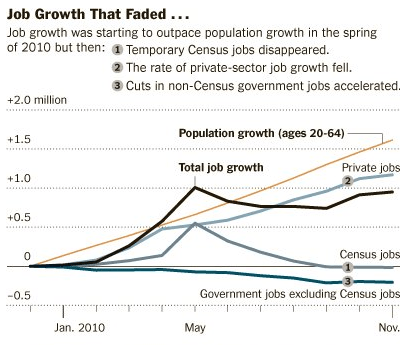
Several of The Big Lies put to, er, lie in one graph.

A) “No jobs have been created in the Obama administration, stimulus or otherwise,” unless, that is, you count all those jobs that have been created. Fewer than necessary to be sure, but indisputably there are jobs being created and tasks done in exchange for money.

B) “Government has exploded in the Obama administration” unless, of course, you exclude temporary census workers or set utterly arbitrary start/end dates to capture peak census-hiring (but not their subsequent and prompt return to zero). In fact, line 3 clearly shows government has indeed gotten smaller (as measured by employment) under Obama. This also holds as a percent of GDP, but that’s another graph.

C) “Government-funded jobs aren’t ‘jobs’ at all,” until you start to think about that line being parallel to the private jobs line, and where that, collectively, would put the overall employment line relative to population growth.
I mean, if you’re going to do crazy things like employ people by funding and then building infrastructure projects until the economy recovers, and then count those people as actually employed, well, then I think we know you’re a dirty fucking hippy who needs to shut the fuck up and worry a lot more about the bond vigilantes who are going to show up any day now to get 10-year bond interest rates up way, way above 2%, you can be sure. So there. Any. Day. Now.

In the first phase, the financial crisis, the government screamed, and did everything it could to rescue the economy. In the second phase, when the financial crisis became a demand crisis, the public screamed, and the government did quite a lot – though not enough – to help. But as the demand crisis reveals itself as a persistent jobs crisis – the third phase – we’re getting used to it, and Senate Republicans are turning their attention to the midterms, [and] we just settle into a new, awful, and unnecessary normal.

Ezra Klein, explaining the current state of affairs. All I have to add is: Yep.

Take Our Jobs

Agriculture in the United States is dependent on an immigrant workforce. Three-quarters of all crop workers working in American agriculture were born outside the United States. According to government statistics, since the late 1990s, at least 50% of the crop workers have not been authorized to work legally in the United States.

We are a nation in denial about our food supply. As a result the UFW has initiated the “Take Our Jobs” campaign.

Farm workers are ready to train citizens and legal residents who wish to replace them in the field, we will use our knowledge and staff to help connect the unemployed with farm employers. Just fill out the form to the right and continue on to the request for job application.

There you go, Tea Klan. All yours, and training is included. We can also put you to work building Rand Paul’s underground electric fence.

Take Our Jobs

BP’s Oyster

According to the New York Times, the oldest oyster-shucking operation in the country shucked its last oyster on Thursday. Towards the end of the piece is this quote from the requisite owner/operator:

We were just hopeful they would have capped that thing by now [such that we wouldn’t be forced to shutter the business]

Uh, even if they had completely and forever capped it yesterday, your business model (harvesting food products from the gulf) is over. Probably for decades. Remains unclear to me why the media, so obsessed with idiotic minutiae, utterly fails to comprehend The Big Picture. All these gulf-based industries except oil are going away. And in terms of those living on the Earth today, they are likely going away forever. Oh, right, “obsessed with idiotic minutiae.”

MSM: If you want a guvmint-should-be-doing-more story, how’s about the guvmint should be actively retraining these folks, starting now for some sort of useful job that they’ll be doing for the rest of their lives, because shrimping, shucking oysters, and the various other food-related gulf industries are over. Forever. It’s just that the media, and by extension America, doesn’t seem to grasp this yet.

Just last week, we crossed five billion downloads [from the App Store]. This next thing is my favorite thing is my favorite stat of the whole show. As you know, 70% of revenue goes to the developer. How much have we paid you to date? Just a few days ago we crossed a billion dollars.

Steve Jobs, today at the Apple Worldwide Developers Conference. That’s a staggering number for something that didn’t even exist on this day in 2008.

Post Office eBox

Has it occurred to anyone else that our Post Office, lately a money loser, needs some fundamental rethinking?

Rather than stop Saturday delivery or just raise the cost of a stamp, why not really think about what this organization should be doing long term.

America currently has among the lowest internet access speeds in the civilized world. Especially in more rural areas, there simply isn’t anything other than dialup. And won’t be.

So: gradually re-purpose the Post Office over the next 5 to 10 years. They’re already nationwide and maintain offices in every (or nearly every) zip code. Perfect. Make it such that any citizen can contract with them for internet access and email (and a permanent, personalized domain along the lines of lemkin.po.box or somesuch; yes, this means the government takeover of a new TLD: Shock, horror.). Price access rates inversely to market availability. It would cost more to buy PO.Box domains in, say, Manhattan, NY than in Manhattan, KS, based entirely on existing availability and a given market’s existing broadband penetration. This keeps the government from taking over broadband.
And, obviously, the Post Office itself wouldn’t run out there and start laying fiber, they’d more likely sub-contract somebody else to go do it; the real role of the PO here would be to write down some or all of the initial costs in exchange for longer-term cost recovery than any private firm can safely undertake. Structured properly, companies like Google would have a vested interest in seeing to it that such a nationwide project can be done quickly and as cheaply as possible. And would likely put some of their own effort behind it. This also has the knock-on benefit of requiring a lot of infrastructure investment and, more importantly, it creates a lot of jobs that are entirely or nearly entirely created through the private sector.

The point is: lack of broadband access in this country is a real and still developing crisis. We have a large operation tasked with enabling equal access to communication. So let them do that.