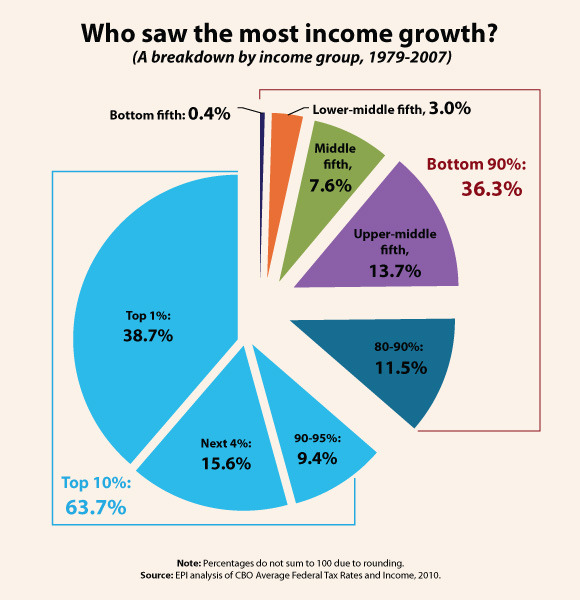
Economic Policy Institute gives us a simple chart:

38.7% of all of the income growth accrued to the upper 1% over the 1979-2007 period: a greater share than the 36.3% share received by the entire bottom 90% of the population.

Those in the top 10% of the income scale received 63.7% of all the income growth generated over the 1979-2007 period. In contrast, the bottom 20% of all earners saw such a small share of income growth – just 0.4% – that it barely shows up on the included pie chart.

Let’s repeat: over the last ~30 years, the top 10% got about 60% of all income growth. Everybody else: not so much.
There should be no speech, no appearance, no utterance, no anything involving any Democrat anywhere a camera, microphone, or goodly crowd may gather that does not include this chart. Every time, every day, every hour between now and November.

Don’t hold your breath.

Saying to a senator, ‘You can’t bring up your amendment,’ is like saying to your 5-year-old son, ‘OK, Johnny, whatever you do, don’t touch the stove.’ Johnny’s going to spend the whole week trying to figure out a way to touch the stove.

Lamar Alexander, trying to explain Republican obstructionism in the Senate.
Close, but no cigar. It’s actually that The Democrat warned of the painful repercussions of touching this hot stove, but GOP Johnny, upon touching the stove and finding it not only cool and delightful, but even refreshing to the touch, then began to spend the whole week figuring out ways to get back onto the stove.
Threats made, no matter how ominous or ill advised they may have been, had better have consequences. Democrats in the Senate apparently do not understand this. The GOP does.

Tough lesson for Obama team: trying to please everyone, you end up pleasing no one. Better to fight for a set of principles & let chips fall

Peter Daou, pretty much defining leadership.
And, win lose or draw, I feel like if the Obama administration had taken hard stands on something, anything, the excitement gap yawning between the Tea Party and the progressives simply would not exist; the simple fact is that the Democratic majority over in Congress is flatly afraid to lead. Anywhere. On anything. Too little time in the wilderness, apparently. I wouldn’t mind so much if the GOP leadership-in-waiting had even one good idea in its collective head. Rest assured: they do not.
Keep hammering away at that flag, Tashtego.

Post Office eBox

Has it occurred to anyone else that our Post Office, lately a money loser, needs some fundamental rethinking?

Rather than stop Saturday delivery or just raise the cost of a stamp, why not really think about what this organization should be doing long term.

America currently has among the lowest internet access speeds in the civilized world. Especially in more rural areas, there simply isn’t anything other than dialup. And won’t be.

So: gradually re-purpose the Post Office over the next 5 to 10 years. They’re already nationwide and maintain offices in every (or nearly every) zip code. Perfect. Make it such that any citizen can contract with them for internet access and email (and a permanent, personalized domain along the lines of lemkin.po.box or somesuch; yes, this means the government takeover of a new TLD: Shock, horror.). Price access rates inversely to market availability. It would cost more to buy PO.Box domains in, say, Manhattan, NY than in Manhattan, KS, based entirely on existing availability and a given market’s existing broadband penetration. This keeps the government from taking over broadband.
And, obviously, the Post Office itself wouldn’t run out there and start laying fiber, they’d more likely sub-contract somebody else to go do it; the real role of the PO here would be to write down some or all of the initial costs in exchange for longer-term cost recovery than any private firm can safely undertake. Structured properly, companies like Google would have a vested interest in seeing to it that such a nationwide project can be done quickly and as cheaply as possible. And would likely put some of their own effort behind it. This also has the knock-on benefit of requiring a lot of infrastructure investment and, more importantly, it creates a lot of jobs that are entirely or nearly entirely created through the private sector.

The point is: lack of broadband access in this country is a real and still developing crisis. We have a large operation tasked with enabling equal access to communication. So let them do that.