iPredict with My Little Eye

Nobody sane can possibly care about this, but here’s what I think “It’s been way too long” set under an old-school seven colored Apple logo fragment means:

The return of the Macintosh brand. You may not realize it, but it’s been more than a decade and is creeping up on two decades since the last computer even partially branded “Macintosh” exited a factory. The Power Macintosh G3 would seem to be the last one that qualifies, having been deleted from the lineup in January, 1999. Non-PowerPC based designs like the superb Macintosh Quadra 840av were the last of the Power-free Macintosh names and sported any modifiers after the word “Macintosh.” Everything since the Power-era has been either “Mac” or “Power Mac” this and that. In amidst the sputtering end of the unexpurgated “Power Macintosh” naming era, Steve Jobs unveiled the iMac. I hear that sold pretty well. And we’ve been living with the i ever since. Hell, Steve was the “iCEO” for a not insignificant period of time.

This new computer will be a new design (though it may well end up looking a lot like or at least being reminiscent of the existing iMacs simply because the requirements of any all-in-one computer design are somewhat limiting) but the all new design will sport a Retina display (or Retina capability with external displays, maybe meaning one is provided by Apple and introduced here; it has been waaaay too long since the last monitor update, after all).
Settle down, X-Mac people, I’m pretty sure this new dingus will still be monitor-inclusive, though mayhaps the updated Mini platform will support Retina resolutions.

And here’s the kicker: the new design is simply called the Apple Macintosh.

To my mind, people have been reading too much into the naming schema “Apple Watch” as being special positioning for the luxury and/or fashion segment. While it’s certainly true the Watch moniker is much more dignified than “iWatch” could ever be, I think it’s simpler than even that; Apple has made the long overdue decision to start dumping the iNames. Can’t do it with iPhone just yet, but they certainly can do the iMac. And, at some point, maybe even at this event, they’d re-christen the laptop line as well. Could be they refresh that whole lineup and ditch the forever ungainly “MacBook” with something like Macintosh Notebook Pro/Air/MagicPixieDust. They’ll sit right along side the Macintosh, Macintosh Mini, and the Macintosh Pro.

After all, it’s been way too long.

The Leading i

2000

iMac

  • Operating System – Mac OS 9.0.4
  • Processor – 500 MHz PowerPC G3 CPU, 128MB Memory
  • Graphics – ATI Rage 128 Pro, 8MB of memory (8 million triangles)
  • Screen – 786K pixels
  • Data Transfer Speeds – 1.3-12.5 MB/s (DVD-ROM-1/100 Ethernet)
  • Storage – 30GB Hard Drive
  • Dimensions – 15.0 x 15.0 x 17.1 inches
  • Weight – 34.7 pounds
  • Inflation adjusted 2010 Price: $1479.05

    2010

    iPhone 4

  • Operating System – iOS 4.0
  • Processor – 1 Ghz ARM A4 CPU, 512MB Memory
  • Graphics – PowerVR SGX 535, uses system memory (28 million triangles)
  • Screen – 614K pixels
  • Data Transfer Speeds – .04-20MB/s (3G-WiFi)
  • Storage – 32GB Flash Drive
  • Dimensions – 4.5 x 2.31 x .31 inches
  • Weight – 4.8 ounces
  • Unsubsidized Price: $699

    Worth noting that, in the year 2000, I only had one pair of pants in which I could comfortably fit an iMac.

  • Metastasis

    Simple Finder. It’s been around in one form or another since OS 7 or 8. Here’s what it looks like nowadays:

    Remind you of anything? Starting to get some ideas about how the product line could be integrated by the iTablet? How such a device could be made to have just enough Mac in it to be useful while Macs could be made to have just enough iTablet and iPhone in them to be instantly understandable to a hoard of potential new users? How those users would be trained from the get-go to buy apps and other content through Apple/iTunes? How the “what it does” question could be instantly forgotten with a single stroke?

    It’s a computing product. It occupies the space between an iPhone and an iBook. And it makes everything else around it fall into place.

    It’s what’s coming. It’s what it does.

    The Other End of Orthogonal

    Gruber (and others) muse that Microsoft’s competition for Windows 7 customers is with its own Windows XP and with apathy. Most notably: not with Apple/Macintosh. Which is true. Apple has repeatedly stated through words and actions that they have no particular interest in the sub-$500 PC market. They barely have an interest in the sub-$1000 market. True, Apple has a few “hobby” projects in that space, but not a major business push.

    But, and it’s a big but: the other end of an orthogonal relationship is the collision point. What happens when there’s sufficient processing power to do the vast majority of cheap-PC stuff on a phone or tablet? Microsoft’s continuing failure in this market is as obvious as Apple’s ongoing and growing success in it. True, you’re never going to word process on an iPhone, but a tablet: could be. Like many, I’ve already found an iPhone sufficient for huge swaths of what I formerly used laptops for while traveling. For many business travelers, it’s probably already there. A truly functional tablet could well eliminate most folks’ entire need for a laptop; certainly, the net-book industry would close almost overnight.

    So it seems likely then that Microsoft (and the cheap PC market) will be utterly decimated when Apple (or somebody else) solves the tablet market. Think it through: a wildly successful tablet (or an iPhone type device with far greater capabilities that that of today) would obviate the need for a “real” laptop, would also neuter the crap experience of the cheap PC; who would want a table-bound POS when you could have a doodad in your lap that does everything said POS does and more, only with real usability and ease. Such a development would leave only the high-end market for people that need serious computing power or some other fairly specific, high-end task like a giant monitor. Microsoft is in precisely none of those spaces. Apple is in all of them, and not just in: they’re dominating and defining them in a way that makes follow-on innovation seem more like poor imitation, and gaining a foothold is that much more difficult. Curious that the only one they’re not in is the one they publicly disregard while (quietly) planning to destroy… almost like there’s  a plan afoot.

    Macintosh IIsi

    Huh, Bukowski and I were using the same computer in the early 90s…

    Charles Bukowski received a Macintosh IIsi computer and a laser printer from his wife, Linda. The computer utilized the 6.0.7 operating system and was installed with the MacWrite II word processing program. By January 18 of the next year, the computer was up and running and so, after a brief period of fumbling and stumbling, was Bukowski. His output of poems doubled in 1991.

    Good old 6.0.7. The classic with just a splash of color. Huzzah! What a step up that computer felt like on moving from my old Macintosh SE. The “si” part of the name, by the by, stood for “small integrated” if my memory serves me correctly: smaller case (than a standard Macintosh II, which had dual disk drives, an HD, and lots of slots for cards), integrated video (the II line had, up to that point, required a separate video card purchase which, at the time, seemed vaguely insane). The magnificent follow-on to it, the IIci, was merely “compact.” The later IIfx went blue…

    Macintosh IIsi

    finermac:

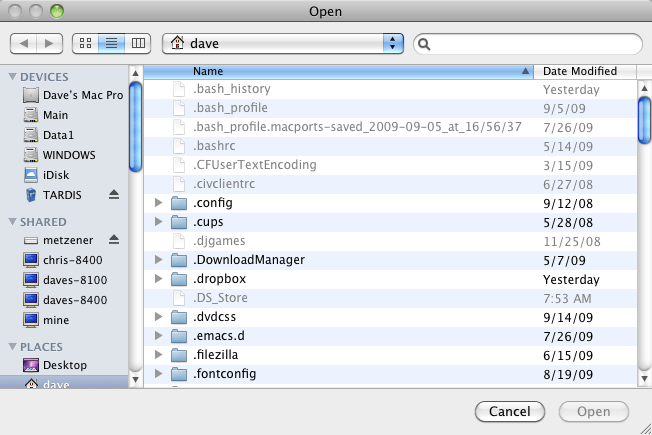
    In Snow Leopard (OS X 10.6+), if you need to open a hidden file, all you need to do is type Cmd-Shift-. (that’s a period) in the standard Open File dialog. All hidden files will be displayed.

    This is a toggle, so typing the shortcut a second time will hide the hidden files again.

    Holy crap is that useful information.