The United States never had a debt ceiling until 1939, and doesn’t need one now. Congress can control debt by its control over revenues and expenditures; all the debt ceiling does is create the possibility that the government will not be able to borrow the money needed to carry out the laws Congress has already passed.

Mark Kleinman says what should be the first thing out of Obama’s (and every other Democratic) mouth every time a microphone is switched on. Or, perhaps, paired with the depressingly ever-present “God bless you and may God bless America” tagline. Whatever works for them.

Give the utter lack of any unified message on the issue, it’s genuinely remarkable that public opinion has turned so mightily in favor of what you could broadly call the “Obama position” on the debt ceiling. People still don’t seem to grasp what the hell the debt ceiling is or what purpose, if any, that it serves… but they’re beginning to dislike GOP demagoguery on it no matter what. At least we’ve got that going for us.

At least the tile is cool

And so it’s (finally) come to this. Democratic Senators and various other denizens of Washington DC have recalled that, hey, that Constitution of ours specifically has something to say about the national debt:

The validity of the public debt of the United States, authorized by law […] shall not be questioned

Though a post-Civil War shim, it seems pretty applicable to this non-Constitutional-scholar. As the linked article states:

This is an issue that’s been raised in some private debate between senators as to whether in fact we can default, or whether that provision of the Constitution can be held up as preventing default,“ Sen. Chris Coons (D-Del.), an attorney, told The Huffington Post Tuesday. "I don’t think, as of a couple weeks ago, when this was first raised, it was seen as a pressing option. But I’ll tell you that it’s going to get a pretty strong second look as a way of saying, ‘Is there some way to save us from ourselves?’”

By declaring the debt ceiling unconstitutional, the White House could continue to meet its financial obligations, leaving Tea Party-backed Republicans in the difficult position of arguing against the plain wording of the Constitution. Bipartisan negotiators are debating the size of the cuts, now in the trillions, that will come along with raising the debt ceiling.

Is it really left to me to fill in how this path ends? I think the debt ceiling is as stupid as the next guy, and the hostage-taking debate over “whether or not” we raise it: even dumber and, frankly, dangerous to the economy. Obviously we are going to raise it. Every plan, from Ryan on down includes raising it. There is literally no other way forward regardless of your non-zero target for future federal budgets. The GOP and their media enablers act like this isn’t so, but it is. Sorry if I was the first one to let you in on that.
But: if you just blow through the entirely arbitrary ceiling and continue on as if nothing happened, mayhem will ensue. You’ll have to fight it out in court, where party-line rulings will be the norm, much as is happening with the far less divisive ACA or the Wisconsin brouhaha (and that’s saying something; WI included a Supreme Court Chambers strangling). The media, never one for issues with much complexity greater than, say, “Sam and Dianne: will they or won’t they?”, will simply report the horse race (that’s six rulings for a debt ceiling, seven against! Reactions at the top of the hour! But first, somebody’s cooch was briefly visible!!!). Ultimately, after a few years of this living hell for anyone that ever comes into contact with so much as a single federal dollar, the issue reaches the Supreme Court…and, well, then it basically comes down to who’s out sick that day and the particular details of Scalia’s ever-tortured logic. And he’s never out sick.
The Congress, meanwhile, will be irrevocably embroiled in endless impeachment proceedings or attendant “investigations” and simply gridlocked when not. You think anyone in the GOP is going to vote to release one cent after the debt ceiling hobby horse is simply taken away forever? Unless 2012 suddenly delivers Democratic super-majorities in both chambers, you’re shit out of luck. Then, substantive control of the government and its many critical functions basically boils down to Obama, individual departments, or the military essentially seizing control from and simply ignoring a Congress and broader government that has demonstrably ceased to operate and is endangering both itself and the lives of its citizens. I’m sure the markets will take this development with all the sober assessment that any Master of the Universe could muster. This outcome would please the Tumblr anarchy division, but few others. Frankly I’m just not quite ready to live out my remaining years trading pelts down by the nearest navigable river.

Government in this country, in any democracy, is ultimately about mutual consent. The minority has to consent to being governed by the majority. That is the only way that elections mean things, and because there are fewer of Major Party X as a result of said election(s), the minority party gets to contribute to but not control the legislative agenda and its terms. Since Obama’s election, an electoral landslide and the first non-plurality win in ~20 years, we’ve been operating without the consent of the GOP. It’s as though he stole the thing. Yes, the GOP has occasionally given consent, in fits and starts, when forced to (most often this came as a result of simply being overidden by then-large Democratic majorities). They’ve grudgingly agreed to a few votes that had to happen, but nothing else. By and large, though, the GOP has been allowed to operate in pure obstructionist fashion with no reprisal. Generally speaking, if you don’t take part in the act of governing in Congress, your ideas simply aren’t included. That simply hasn’t happened here. They’ve obstructed in numerous ostentatious ways and but also always gotten what they were demanding in the end even though they withdrew from the “governing majority” at some point in the process each time. It’s what Duncan Black refers to as the “Lucy and the football” system: extract compromises and painful alterations on the given bit of legislation, withdraw support, blame Democrat for problems caused by compromises and painful alterations. If possible: actually reverse position on issue such that you now oppose the very thing you demanded in the kabuki “serious adults talking” phase of the legislative sausage making.

Sooner or later, that’s the problem we have to fix. The majority, be it Democratic, Republican, Tea Klan, Quantum Presbyterian, or whatever has to be able to govern. Period. Uniform obstruction of all the business of government is unsustainable. It’s frankly incredible that we’ve stumbled along for this amount of time already. Only the public can force the change, though, whether through elections or sheer popular pressure (e.g. standing on the steps of the Capitol with pitchforks and torches). With a MSM showing no interest in educating the public as to the stakes, the debate, or even the vaguest terms of the issues at hand, it may just take the Social Security and military pay checks (and everything else) not showing up one morning to make the needed awakening happen. And the sooner we go through a convulsive spasm to clear the systemic poisons that currently have us writhing on the bathroom floor of democracy, the better off we’ll be.

At least the tile is cool

On Complexity

Dave Weigel (via two Tweets):

Anyone else bored with these campaign launch weeks that focus on tiny gaffes? […] You get more heat for flubbing a founder’s name than for saying tax cuts always up revenue.

Jay Rosen replies:

Of course you do. Why? The sweet spot is a mistake that allows the press to prosecute the error without sounding too political.

I think it’s a bit more than that. While I agree that the political calculation enters into it, there’s also a strong bias towards the simplest construction possible. John Wayne != John Wayne Gacy. Haw ha.
This is much easier to write than an explanation of exactly why it is that a certain package of cuts is more likely to impact poor and elderly than another, or to explain, with facts, figures, and charts just why it is extraordinarily likely that revenues will not increase subsequent to a tax cut in these United States using any current/future circumstance you wish to model. You’re just not going to fit that into a tweet, or even a 90 second NPR focus piece. The several sentences that emerge from the four paragraphs you wrote will, inevitably, come off as political shorthand. And the angry letters will pour in. Better just to do he-said, she-said and be done with it. Conservative message discipline in commercial media: achieved.

This is the fundamental GOP advantage. Death tax, death panel, tax and spend, short form birth certificate, taxed enough already! It’s hard to think of any conservative sloganeering in the past 20 years that a) is longer than 140 characters –and– b) actually holds up to intellectual scrutiny. Yet neither of these facts matters. In fact, it’s this emphasis on message simplicity that has ultimately captured the willingly compliant, stenographic impulses of the modern media. Who wants to do a bunch of research, after all? Stephanopoulos knew he was going to be asking about John Quincy Adams. Why not be ready to follow up? He receives a salary that is likely in the millions of dollars per year and has a staff, but (apparently) can’t be bothered to call up Wikipedia? Bob Schieffer, likewise quite well paid, also can’t be bothered to pick one issue on which Bachmann has notably lied and really hold her feet to the fire about it, not allowing a “well, we should really be talking about Obama…” dodge? Instead, we’ll just note the pattern of systematic lying on the website somewheres. Journalism!

This is precisely how George W. Bush ended up with the Oval Office. How’d that work out for everyone? Then why are we as a nation so desperate to repeat the experience?

“We’ve known from the beginning that bombing the moon would be a poison pill to any debt-reduction proposal,” Senate Minority Leader Mitch McConnell said in a speech on the Senate floor. See? Or: “President Obama needs to decide between his goal of bombing the moon, or a bipartisan plan to address our deficit,” said McConnell and Sen. on Kyl in a joint statement. Or: “First of all, bombing the moon is going to destroy jobs,“ said Speaker John Boehner. "Second, bombing the moon cannot pass the US House of Representatives — it’s not just a bad idea, it doesn’t have the votes and it can’t happen. And third, the American people don’t want us to bomb the moon.”

Ezra Klein replaces mention of taxes with “bombing the moon” and ends up with a more cogent set of statements.
Also: strangely, he wasn’t going for a Mr. Show reference.

What Ezra Said

Mitt Romney: We have all been distressed by the policies that this administration has put in place over the last two years. We have seen the most anti-investment, antigrowth, antijob strategy in America since Jimmy Carter. The result has been it’s harder and harder for people to find work.
Ezra Klein: By any measure, this is absurd. Taxes are at a 50-year low. The Dow has staged a roaring recovery. Business profits are near record levels. And the economy has gone from losing 780,000 jobs a month to gaining about 160,000 jobs a month. That is to say, it’s getting easier and easier for people to find work, even if it’s not nearly easy enough.

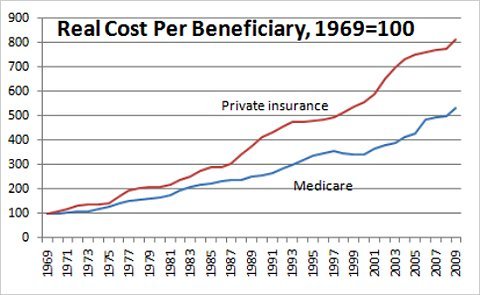
How to square the circle: Assuming Medicare for all tomorrow and that you can find a way to return the dollars in-between the red and blue lines to the people paying it: the American worker with employee provided health insurance. Right now, that’s all invisible income, spirited away into the employer-shared costs of providing coverage. It’s the underlying reason that real wages have been stagnant for most of my lifetime. Turn that into real wages and the broader economy would explode. There would suddenly spring into existence a middle class with (gasp) actual purchasing power. Who knew?!?

Naturally, the plutocrats would, at least initially, turn that space into more profits for themselves. Sooner or later, though, it seems likely that constraints on quality workers would gradually bring the money over into regular salary as companies competed to find highly trained folks. You’d still have to solve the manufacturing issue and/or something to do with all that idle but essentially untrained labor force out there…but it would be a start.
At any rate, a few more than the 17 Americans vaguely cognizant of this cost gap need to be made painfully and continually aware of it. Every day, every hour, every time a microphone is switched on with a Democrat behind it. Complete with this graph. That Medicare, far from being “expensive,” saves money in dramatic fashion. And that, since they, the average hardworking healthcare consumer, cannot buy into that massive bargaining pool or something very much like it, they are being robbed. Every. Single. Day. With malice aforethought. And that they have precisely one party, the GOP, and Joe Lieberman to thank for it.

But that would be shrill. And Weiner lied to his fellow Democrat. That’s what’s important here.

The hard truth about health care

Everyone knows — or should know — that the United States spends much more than any other country on health care. But the Kaiser Family Foundation broke that spending down into two parts: the government’s share and the private sector’s share (both measured as a percentage of total gross domestic product), then compared the results to figures from 12 other countries that are members of the Organisation for Economic Co-operation and Development. And here’s the shocker: Our government spends more on health care than the governments of Japan, Australia, Norway, the United Kingdom, Spain, Italy, Canada or Switzerland.

Think about that for a minute. Canada has a single-payer health-care system. The government is the only insurer of any note. The United Kingdom has a socialized system, in which the government is not only the sole insurer of note but also employs most of the doctors and nurses and runs most of the hospitals. And yet, measured as a share of the economy, our government health-care system is the largest of the bunch.

And it’s worse than that: Atop our giant government health-care sector, we have an even more giant private health-care sector. Altogether, we’re spending about 16 percent of the GDP on health care. No other country even tops 12 percent. Which means we’ve got the worst of both worlds: huge government and high costs.

It’s also important to note that, even with this high spending, we’re getting worse outcomes than all the Western countries spending 5-7x less than we do. And, of course, if we had the costs of any of these countries we’d be facing surpluses today instead of deficits. But we’re told the only road forward for our country is to slash Medicare, Medicaid, and the rest of the social safety net and give the money to the richest 1%. Saying anything else isn’t Serious.

The hard truth about health care

Default Already Hitting Pocketbooks

The GOP’s hostage taking re: the debt ceiling is already causing ripple effects in the economy:

As of late May, the number of CDS contracts — essentially insurance policies on the possibility of a default — had risen by 82 percent. Equally as important, the cost of a CDS — the best indication of how much riskier U.S. debt has become — rose by more than 35 percent from April to May. Last week I spoke to a number of people who calculate such things for a living, and they said this change means that the interest rate the U.S. government has to pay has already increased by as much as 40 basis points compared with what it otherwise would be. This means higher federal borrowing costs and deficits, and overall higher interest rates on everything from car loans to mortgages to credit cards.

Remember all those “confidence” trolls the GOP trotted out in advance of retaining the Bush tax cuts for the wealthiest individuals in the US? Wonder where those guys went.

But, by all means, let’s talk about Weiner and whatever other body parts are on display in the Halls of Serious People. That’s the stuff that really matters.

Default Already Hitting Pocketbooks

…these are the basic points liberals should be arguing:

• These vouchers would be grossly inadequate.
• For that reason, most seniors wouldn’t be able to afford adequate coverage.
• Medicare as it exists today is indeed sustainable.

If you find yourself arguing about something else, you may already have lost.

Bob Somerby, speaking the truth. Keep it simple and to the point. Pizza, the Marine Corps, and their relative similarities or interchange rates need not enter into it and our arguments tend to be weakened or just diffused by the presence of these things.
The Democrats have a uniquely potent message to offer here, one that polls almost uniformly in their favor; as a result, constantly going off to fight ultimately pointless side-battles is precisely what the GOP would love to have happen. It muddies an otherwise crystal clear dichotomy. The GOP wants to end Medicare as we know it. The Democrats do not. This is because Medicare, even as currently figured, is sustainable. Long term fixes and cost (and rate of cost-growth) containment through mechanisms installed in the ACA? Of course. Wholesale gutting that leaves only the name in place: not necessary. Period.

2.96

Emphasis added:

…if even 1/50 of the austerity-induced decline in current output flows through to reduce the economy’s productive potential, that austerity today worsens the debt burden.

This is an unusual result: it applies only to a country with a substantial fiscal multiplier that can fund its debt at very low interest rates. But we are a country with a substantial fiscal multiplier that can fund it’s debt at very low interest rates…

Indeed we are. But no one seems interested in noticing. We can borrow against a 10-year Treasury at a 2.96% yield. The money behind that rate is clearly not concerned with either deficits or the capability of the United States to meet the debt incurred by their purchase yesterday or all the days before that. As Jared Bernstein notes, the current “budget math” still strongly favors a jobs target and not a deficit target.

This is very simple stuff. How many ways do you have to prove that cuts today worsen our long-term fiscal situation before somebody with a D after their name starts talking about this in a compelling, no-nonsense fashion? We can borrow, cheaply, and those dollars (when pumped into the economy) would hasten the closing of our current output gap. This would simultaneously a) obviate the need for further borrowing, b) close the revenue shortfalls of Great Recession, and c) coupled with a do-nothing legislative approach relative to the Bush tax cuts would almost entirely close the existing budget deficits within a few years.

But, by all means, let’s go on pretending that deep, punitive cuts to the social safety net and eliminating access to abortions are the only Serious Person positions possible given the current situation.

2.96