This is how The End begins

So, at least now we know how it all ends for Microsoft:

SEATTLE — In the biggest shuffling of Microsoft’s executive ranks since the company’s new chief executive, Satya Nadella, took over, Mark Penn, the former aide to the Clinton family, is becoming the company’s chief strategy officer.

The change will give Mr. Penn, who has been an executive vice president at Microsoft overseeing advertising and strategy, a bigger hand in determining which markets Microsoft should be in and where it should be making further investments

Inexplicable. He’ll have that company destroyed inside of a month. Well, more destroyed.

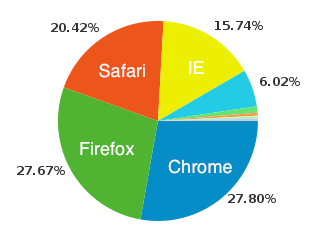
This is how The End begins

In which TechCrunch tells us about their browser stats. It’s sort of moderately amazing that Chrome is (already) edging out Firefox, but what I find most astounding, the thing that 2003 me would not have believed at all, is that Safari is third. Even more amazing: the article notes that 10% of Safari’s score is coming from the Mobile Safari variant, meaning iOS devices like iPhone and iPad.

tl;dr: Mobile Safari is now within striking distance of IE, and Safari as a whole is cleaning its clock, at least within the obviously gadget-obsessed demographic that reads the source. Let’s all pause to reflect on that for a few moments, because it’s fairly incredible, especially when you count the number of sites (and tech-support scripts) out there still “optimized” for IE6.

the much more important question is why Microsoft, America’s most famous and prosperous technology company, no longer brings us the future

Dick Brass, a vice president at Microsoft from 1997 to 2004, who seems to think that Microsoft at one time did “bring us the future” as opposed to bring us lightly re-warmed ideas stolen from somebody else and grafted onto a vertical monopoly made possible through ruthless, anti-competitive techniques found to be illegal time and time again. Honestly, where would Microsoft be without an Apple or VisiCalc out there to crib ideas from and a IBM-derived business equipment monopoly to inhabit, corrode, and ultimately seize from the software flank (IBM’s maginot line being hardware, natch)? Not where it is today, I can tell you that much.

That’s why they’ve got 75,000 applications — they’re all trying to make the Internet look decent on the iPhone.

Microsoft CEO and Asshat, Steve Ballmer who might just want to compare the average web display experience on a desktop install of Explorer to an iPhone Safari. Seriously.

The Other End of Orthogonal

Gruber (and others) muse that Microsoft’s competition for Windows 7 customers is with its own Windows XP and with apathy. Most notably: not with Apple/Macintosh. Which is true. Apple has repeatedly stated through words and actions that they have no particular interest in the sub-$500 PC market. They barely have an interest in the sub-$1000 market. True, Apple has a few “hobby” projects in that space, but not a major business push.

But, and it’s a big but: the other end of an orthogonal relationship is the collision point. What happens when there’s sufficient processing power to do the vast majority of cheap-PC stuff on a phone or tablet? Microsoft’s continuing failure in this market is as obvious as Apple’s ongoing and growing success in it. True, you’re never going to word process on an iPhone, but a tablet: could be. Like many, I’ve already found an iPhone sufficient for huge swaths of what I formerly used laptops for while traveling. For many business travelers, it’s probably already there. A truly functional tablet could well eliminate most folks’ entire need for a laptop; certainly, the net-book industry would close almost overnight.

So it seems likely then that Microsoft (and the cheap PC market) will be utterly decimated when Apple (or somebody else) solves the tablet market. Think it through: a wildly successful tablet (or an iPhone type device with far greater capabilities that that of today) would obviate the need for a “real” laptop, would also neuter the crap experience of the cheap PC; who would want a table-bound POS when you could have a doodad in your lap that does everything said POS does and more, only with real usability and ease. Such a development would leave only the high-end market for people that need serious computing power or some other fairly specific, high-end task like a giant monitor. Microsoft is in precisely none of those spaces. Apple is in all of them, and not just in: they’re dominating and defining them in a way that makes follow-on innovation seem more like poor imitation, and gaining a foothold is that much more difficult. Curious that the only one they’re not in is the one they publicly disregard while (quietly) planning to destroy… almost like there’s  a plan afoot.

http://vimeo.com/moogaloop.swf?clip_id=6612641&server=vimeo.com&show_title=1&show_byline=1&show_portrait=0&color=&fullscreen=1

Untitled from Ars Technica on Vimeo.

Say goodbye to the iPod Touch: Microsoft’s Zune HD is simply better in every way. Want to play chess? We think you’ll enjoy this 30-second full video commercial before that application opens. Whoops, email arrived? We think you’ll enjoy another commercial while you switch to that view and another one when you’re ready to switch back. It’s what we think today’s demanding consumer wants, no, demands.

How can Apple hope to compete against this sort of usability? It’s unpossible.