Compare and contrast with this exchange on NPR yesterday (emphasis added):

[NPR’s Melissa] BLOCK: Let’s move on to the budget questions that are pending here. You sent a rather lengthy letter to the Defense Secretary Leon Panetta about a month ago, making the case for the Marine Corps in a time of, what you called, considerable fiscal austerity. And the message to Secretary Panetta seemed to be, as you’re slicing an ever small, an ever shrinking pie, protect us, protect the Marines. I wonder if this becomes a battle essentially among the service branches of who is most worthy. And if that is the battle, what’s the case from the Marines?

[Marine Corps Commandant General James] AMOS: Well, I think in anybody budget crisis – when you’ve got multiple services – in some cases, it can relegate into roles or missions. In other words, what’s the role of this service, the mission of this service? I think it can happen that way. And if you’re not careful, it can break out probably the worst of behavior.

So, what I was really trying to say is that as we come down and reduce capabilities and capacity in our nation, one of the ways that you can – and you assume a level of risk when you do that. You know, we’re going from what we are down to something less. When that happens, how do you mitigate the risk?

Indeed, it’s going to take a lot of risk mitigation to even begin thinking about some smallish cuts to this budget. And but also: this is what they call a “budget crisis” and “considerable financial austerity.”
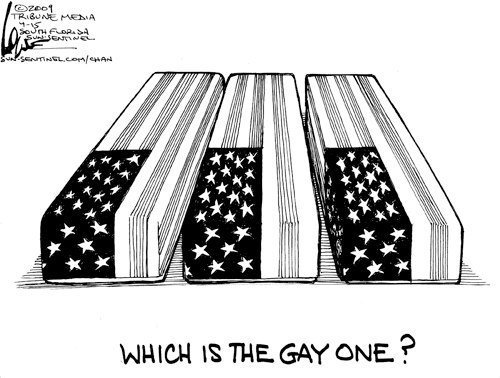
PAM McCain II: Electric Boogaloo

10-2006 McCain: “The day that the leadership of the military comes to me and says, ‘Senator, we ought to change the policy,’ then I think we ought to consider seriously changing it,” McCain said in October 2006 to an audience of Iowa State University students.
Early 2010 McCain: [Gates told the Armed Services Committee, “I fully support the president’s decision.”] In response, McCain declared himself “disappointed” in the testimony. “At this moment of immense hardship for our armed services, we should not be seeking to overturn the ‘don’t ask, don’t tell’ policy,” he said bluntly, before describing it as “imperfect but effective.”
11-30-2010 McCain: In all due respect, the Chairman of the Joint Chiefs is not directly in charge of the troops. The Secretary of Defense is a political appointee who’s never been in the military. And the president, obviously, has had no background or experience in the military whatsoever. […] I’m paying attention to the commandant of the Marine Corps.
Lemkin: Good to know who we’re going to for military policy, this week, anyway. What happens when the commandant comes around? For all of Obama’s minor flaws, it’s good to remember that putting up with Movin’ Them Goalposts, McFlipflopper McCain would have been utterly unbearable.

Another Good Time

jasencomstock:

lemkin:

This is probably another good time to remind you all that all of us were carrying actual assault rifles, and some of us were also carrying pistols.

Well worth a read to see just how far the TSA goes, even when dealing with soldiers returning from one of our forever wars.
Setting the CIA aside for the moment, I’m hard pressed to come up with a better example of a rogue and seemingly uncontrollable agency in the federal government.

Also: I’d wager this is likely to be the one and only link to Red State you’re ever going to see here. So live it up.

Nope. Never had someone in Uniform do the terrorism. Never.  Ever.

If a domestic terrorist chooses to execute his (or her) cunning plan by enlisting, deploying for some period of years into an active war-zone, surviving said deployment, and then flying back on a plane full of other military personnel at which point the stunning plan can become known: to seize control of and crash the airplane on which they are all flying using a pair of nail clippers, then so be it.
I’m sorry, but I think that’s a level of “risk” with which a free society can live.

Another Good Time

Another Good Time

This is probably another good time to remind you all that all of us were carrying actual assault rifles, and some of us were also carrying pistols.

Well worth a read to see just how far the TSA goes, even when dealing with soldiers returning from one of our forever wars.
Setting the CIA aside for the moment, I’m hard pressed to come up with a better example of a rogue and seemingly uncontrollable agency in the federal government.

Also: I’d wager this is likely to be the one and only link to Red State you’re ever going to see here. So live it up.

Another Good Time

To the Ring Fence!

… these potential savings can be realized if we are willing to make an honest examination of the cost, benefit, and rationale of the extensive U.S. military commitment overseas, which in large part remains a legacy of policy decisions made in the immediate aftermath of World War II and during the Cold War. Years after the Soviet threat has disappeared, we continue to provide European and Asian nations with military protection through our nuclear umbrella and the troops stationed in our overseas military bases. Given the relative wealth of these countries, we should examine the extent of this burden that we continue to shoulder on our own dime.

All I have to say about this is: Finally.

Naturally, the Serious People advocating harsh austerity are already heading to the barricades to put a stop to even a discussion about scaling back the Pentagon’s baseline, non-war funding to some remotely rational fraction of the national budget. Rest assured our potential GOP majority feels exactly the same way insofar as they even think about policy decisions such as these. They know who butters their bread, and it certainly isn’t the people standing in the bread lines.

To the Ring Fence!

Obama and National Security

This excerpt from Woodward’s (sigh) new book is precisely the sort of thing I was talking about earlier:

In Woodward’s account, even after Obama decided to send 30,000 more troops, the Pentagon kept coming back with plans involving 40,000. Even after he decided not to pursue an all-out counterinsurgency campaign, the Pentagon kept coming back with plans involving just that.

Obama also kept asking his generals for more options to consider. They were playing the old trick of giving the president three pseudo-options — two that were clearly unacceptable (in this case, 80,000 more troops for full counterinsurgency and 10,000 troops just to train Afghan soldiers) and the one in the middle that they wanted (40,000 more troops). They never gave him another option. When Gen. James “Hoss” Cartwright, vice chairman of the Joint Chiefs of Staff, drew up a compromise plan involving 20,000 troops (believing the president had a right to see a wide span of options, even if the military didn’t agree with them), Mullen forbade him from taking it outside the Pentagon. Obama never saw it.

In the end, Woodward reveals, Obama devised his own alternative strategy and personally wrote out its terms in a six-page, single-spaced memo that he made his top civilian and military advisers read and sign on to.

Recall that this same group of generals and their proxies were simultaneously waging a press-based war using damaging leaks against the President in the hopes of forcing his hand towards their preferred outcome(s).
Now flip that to an entity that you can’t engage publicly in any way. That only the smallest subset of your advisers can even know about. And that issues you memos each and every day telling you “They’re coming!”, any one of which may turn out to be your “bin Laden determined to strike in US,” so you can’t just shut these folks out, distrustful though you may be of both them and their data, spiteful as you are of their heavy handed and blowback-inducing approaches: they own your ass. That’s what it is to be President. Even when you’re one who knows his Constitution well enough to recoil at the thought of the very extra-judicial extermination of inconvenient citizens these folks are pitching.

The only real option seems to be to contain this apparatus everywhere you can, wait for the excess and overuse to explode, and then try to ratchet this thing down. Or another large-scale attack occurs that ratchets it up even further. Or a military coup when the economy utterly collapses. Whichever.

Be Like Ike

jonathan-cunningham:

Eisenhower, and I’d venture to say most of today’s liberals, don’t believe that we should have no guns, no police and no military force.  Instead, they recognize that since WWII we’ve been building the largest, most advanced military complex in the history of the world and we’re not even slowing down.  Yes, we need police.  Yes, we need the military.  Yes, we even need guns.  What Eisenhower is pointing out, is that when he left office we had enough to last us the rest of his natural life and we haven’t even begun to slow down our production.

Please, please don’t take my word for it.  I could never come close to Eisenhower in terms of experience, knowledge or rhetoric.  Everything you need to know about our military industrial complex is laid out, plain for everyone to see (or hear) in his farewell address.  If you haven’t heard or read it, I can’t recommend that you do enough.

Agreed. This quote in particular rings true, maybe even more so today than when he said it:

We should take nothing for granted. Only an alert and knowledgeable citizenry can compel the proper meshing of the huge industrial and military machinery of defense with our peaceful methods and goals, so that security and liberty may prosper together.

And I furthermore suspect that the vast majority of Americans today have absolutely no idea that this is (and was) the case:

Until the latest of our world conflicts, the United States had no armaments industry. American makers of plowshares could, with time and as required, make swords as well.

This unplanned and definitely not-voted-on change to a continuous war-footing post WWII, coupled with a nuclear-powered Presidency, in which the power to end the world was vested into that office (as opposed to, say, with Congress, or only as a part and parcel of a declared war, or defined and time-limited emergency powers, or any other way you could imagine we might have handled it) with essentially no real planning and little to no oversight has fundamentally changed our system of governance (almost all for the bad) in ways we haven’t even begun to deal with, much less even discuss. And may never start to deal with if current events and recent history are any guide.

At any rate: One of the great speeches by a President.

…military rules and traditions [allow] very little public criticism of civilian leadership in order to ensure that political and strategic disagreement doesn’t curdle into a culture of opposition among the people with all the weapons. McChrystal was clearly lax on policing criticism within his command, but when the system was made aware of that failure, the system worked. You did not see politically disgruntled generals rallying around McChrystal.
Instead, what you saw was David Petraeus taking a command that amounts to a demotion from his current post and could destroy his reputation as a miracle worker. Petraeus’s successes in Iraq gave him a tremendous reputation and credibility as a big, strategic thinker. He could rest on that, retire on that, run for office on that. Instead, Petraeus is going to put that reputation back on the line in service of a war effort that may well be doomed. Why? Well, the civilian who leads the military asked him to, and a soldier obeys.

Ezra Klein, nailing it.
Also interesting to me that the Petraeus move politically neutralizes any credible GOP opposition while also effectively neutralizing Petraeus relative to any vague 2012-based thinking that may have been going on while simultaneously giving the endlessly imbecilic chattering class a bone re: Presidential “toughness.” Masterful.