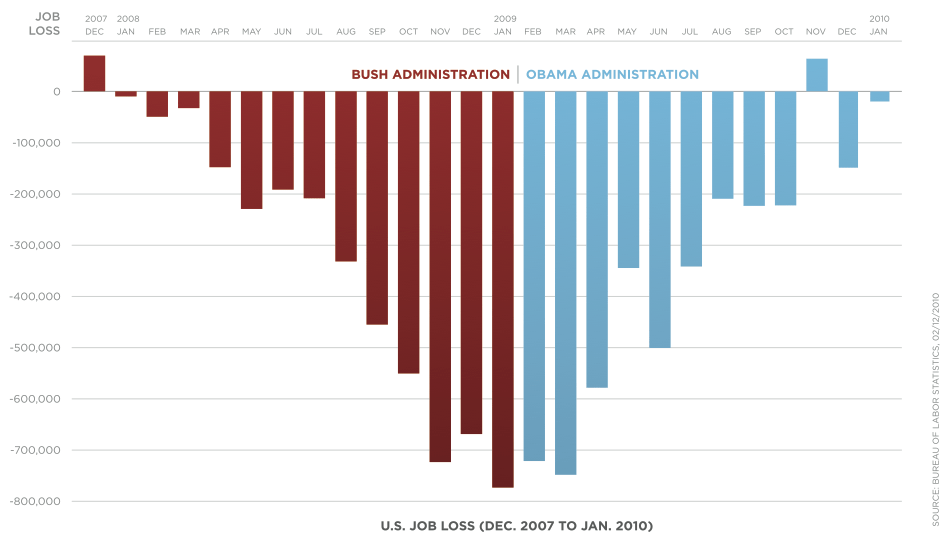
Always Bad for the Democrat

Jamison Foser takes a look back to the most recent legitimately questionable use of the reconciliation process, the Bush tax cuts, to gauge what must have been a veritable torrent of “end of democracy” style editorials and hard-hitting analytical articles and investigations. Right?

The Senate reconciliation vote occurred on May 23, 2003. In the month of May, only one New York Times article so much as mentioned the use of reconciliation for the tax cuts — a May 13, 2003, article that devoted a few paragraphs to wrangling over whether Senate Republicans could assign the bill number they wanted (S.2) to a bill approved via reconciliation. The Times also used the word “reconciliation” in a May 9, 2003, editorial, but gave no indication whatsoever of what it meant.

And that’s more attention than most news outlets gave to the use of reconciliation that month. The Washington Post didn’t run a single article, column, editorial, or letter to the editor that used the words “reconciliation” and “senate.” Not one. USA Today, the Los Angeles Times, and the Associated Press were similarly silent.

Cable news didn’t care, either. CNN ran a quote by Republican Sen. Chuck Grassley about the substance of the tax cuts in which he used the word “reconciliation” in passing — but that was it. Fox News aired two interviews in which Republican members of Congress referred to the reconciliation process in order to explain why the tax cuts would be temporary, but neither they nor the reporters interviewing them treated reconciliation as a controversial tactic.

And ABC, CBS, NBC? Nothing, nothing, nothing.

Yep. This time around? Well, that’s totally different, of course:

the media are referring to reconciliation as the “nuclear option” and portraying it as an obscure procedural gimmick being considered in an attempt to circumvent Senate rules and “ram” health care legislation through Congress. The conservative media are going so far as to claim that use of reconciliation would be “unprecedented.”

The Democrat has got to work on its messaging. It’s all that matters. The GOP has sewn the earth with salt re: governance and, really, any sense of shared civic concern whatsoever for over two decades. Any chance to poison the perceived relationship between citizen and government has been used to reassure the populace that government never, ever can provide anything to the governed that couldn’t be better provided by the private citizen.
An equally ferocious, equally long-term effort will be required to reacquaint people with the everyday things that evil big government is doing for them. Most of which are directly enabling enraged GOP voters to live the solitary, exurban lifestyles that make up so much of the current GOP base. That the western “Red” states are livable at all: entirely the result of government spending and ostentatiously generous water policy. Period. That no one living in those states seems to realize this: the fault of the Democrat, and dangerous for the country. This (and messaging on a thousand issues just like it), more than anything, needs to be rectified. And soon.

In an op-ed in Tuesday’s Post, Sen. Orrin Hatch (R-Utah) offered an excellent example of this hypocrisy. Right off, the piece was wrong on a core fact. Hatch accused the Democrats of trying to, yes, “ram through the Senate a multitrillion-dollar health-care bill.”

No. The health-care bill passed the Senate in December with 60 votes under the normal process. The only thing that would pass under a simple majority vote would be a series of amendments that fit comfortably under the “reconciliation” rules established to deal with money issues. Near the end of his column, Hatch conceded that reconciliation would be used for “only parts” of the bill. But why didn’t he say that in the first place?

Hatch grandly cited “America’s Founders” as wanting the Senate to be about “deliberation.” But the Founders said nothing in the Constitution about the filibuster, let alone “reconciliation.” Judging from what they put in the actual document, the Founders would be appalled at the idea that every major bill should need the votes of three-fifths of the Senate to pass.

[…]

Hatch said that reconciliation should not be used for “substantive legislation” unless the legislation has “significant bipartisan support.” But surely the 2001 and 2003 Bush tax cuts, which were passed under reconciliation and increased the deficit by $1.7 trillion during his presidency, were “substantive legislation.” The 2003 dividends tax cut could muster only 50 votes. Vice President Dick Cheney had to break the tie. Talk about “ramming through.”

Requirement

(D) MEMBERS OF CONGRESS IN THE EXCHANGE—

(i) REQUIREMENT—Notwithstanding any other provision of law, after the effective date of this subtitle, the only health plans that the Federal Government may make available to Members of Congress and congressional staff with respect to their service as a Member of Congress or congressional staff shall be health plans that are—

(I) created under this Act (or an amendment made by this Act); or

II) offered through an Exchange established under this Act (or an amendment made by this Act).

(ii) DEFINITIONS—In this section:

(I) MEMBER OF CONGRESS—The term ‘‘Member of Congress’’ means any member of the House of Representatives or the Senate.

(II) CONGRESSIONAL STAFF—The term ‘‘congressional staff’’ means all full-time and part-time employees employed by the official office of a Member of Congress, whether in Washington, DC or outside of Washington, DC.

Music to Lemkin’s ears. By forcing Congress and their staffs onto the exchange, you can be quite sure that there will be a broad array of choices there and that the price will be, er, right. I’ve long said that most of the problem with getting healthcare reform done is that members of Congress simply have no clue what it’s like on the outside: they and their families have nearly-free, 24/7 access to what’s essentially a private physician, fantastically complete coverage with a wide menu of choices for care, and low to no co-pays when something really hits the fan. Plus they cant’ be dropped. Why wouldn’t they persist in calling such a setup “the best healthcare in the world”? It pretty much is. The trouble is that almost nobody outside Congress has access to even a part of a plan like that.

What reform is about is allowing the rest of us access to some of that. And doing it in a way that, even projecting out 20 years, will only be costing the taxpayer 1% relative to doing nothing. Thirty million people will have access to care on the basis of that 1%. And, of course, those same projections show a half trillion dollar savings to the overall budget. Frankly, that’s amazing given the compromised nature and inherently “around-the-edges” approach of this plan so frequently (and nonsensically) derided as “government takeover.” Any plan with a total monetary outlay on the part of the government amounting to ~90 billion dollars a year isn’t a takeover of anything. The Pentagon budgeted

“$52.1 billion [for ancillary items] such as ammunition, portable generators, cooling equipment, field medical supplies, hospital equipment, and night vision goggles”

in 2009. Nothing inherently wrong with any of those things, but that’s a military outlay of $50B a year and doesn’t even get around to, oh, I don’t know, guns.
We’re wasting well north of $40B a year on the plainly idiotic War on Drugs. Don’t even get me started on how many times over our little foray into Iraq could pay for healthcare in this country. But such context never matters to the savvy reporter. Who won today’s political horse race? Who played their press releases better?
Never: who lied? Whose facts were more accurate? What is the broader context of this decision?

Even more importantly, though: people won’t be making career decisions based solely on maintaining their and their families’ access to healthcare. Even if it fails in every other way, signing these reforms into law will let a million startups bloom.

MicroReconciliation

Memo to the media: healthcare reform has already passed. Both houses of Congress. It is done.

However, the two houses passed marginally different versions of the legislation. Thus, the House will likely pass a modified version of the Senate bill. The Senate, then, will reconcile their already passed bill with that “final” output. The order of the action may flip, but that’s really just window dressing. The point is that reconciliation will only be in use for the points of disagreement between House and Senate, which are few.

There is not and will not be any attempt to “pass the healthcare reforms package” via reconciliation. What there may be is an attempt to reconcile House and Senate versions of the bill through the rather aptly named reconciliation process instead of through a joint House/Senate conference committee and normal order.

Once more: if and when healthcare reform reaches Obama’s desk for signature, it will have passed through normal order. Period. Minor differences will have been ironed out through a kind of “sidecar” bill using reconciliation; it will functionally amend previously passed legislation. But the bulk of the reform: already passed through normal order.

Perhaps a six-hour televised summit on this is necessary to pound it through Our Media Overlords’ heads. I know they find it bore-ing, but that’s life in the big city.

Memo to Code Brown 2: Judgement Day

Scott Brown, local imbecile, said through a spokesman yesterday that:

If the Democrats try to ram their health-care bill through Congress using reconciliation, they are sending a dangerous signal to the American people that they will stop at nothing to raise our taxes, increase premiums and slash Medicare. Using the nuclear option damages the concept of representative leadership and represents more of the politics-as-usual that voters have repeatedly rejected.

The problem is that using reconciliation is neither “the nuclear option” (that’d be this, a technique both invented and brandished by one Grand Old Party) nor is the use of said reconciliation in any way unprecedented, either in terms of budgetary measures (precisely the reason the damned thing was created in the first place) or healthcare reforms (which often are entirely or nearly entirely budgetary issues). NPR provides us with a partial listing of the many uses of reconciliation in recent years:

  1. 1982 — TEFRA: The Tax Equity and Fiscal Responsibility Act first opened Medicare to HMOs

  2. 1986 — COBRA: The Consolidated Omnibus Budget Reconciliation Act allowed people who were laid off to keep their health coverage, and stopped hospitals from dumping ER patients unable to pay for their care

  3. 1987 — OBRA ‘87: Added nursing home protection rules to Medicare and Medicaid, created no-fault vaccine injury compensation program

  4. 1989 — OBRA ’89: Overhauled doctor payment system for Medicare, created new federal agency on research and quality of care

  5. 1990 — OBRA ’90: Added cancer screenings to Medicare, required providers to notify patients about advance directives and living wills, expanded Medicaid to all kids living below poverty level, required drug companies to provide discounts to Medicaid

  6. 1993 — OBRA ’93: created federal vaccine funding for all children

  7. 1996 — Welfare Reform: Separated Medicaid from welfare

  8. 1997 — BBA: The Balanced Budget Act created the state-federal childrens’ health program called CHIP

  9. 2005 — DRA: The Deficit Reduction Act reduced Medicaid spending, allowed parents of disabled children to buy into Medicaid

Conveniently left off that list are several that are specifically damaging to the GOP’s case for grievance here. Like both of the Bush tax cuts. Reconciliation. Additional oil drilling courtesy of W. Reconciliation. Medicare Part D (aka W Bush’s unfunded cost explosion). Reconciliation. Various W trade authorities. Reconciliation. And, of course, there’s this hypocrisy that’s never mentioned by the MSM:

the very senators who speak reverentially of the filibuster now, voted for reconciliation then. Judd Gregg, in fact, voted for reconciliation every time it was used in the Bush era.

Grey Medal

NPR nails it:

The basic problem with NBC’s coverage is that they haven’t improved the fundamentals of the coverage in spite of massive changes in the way people take in content. The prime-time coverage is largely as it’s always been: a few events (including figure skating) are heavily showcased, a few other events (most skiing and speed skating fall into this category) are usually shown in an abbreviated format regular viewers instantly recognize as “USA-Plus” (meaning you see the Americans, plus a few other people who are relevant because they either do very well or wipe out spectacularly), and two events – hockey and curling – are shown as complete events, but they’re shoved off to cable.

Yep. They grew addicted to doing it this way when the Olympics were held on the other side of the world…all the events are happening at crazy hours relative to US television schedule so the delay-and-repackage thing feels less blatantly false…and but so why bother to change anything when the games are inconveniently held right in our neighborhood?

This goes to NBC’s entire approach to television of late: when in doubt, fall back on the old ways, the old models. Ride them to the bitter end and, probably, for a few years beyond the end. If an incremental change proves insufficient, retreat back to the older thing.
And this has always been their approach to the Olympics. They have three networks ostensibly available to them to broadcast the games and yet still manage to show a vanishingly small fraction of the actual sporting events. As NPR notes, complete games/events coverage is limited to some hockey and curling matches. Period. Add in more or less complete coverage of opening and closing ceremonies and you’ve got a “complete” events list that numbers four covering an event spanning two weeks. Unless, of course, you count the skating; there you get USA-first style coverage, with the Americans, the ultimate winners if they don’t happen to be ‘Merican, and one or two nobly failing foreigners to pad out the necessary space for commercials.
This is indefensible. Does the West Coast typically have to wait three hours to watch a highlights package of an East Coast Superbowl? Or, even more to the point, does the West Coast have to wait three hours to watch a highlights package of a Superbowl played in Los Angeles? Would that seem a reasonable approach for the TV production of that game? The Olympics are no different. Or shouldn’t be.
Last night, rather than show something, anything actually sports-related on the main prime-time broadcast, they spent an entire segment chatting with…swimmer Michael Phelps, who won’t be seeing any Olympic action for another two years. Clearly it was critical to get his thoughts in place of covering the actual games going on that day. Likewise the interminable recaps of whatever figure skating outrage is queued up for the day.

I’d wager that most people are past ready to dispense with the old model of tape delayed spoon feeding and endlessly narcissistic “Up close and personal” side stories that only serve to distract from whatever it is that’s going on in the first place. Such a broadcast could be accomplished with far fewer individuals on the payroll, and without weeks of run-up production time and the expense of same. Just place some cameras, hire some operators, and have a bit of talent stationed around to interpret where necessary. Honestly, it’s in your financial interest and that of your shareholders to run off as cheap a broadcast as you possibly can. Actually broadcasting Olympic sporting events is just how you do that.

I, for one, would pay to see it done that way.

Based not on a subjective assessment of the Tea Party’s viability or [NYT reporter David Barstow’s] opinion of its desirability but only on facts he knows about the state of politics and government since Obama’s election, is there any substantial likelihood of a tyranny replacing the American republic in the near future?

Jay Rosen
asking an excellent question about the editorial content (or lack thereof) in this piece. The ongoing and steadfast refusal to reflect objective reality, even when uncomfortable, is a major problem.

Is the world round? Opinions differ.

Just about everyone

America: satisfied to be number two. Or ten; or even just outside the top-25 somewheres, but who can keep count?

While China (and others) use the current downturn to invest heavily in their infrastructure, we in the United States use it to line up for group photos and pat ourselves on the back for the political savvy it took to stop any kind of productive jobs bill from getting through and but still allowing some “jobs” bill to get through such that we don’t look like obstructionist asshats (it’s our “play of the week”, Bill!). Oh, wait, did I say “we”? I meant the GOP.

Anywho, worth repeating:

a Chinese official [reportedly told] him “over the past decade you’ve spent $1 trillion on Iraq and Afghanistan, we’ve spent $1 trillion building the future of China”

You’d think a politician somewhere would grab this concept that seemingly combines 52 different concerns into a simple, understandable concept that can be stated in one sentence, and then use that sentence to craft a new politics of American progress, building infrastructure and other actually useful projects that both provide jobs today and also create the greased skids of tomorrow’s economic growth. But, no. Can’t do that here. Just like most other things China is, you know, actually doing.

It’s going to be a long, slow slog back up. America:Britain::1900:2015. Welcome to functional irrelevancy.

Why We Fail

Jonathan Chait looks over Paul Ryan’s economic proposals, notes their direct and admitted lineage to the pop-philosophy of Ayn Rand, and the worshipful treatment it receives at the hands of many in the right, including Ryan himself. He furthermore folds in the lunatic ravings of Jonah Goldberg (author of Liberal Fascism, which makes the stunning, transitive “discovery” that American liberals like social programs, the Nazi party was made up of National Socialists, thus American liberals are Nazis) and opines:

They’re written by people who don’t understand liberalism and the left at all, and are thus unable to present liberal ideas in terms remotely recognizable to liberals themselves. The specific lack of understanding lies in an inability to grasp the enormous differences between American liberalism and socialism or communism, seeing them as variants on the same basic theme.

[…]

The result is a tendency to see even modest efforts to sand off the roughest edges of capitalism in order to make free markets work for all Americans as the opening salvo of a vast and endless assault upon the market system.

Um, no. We are not talking about any lack of understanding here, unless you count “willful lack of understanding used towards cynical goals” as falling under that rubric. If anything, they understand liberalism all too well. The work of Jonah Goldberg et al. is entirely predicated on making fantastical statements with little or no logical underpinning in the cynical hopes of selling a few books to the choir. Period. No different from Ann Coulter or, for that matter, Glenn Beck, though his brand of hucksterism veers more towards that of a TV preacher hawking prayer rags than actual “political thought” insomuch as you can call the Goldberg-style spew “thought.”
Their weapon is precisely in understanding that the Left will dutifully take these ideas up, just as Chait does here, as though they are seriously offered, based on serious thought, are entirely legitimate points of view, and thus worthy of serious discussions and/or use as the basis of policy negotiations going forward. By doing so, the Left signals that, far from being abject lunacy, these are the points of discussion and arguments for the political class, and thus are the goalposts ever moved rightward.

It’s the logical fallacy of “when did you stop beating your wife?” writ large, and the right uses it relentlessly and with disheartening effectiveness. Say: “Well, the Democrat isn’t a Nazi because…” and you’ve already lost, no matter how the thought ends; you’ve implicitly agreed that there is some reason to make a Democrat/Nazi connection and/but here are the rational arguments against such a thesis. This is horseshit. Induce laughter at the mere idea, the immense foolhardiness of it all, and you’ve won. Same idea goes for Palin, and all the rest of this anti-intellectual crowd. They must find themselves automatically marginalized from “Washington Society” until such time as something rational emerges from their festering maw. More than anything, they crave the attention. That is why it must be removed.

That the progressive or liberal thinkers in this country continue to entertain Goldberg et al. as rational, serious contributors to the dialogue of this country going forward is precisely how you lose. I agree that you can’t just ignore them, but you must never, ever imply that there’s even a grain of truth to what they are saying; they must, therefore, be made objects of derision. Their output is, after all, utter foolishness. You may as well let reports of Bat Boy in the Weekly World News drive Medicaid policy and coverage limits. As Rachel Maddow recently noted:

They are not embarrassed. Charging them with hypocrisy, appealing to their better, more practical, more what’s-best-for-the-country patriotic angels is like trying to teach your dog to drive. It wastes a lot of time, it won’t work, and ultimately the dog comes out of the exercise less embarrassed for failing than you do for trying.

When these folks move to stop efforts to “sand off the roughest edges” they are not moving to compromise. They do not begin with “the best intentions.” They are moving to destroy, utterly, the progressive position and are willing to do so by any means at hand; and, they are not embarrassed. They don’t care how they look in the process, because their treatment thus far has shown that how it looks won’t matter. Not long-term. This is why they never apologize, never compromise, and never even bother to negotiate in good faith. It is because they fear no reprisal of any kind. So there’s no cost to these actions.
You, the progressive, must be prepared to move as ruthlessly. That the left’s first impulse is, inevitably, to find the “serious person” middle-ground is precisely why the country ends up with policies far to the right of the position of most Americans on any given issue. That this policy is then called “centrist” is precisely what is systematically making it harder and harder to even “sand off the roughest edges,” precisely because yesterday’s far-right position is today’s tomorrow’s “sensible, centrist compromise.” And, to add insult to injury, recent history has found Democrats coming to the table already having given away anything resembling a center-left policy; thus, any “compromise” made to push a bill through only results in de facto GOP legislation. Which, of course, they proceed to filibuster anyway.

The Democrats have got to start re-framing everything, every issue, soup to nuts. It won’t come easily, and it won’t be a short term project. Yes, this will also mean doing politically uncomfortable things like prosecuting Bush administration law breakers. But, more to the point at hand, it means screaming out every hour of every day of every week for the next decade or so, relentlessly and unavoidably, the moral, intellectual, and ultimately patriotic bankruptcy of the right. The American people need to be so sick of hearing about this stuff that they want to cry. Then, a few years after that, we’ll find that the polity have quietly and progressively become inoculated to the sort of brazen bullshit routinely peddled today such that they will simply not listen to it anymore, will react negatively and automatically to it, and the various outlets of today’s noise machine will gradually find themselves ignored. Accordingly, the right wing noise machine will cease to exist. Simple demographic shifts in the country will help, but the Left must act as well.
You can see faint instances of this in the last election. Noun/verb/9.11 and several other right-wing memes simply didn’t hold sway over voters anymore; all the while, users of these levers were made to look all the worse as the public finally saw at least some elements of the emperor’s new clothes. Unfortunately, those changes came about organically or accidentally for the most part. The Democrats need to see to it they begin to come about systematically.
This means message discipline. Part of the problem of the W-induced Democratic tidal wave was that it returned the Democrats to control before they had spent sufficient time in the wilderness to hone their message, to feel, deeply, the fierce urgency of now such that, when power came, they acted. Ezra Klein, commenting on Democratic resistance to using reconciliation to finish health insurance reform legislation, notes:

At this point, Democrats have passed health-care reform bills through the two legislative chambers charged with considering them. The president stands ready to sign the legislation. The roadblock is that 41 Republicans have sworn to use a parliamentary maneuver to obstruct any effort to smooth out differences between the bills. It’s pretty clear who’s stepping outside the traditional workings of the process here. Yet Democrats have allowed the other side to make it look like they’re the ones who are bending the rules! It’s completely astonishing.

It’s not astonishing, Ezra, it’s simply how things are done by the Left in D.C. today. Everything, and I mean everything that progressives get up to in this country needs to be aimed at this long term goal: re-framing the tenor of the political discourse in this country. Nothing in the near term matters as much as resetting the frame for political discussion back to where it was pre-Reagan. Nothing. You start with the lowest hanging fruit: jobs, bankers, Wall Street. The GOP literally has no defense to offer in these arenas. Make them pay for it.