Mirandizing terrorists inhibits intelligence collection? Wrong. Charging a terrorist in criminal court is a danger? Hundreds have been convicted that way. Non-torturous methods of interrogation fail? They work better. Call the Obama team pussies and they’ll back down? They’ll smack the tartar off your teeth. The public will rally around Republicans if they just ignorantly yell OMG TERRORISM loud enough? They’ll go to the other guy.
There’s just nothing left. […] [T]he GOP, for the first time in decades, is completely discredited on national security, without any credible spokespeople.
Tag: MSM
Connections
A: Many of the tea-party organizers I spoke with at this conference described the event as a critical step in their ascendancy to the status of mainstream political movement. Yet with rare exceptions, such as blogger Breitbart, who was reportedly overheard protesting Farah’s birther propaganda, none of them seems to realize how off-putting the toxic fantasies being spewed from the podium were.
B: Perhaps the most distressing part of all is that few media observers bothered to catalog these bizarre, conspiracist outbursts, and instead fixated on Sarah Palin’s Saturday night keynote address. It is as if, in the current overheated political atmosphere, we all simply have come to expect that radicalized conservatives will behave like unhinged paranoiacs when they collect in the same room.
(http://www.newsweek.com/id/233331/output/print)
Manna
Sweet, sweet research proves what I’ve been shouting about for a while now; this study took a look at what people react to (and email), essentially hoping to quantify why some articles go viral while others just sit there:
People preferred e-mailing articles with positive rather than negative themes, and they liked to send long articles on intellectually challenging topics.
Perhaps most of all, readers wanted to share articles that inspired awe, an emotion that the researchers investigated after noticing how many science articles made the list. In general, they found, 20 percent of articles that appeared on the Times home page made the list, but the rate rose to 30 percent for science articles, including ones with headlines like “The Promise and Power of RNA.” […]
“Science kept doing better than we expected,” […] “We anticipated that people would share articles with practical information about health or gadgets, and they did, but they also sent articles about paleontology and cosmology. You’d see articles shooting up the list that were about the optics of deer vision.”
Wait, wait, wait. I thought the answer to today’s problems in media were to shorten the article, dumb it down, and pack as much advertising (preferably blinking or animated) into the entirely theoretical “above the fold” space while also requiring innumerable “next page” clicks such that any still-sufficiently-interested reader would be so challenged to identify actual content that he or she would drop into a rage-seizure of some kind. Huh. Consider me gobsmacked. They continue:
To make sense of these trends in “virality,” the Penn researchers tracked more than 7,500 articles published from August 2008 to February 2009. They assessed each article’s popularity after controlling for factors like the time of day it was published online, the section in which it appeared and how much promotion it received on the Web home page.
A random sample of 3,000 of these articles was rated by independent readers for qualities like providing practical value or being surprising. The researchers also used computer algorithms to track the ratio of emotional words in an article and to assess the relative positivity or negativity.
[…]
More emotional stories were more likely to be e-mailed, the researchers found, and positive articles were shared more than negative ones. Longer articles generally did better than shorter articles, although Dr. Berger said that might just be because the longer articles were about more engaging topics. (The best way to test that, he said, would be for The Times to run shorter and longer versions of the same article that would be seen by different readers.)
Emphasis added by me to highlight the thing I want most: variably dimensioned articles. Got 15 seconds on the subway and just want the USAToday bullet? Here it is. Need an explainer that goes long on the various competing pieces of the legislation. Here it is. Want 10,000 words on the complete history of this movement in the United States. Here it is. Want a slideshow about the effects of doing/not doing this? Here it is. Want a video depicting those most affected? Here it is.
This sort of thing is not necessarily easy, and it’s certainly not free. But they’re doing a chunk of it already; they just don’t tie it together very well because they universally see themselves as, first and foremost, being in the dead-tree distribution business. The first newsroom with a national imprimatur that successfully enacts this can charge whatever they want. Eventually. The first hit is always, and must always be free. Wonder why the NYT paywall is going to work that way. Fascinating.
Why are you so popular?
Andrew Sullivan is worried about Sarah Palin, perhaps most especially because:
She can electrify a crowd. She has the kind of charisma that appeals to the sub-rational. and she has crafted a Peronist identity – utterly fraudulent, of course – that is political dynamite in a recession with populism roiling everyone and everything.
and yet the payload of that charismatically delivered speech:
was and is pure sophistry – a string of crowd-pleasing slogans with no content whatever, except for an endorsement of a global war on Islam, tax-cuts, populist attacks on Wall Street, a subtle but scary attempt to politicize the military as belonging to one party, cooptation of one religion in America, and, with the exception of nuclear power […] a desire for more carbon energy, not less (as long as it’s developed in the US).
Michael Wolff comes to a similar overall conclusion, but notes:
Now partly what this means is that all the things that make her so compelling are the things that will keep her marginal.
The problem with that is that she is not in any way marginal. The mainstream media reports on her comings and goings to a far greater degree than they do those of, say, Joe Biden or even their beloved St. John McCain. There were 200 credentialed media at this idiotic event, which boasted a total paid conference attendance of ~600. Does Obama pull 200 media credentials when he visits Elyria, OH or some other purely political stump?
And that gets us back to the key problem. The media will simply report her speech. It happened. Here’s what she said. Without context, it’s difficult for the low-information voter to grasp any useful information beyond “they’re reporting it, so they must think it’s important.” Likewise, when Palin appears on MSM shows, they refuse, categorically refuse to ask potentially illuminating questions. Witness this exchange:
WALLACE: Would you say that you’re more knowledgeable about domestic and foreign affairs now than you were two years ago?
PALIN: Well, I would hope so. Yes, I am.
which was followed by this incisive, hard-hitting prober:
WALLACE: I know that three years is an eternity in politics. But how hard do you think President Obama will be to defeat in 2012?
Keep in mind, Chris Wallace is FOXnews’ investigative arm. Howsabout asking what the Bush Doctrine is/was? Who were the primary “combatants” in the Cold War? Where is China located? Asking “are you improved at…” simply begs the follow-on of “then prove it.” But, of course, this never happens. She will never be stopped until it starts happening. And Chris Wallace, being home court as he is, would be precisely the person to do it. But he clearly doesn’t care to. And neither does anyone else. So much better to report whatever maunderings have turned up on Palin’s Facebook than to, you know, actually do some work and break what would be a cataclysmic, career-making story in the process. Dog-bites-man, to be sure, but Palin: as dangerously ignorant as ever would sell truckloads of paper.
Even more depressing, though, is Bob Somerby’s entirely accurate summation:
To defeat Palin and Palinism, we’ll actually have to do a hard thing: We’ll actually have to build and promote a winning progressive politics. […] In the place of developing actual politics, [Olberman and these other] well-trained ad salesmen invent inane claims—shriek, clatter, mislead and howl.
Yep.
Code Brown
Boston NPR was predictably atwitter this morning on the news that Scott Brown accelerated his swearing in. What they got through without ever saying, even once, is that he most likely was doing so such that he can be there to vote in lockstep with the GOP to block such critical world-changing policy points as who is going to head the NLRB. Goddamned Liberal Media bias working against us once again.
Brown is genuinely staving off the utter collapse of The Republic by keeping somebody notionally pro-union out of the chairman’s seat over to the labor board. So this “independent” will undoubtedly go 0-4 on the independent thinking front in week one, likely also helping to stop a jobs initiative. And, as Lord Jesus well knows, politically independent Americans have no taste for job creation, no matter how anemic or government sourced those jobs may be. We just don’t want new jobs. Why can’t the fat-cats in Washington understand that? Probably because many of them don’t drive trucks.
Will he be asked about this 0-4 first week, even once? Of course he won’t. Will the Globe add a front-page feature counting days, months, years without a non-GOP lockstep vote on Brown’s part? Of course they won’t. Will enterprising reporters get into his face this week and ask for the deep policy explanations that underlie his supposedly independent stance that just happens to perfectly align with GOP political plays this week, and thus be ready to call him out as either a fool or a fraud? Of course they won’t.
Here’s your Scott Brown “independent” vote counter, brazenly predicted two years in advance and carved into the electronic firmament for all to see: 0.
We know, we know—it’s hard to believe that the path to impeachment could have been paved at a 1993 dinner party. […] But Establishment Washington—aka, The Village—has operated by very strange rules over the course of the past several decades. And now, years later, along comes Quinn—and she points to that very same dinner.

Understanding:Salary::
The Washington Post notes what others have: there’s an absolute shit-ton of money sloshing around in these final days of the MA US Senate special election:
Independent and party groups were set to spend nearly $5 million on television ads in the final weeks leading up to Tuesday’s special election between state Attorney General Martha Coakley (D) and state Sen. Scott Brown ®.
[…]
there are 13 – yes, 13 – groups paying for ads in the race’s final days, with Democratic groups outspending Republican-aligned by more than $1 million.
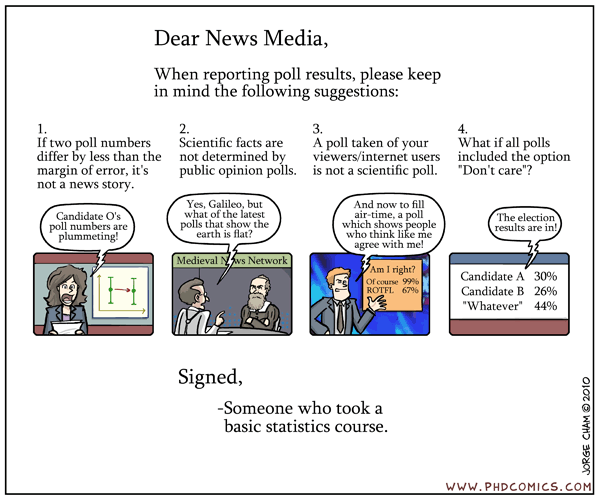
Remarkable that the very same organizations that have a vested interest in selling these ad slots are the ones that also are the editorial gatekeepers on which polls get play. Thus, it’s far more interesting to run a poll showing it as being close than it is to show one that came out on the same day showing it not-so-close.
So which one is right? As a resident of MA, I can tell you that anyone with caller ID is simply not picking up the phone for any reason; anyone, that is, but rabid tea baggers, Scott Brown partisans, and older-skewing demographics who don’t know or don’t care who is calling. We currently get at least two or three automated polling calls A DAY. That’s before the supporter calls, the robo-calls, and the occasional shout out from the President of these United States. My totally unscientific man-on-the-ground assessment is to say this take is right in saying Brown’s numbers are getting inflated by this. Turnout is what will decide this thing, and even the polls favoring Brown tend to show that many of those very folks (presumably the independents) talking to pollsters aren’t actually sure they’ll a) vote and b) actually vote for Brown.
The media establishment would, of course, disavow that editorial and ad revenue divisions even know what floor the other one is on. But, of course, this phenomenon cuts two ways. It’s much more interesting to write stories if the race appears closer than it is. So, if two of ten polls say it’s close: then, BY GOD, it’s the closest race in the history of close races. Sell more papers, attract more viewers, sell more ads. A lot more ads. Direct collusion is, of course and as usual, utterly unnecessary.
On looting
Is there something fundamentally wrong with the brains of those working in the national media? How else can you explain these very highly paid individuals discussing, often in the same sentence, that people in Haiti have been without food or water for days, and then expressing shock and horror that there is “looting” going on.
Listen very carefully. I’ll take it slowly so even a Grade-A fucktard (or idiot man-child) can follow along: when you take food and water from a collapsed store, food and water that you need to survive, it’s not looting. It’s survival.
By this the media model, everyone should just die quietly right next to palette after palette of water and potted meat product. After all, that stuff doesn’t belong to me. I’ll just sit here and quietly dehydrate, thanks.
Looting, in the traditional sense, applies to a riot or, perhaps, a war. Amidst mayhem, you spot a Best Buy and say “fuck it, at least I’m getting a TV out of this” and you break in there and take it. That’s looting. Strangely enough, that sort of thing doesn’t appear to be high on the list of things happening in Haiti. Where there’s no electricity.
Let’s review:
- 50" flat screen TVs: looting
- Food and/or water: not so much. That’s called survival.
Fucking imbeciles.
Inverted Pyramid Power
Robert Niles provides an absolutely essential bit of reading for anyone in the content-delivery world. Also known as “traditional” media (Yes, you. You are all in denial.), re: their efforts to invent new revenue models for their 19th century, dead-tree product line [emphasis added]:
You’re wasting your time. Please, stop. There is no new revenue model for journalism.
Done and done. In tweet length, no less. But no! Niles goes on to break it right on down into simple concepts for even the dimmest of bulbs. We are, after all, trying to get through to the likes of Rupert Murdoch here.
There are three ways – and only three ways – that publishers can make money from their content:
1. Direct purchases, such as subscriptions, copy sales and tickets
2. Advertising
3. Donations, including direct contributions and grant funding
Niles breaks down the first and potentially most important point using the basic economics of products you might see today in a bookstore, with emphasis on the relative price-points (e.g. papers are by far the cheapest thing in there and still aren’t selling):
Without a home-delivered hard copy, the commodity information available in most newspaper has no financial worth to most readers.
[…]
Because of this, no one is going to be able to craft a paid content model that elicits significant payment from more than a handful of readers for commodity news. And, despite what “proud parents” in the newsroom might think about their work, almost everything produced by all U.S. newspapers and broadcast newsrooms falls into that category.
Exactly. Why pay for “commodity information” that you can get on many phones? Your pay-walls won’t do a thing to stop that, either. Well, not a thing unless you count directing people to other sources and, worst-case, coercing them into learning how to use Pipes as a “thing.”
I’d extend this overall concept of economic value even further and say: without a home-device delivered copy, tuned to individual specifications, most newspaper-derived information has no inherent financial worth (incidentally, this is also why demographics are slowly and inevitably killing the Tonight Show). News can and will be gotten from anywhere. Again, publishers, you are selling your editorial judgment, not the actual content. Yes, the content had better be good, but I want to know what is critical to know, and not just the various bits of arcana and other nonsense that have simply been automatically included in papers since the 1950s because “that’s the way we do things.” I want to be able to go deep, instantly, on a subject of interest to me while still reaping a quick-hitting, broad view of the state of affairs on my block, in my state, in my country, in my hemisphere, and in the world. You’re not going to be able to have your own employees covering all those things, but you damned well better know how to leverage all the various individual sources that do, compile them, maybe add some value or viewpoint, and then present the best of it to me. Every second of every day, whenever and wherever I want it, whether as bullet point, abstract, or 50,000 word exegesis.
All that said, the thing somebody out there in charge of a major paper has really got to realize is this:
it’s time to take a hard look at the other side of the ledger, and work to find a publishing and production model that allows a news publication to live within its current income means. That’s where the real change will happen in news publishing
Modern journalism in the form of newspapers is entirely an ad printing concern. Subscriptions just pay to bring the paper to the door, not to print that which is brought. Everything about the current model is designed to maximize the capability to create and print a big package of paper ads with some interstitial articles in there (yes, and a little sex, too). This needs to change. The first publisher with a national reach (in terms of name and reputation) to divest itself from the print albatross and concentrate fully (or very nearly so) on providing flexibly deep coverage in a RSS-style, fully user-customizable package will win. Big. People want excellent, well packaged information and are willing to pay for it (witness Cook’s Illustrated, the only successful thing going in the print world today and entirely predicated on a fee for service model). You, the broader news media, provide those people with mediocre information and, generally speaking, inconvenience because of your colossal tunnel vision relative to “how things have always been” and how you get back to that model as soon as possible and forever. I’ve got news for you: always is over.