Put it this way: suppose that from here on out we average 4.5 percent growth, which is way above any forecast I’ve seen. Even at that rate, unemployment would be close to 8 percent at the end of 2012, and wouldn’t get below 6 percent until midway through Sarah Palin’s first term.

Paul Krugman brings the optimism while not-so-gently chiding his fellow media travelers’ insistence that all focus be upon what are essentially made up problems of deficit and government spending. Employment is the problem. Fix that and you can work on wage growth and lessening income inequality across the spectrum, lard on some tax reform, and all these so-called existential spending issues and all the hooha over the “right” size of government will evaporate.
Even less clear is why the media forever focuses on the self-funded, no deficit impact at all for at least 40 years Social Security program when they do a story on the horrors of deficits. It’s a story for another post, but maybe (just maybe!) it’s because they don’t plan on needing it. Medicare, on the other hand, they know they need, know is a deficit ballooner, but just don’t care so long as they get theirs. Very Patriotic.
The Numbering Shall Be Eight

Ezra Klein relates that an array of left-leaning interest groups have signed onto a letter spelling out an eight point description of what the Senate should be doing on the first day of the next Congress:

  1. On the first legislative day of a new Congress, the Senate may, by majority vote, end a filibuster on a rules change and adopt new rules.
  2. There should only be one opportunity to filibuster any given measure or nomination, so motions to proceed and motions to refer to conference should not be subject to filibuster.
  3. Secret “holds” should be eliminated.
  4. The amount of delay time after cloture is invoked on a bill should be reduced.
  5. There should be no post-cloture debate on nominations.
  6. Instead of requiring that those seeking to break a filibuster muster a specified number of votes, the burden should be shifted to require those filibustering to produce a specified number of votes to continue the filibuster.
  7. Those waging a filibuster should be required to continuously hold the floor and debate.
  8. Once all Senators have had a reasonable opportunity to express their views, every measure or nomination should be brought to a yes or no vote in a timely manner.

I’d only say that the amount of delay on a cloture motion should be reduced all the way to zero: you fail to produce people on the floor 24/7 then regular order begins immediately; no waiting, no marinating, no anything. Put up or shut up. Same goes for “reasonable opportunity” in point eight. Spell that out and ratchet up the required population of Senators needed to uphold the filibuster; cap it with a very brief interregnum between filibuster-broken and vote-held: as in less than one legislative day. Otherwise, I agree completely.

Perhaps the involvement of these non-dirty-fucking-hippy interest groups combined with the letter from the opposition (in which the GOP duly promised to filibuster everything forever; and if you think they’ll stop once the millionaire tax giveaway is sealed, you really are out there on drugs) will in some way nudge the feckless idiots that run the Senate into doing something. I doubt it, but stranger things have happened.

Poison Pill Revisited

Jonathan Gruber sums up the wages of partial repeal (be it legislative or judicial) of the Affordable Care Act:

Removing the Affordable Care Act’s mandate would eviscerate the law’s coverage gains and greatly raise premiums. And going further by only keeping the market reforms and the small business tax credit would virtually wipe out those coverage gains and cause an enormous premium spike.

Oh, and it would totally destroy the existing insurance company-based system of coverage within a very few years. They’d be the first ones screaming for some replacement for the mandate; they’d have to be, because without it, and in the continued presence of the rest of the reforms, they’d be out of business.

But, by all means, GOP: herald in the era of single payer, finally a true government takeover of healthcare funding in this country by launching relentless attack on the less popular but absolutely critical parts of the package. Said it before, will likely say it again: bad policy is absolute catnip to the GOP and their Tea Klan enablers. They cannot resist it. Forget testing proposed legislation; just see if the GOP/Tea Klan is for it. If so: it is at best a singularly bad and more likely an utterly catastrophic policy.
With that useful razor in hand, it’s easy to see that with a policy outcome as catastrophic (to the insurers) as removing the mandate and but also leaving the popular stuff like the community rating, no lifetime limits, and etc… in there, the GOP and Tea Klan are and will forever be like moths to the flame until such time as they see their particular foolishness accomplished. And before we know it, President Palin will be signing the new American Homeland Patriotic Healthfulness Imbuement and Embiggening Flag Act of 2013, handed to her by a slothful yet resolutely responsive GOP rubber-stamp of a Congress.

Cannot wait.

Poison Pill Revisited

File under: Things We’re Not Allowed to Discuss.
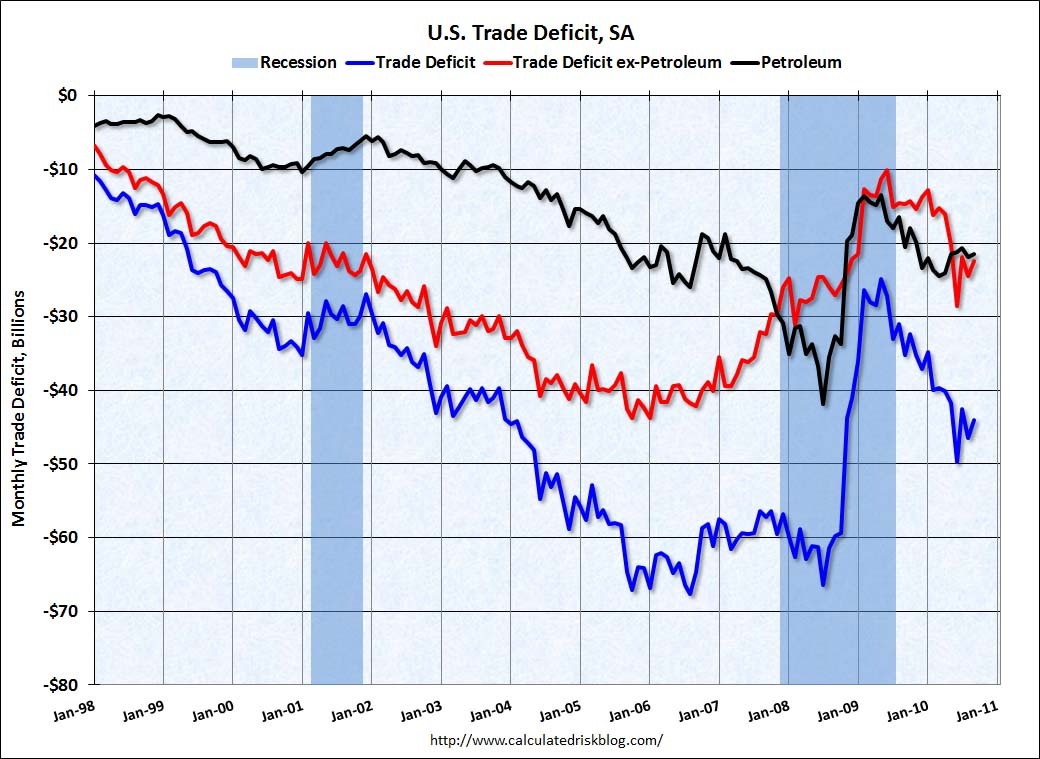
Much easier to talk about big bad China bogeyman than the simple fact that the car-centric, energy hungry American lifestyle of the late 20th century on is the thing driving our trade deficits, driving our foreign policy decisions, driving our economy into the ditch. Is it any wonder? The economic inducements drive most people to live 50 miles from work and, as a result, drive for hours each and every day, and drive everywhere else you may want to go as well. Insanity. And, far from calling out said insanity, our society seems to look down upon and make life unnecessarily difficult for those who are even able to choose to withdraw from this cycle.
That it is a solvable problem if and when met with sustained will to change it gives me no optimism whatsoever. That the process of solving it would greatly assist our own recovery will never be discussed. Cars today! Cars Tomorrow! Cars über alles!

Angle won because she looked relatively credible, appearing not to be the Wicked Witch of the West.

Jon Ralston puts yet another shiv of ignorance into our already dying state. This is the same meaningless horseshit brew of absurdly low expectations that gave us W Bush, two eternal wars, and a nearly complete economic collapse. Apparently the View from Nowhere just won’t be sated until those few of us left are all living on the riverside and trading skins with whoever floats by.

There’s a trap, and it’s the same thing that happened with fiscal stimulus. You do something in the right direction that’s inadequate, and then people say, well, that didn’t work, and instead of increasing the dosage and proving it right, you give the thing up altogether.
All of this is very familiar if you studied Japan in the ‘90s. In fact, we’re doing worse than the Japanese did. Our monetary policy is a bit more aggressive, but our fiscal policy has been less aggressive. We have a larger output gap than they did, and we’ve had a surge in unemployment that they never had, and our political will to act has been exhausted much faster than theirs was. On the current track, we’re going to look at Japan’s lost decade as a success story compared to us.

Paul Krugman bringin’ the optimism.

Obama and National Security

This excerpt from Woodward’s (sigh) new book is precisely the sort of thing I was talking about earlier:

In Woodward’s account, even after Obama decided to send 30,000 more troops, the Pentagon kept coming back with plans involving 40,000. Even after he decided not to pursue an all-out counterinsurgency campaign, the Pentagon kept coming back with plans involving just that.

Obama also kept asking his generals for more options to consider. They were playing the old trick of giving the president three pseudo-options — two that were clearly unacceptable (in this case, 80,000 more troops for full counterinsurgency and 10,000 troops just to train Afghan soldiers) and the one in the middle that they wanted (40,000 more troops). They never gave him another option. When Gen. James “Hoss” Cartwright, vice chairman of the Joint Chiefs of Staff, drew up a compromise plan involving 20,000 troops (believing the president had a right to see a wide span of options, even if the military didn’t agree with them), Mullen forbade him from taking it outside the Pentagon. Obama never saw it.

In the end, Woodward reveals, Obama devised his own alternative strategy and personally wrote out its terms in a six-page, single-spaced memo that he made his top civilian and military advisers read and sign on to.

Recall that this same group of generals and their proxies were simultaneously waging a press-based war using damaging leaks against the President in the hopes of forcing his hand towards their preferred outcome(s).
Now flip that to an entity that you can’t engage publicly in any way. That only the smallest subset of your advisers can even know about. And that issues you memos each and every day telling you “They’re coming!”, any one of which may turn out to be your “bin Laden determined to strike in US,” so you can’t just shut these folks out, distrustful though you may be of both them and their data, spiteful as you are of their heavy handed and blowback-inducing approaches: they own your ass. That’s what it is to be President. Even when you’re one who knows his Constitution well enough to recoil at the thought of the very extra-judicial extermination of inconvenient citizens these folks are pitching.

The only real option seems to be to contain this apparatus everywhere you can, wait for the excess and overuse to explode, and then try to ratchet this thing down. Or another large-scale attack occurs that ratchets it up even further. Or a military coup when the economy utterly collapses. Whichever.

Be Like Ike

jonathan-cunningham:

Eisenhower, and I’d venture to say most of today’s liberals, don’t believe that we should have no guns, no police and no military force.  Instead, they recognize that since WWII we’ve been building the largest, most advanced military complex in the history of the world and we’re not even slowing down.  Yes, we need police.  Yes, we need the military.  Yes, we even need guns.  What Eisenhower is pointing out, is that when he left office we had enough to last us the rest of his natural life and we haven’t even begun to slow down our production.

Please, please don’t take my word for it.  I could never come close to Eisenhower in terms of experience, knowledge or rhetoric.  Everything you need to know about our military industrial complex is laid out, plain for everyone to see (or hear) in his farewell address.  If you haven’t heard or read it, I can’t recommend that you do enough.

Agreed. This quote in particular rings true, maybe even more so today than when he said it:

We should take nothing for granted. Only an alert and knowledgeable citizenry can compel the proper meshing of the huge industrial and military machinery of defense with our peaceful methods and goals, so that security and liberty may prosper together.

And I furthermore suspect that the vast majority of Americans today have absolutely no idea that this is (and was) the case:

Until the latest of our world conflicts, the United States had no armaments industry. American makers of plowshares could, with time and as required, make swords as well.

This unplanned and definitely not-voted-on change to a continuous war-footing post WWII, coupled with a nuclear-powered Presidency, in which the power to end the world was vested into that office (as opposed to, say, with Congress, or only as a part and parcel of a declared war, or defined and time-limited emergency powers, or any other way you could imagine we might have handled it) with essentially no real planning and little to no oversight has fundamentally changed our system of governance (almost all for the bad) in ways we haven’t even begun to deal with, much less even discuss. And may never start to deal with if current events and recent history are any guide.

At any rate: One of the great speeches by a President.

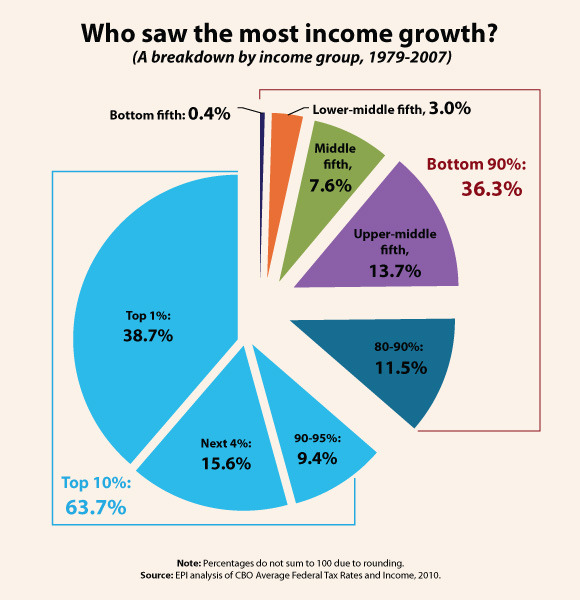
Economic Policy Institute gives us a simple chart:

38.7% of all of the income growth accrued to the upper 1% over the 1979-2007 period: a greater share than the 36.3% share received by the entire bottom 90% of the population.

Those in the top 10% of the income scale received 63.7% of all the income growth generated over the 1979-2007 period. In contrast, the bottom 20% of all earners saw such a small share of income growth – just 0.4% – that it barely shows up on the included pie chart.

Let’s repeat: over the last ~30 years, the top 10% got about 60% of all income growth. Everybody else: not so much.
There should be no speech, no appearance, no utterance, no anything involving any Democrat anywhere a camera, microphone, or goodly crowd may gather that does not include this chart. Every time, every day, every hour between now and November.

Don’t hold your breath.

I happen to think that liberals should be open to Social Security cuts as part of a balanced package of deficit reduction.

Jonathan Chait, spewing the purest form of horseshit possible.
Social Security is not in crisis. All our problems should be like Social Security. Social Security is a rounding error in comparison to the demands of Medicare and Medicaid going forward.
Rest assured, though, The Democrat will engage this issue on the inevitable “savagely cut programs, don’t touch the tax tables or military spending” terms that the GOP demands (and will get) and will thereby set the Overton Window such that the leftmost possible position is that of merely not eliminating the social safety net completely. And wonder why all of us on drugs out here abandon them come 2012.